 Hacker Cinema
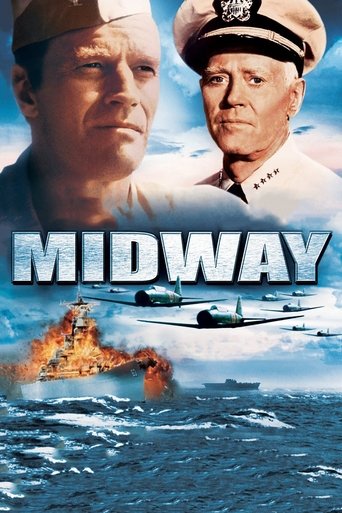
Midway
1976 · Film · 132 min
Directed by Jack Smight
This war drama depicts the U.S. and Japanese forces in the naval Battle of Midway, which became a turning point for Americans during World War II.
1 positive1 negative1 mixed1 neutralfrom 4 commenters
Where to watch
No streaming data for this title.

5 comments on Hacker News
Veeery interesting. After realizing that Tora, Tora, Tora! and Midway might make a good double-feature (I tried it, and, they do!) it occurred to me that it might be possible to assemble a film-based curriculum to teach a great deal of the history of roughly 1933-1948, covering the lead-up to and immediate aftermath of the war, in a way that's entertaining while being more informative than misleading. There are thousands of films covering the time period from dozens of countries, and lots of those stick reasonably close to historical events, so it might work out.
The hard part, I think, would be tracking down films that give a good sense of the causes and course of more-obscure things like Italy's invasion of Ethiopia. You'd need to find two or three good films on that. Spanish civil war? The invasion and occupation of Poland? The political maneuvering between the Nazis and Soviets before they went to war with one another? The Winter War? These have to be covered by a few films that could act to "teach" the events, but I don't know what those films are and bet most are non-English and not well-known in English, making them harder (for me) to track down.
It’s all about perspective.
Some people find original Star Wars to be a truly great movie. Those same people may find the movies that inspired Star Wars, like Kurosawa’s “Hidden Fortress” or Midway boring or solely on technical factors like color vs black and white. In a mass market product those technical factors make the work less approachable.
I spent several years walking through a pretty good collection of mid-20th century modern art. Most of it made no impression on me at all, but one installation’s aesthetic appealed to me for reasons that I cannot really describe. Part of it was the absurdity of what the facility did to that space — they literally dropped a random howitzer in the room. But if I nerded out and studied the artists and their art, I’d develop a more nuanced understanding and appreciation.
Star Wars didn't borrow ideas from Japan, it "borrowed" a Kurosawa samurai movie "the Hidden Fortress", added some aerial scenes inspired by "Midway" and did it in space.
Here's my big problem. Why do books, movies, and television not have to face this kind of crap? Why don't game developers get the same privileges as other media? Because its interactive? That's a load of crap. Because its immersive? Other media should be insulted by that assertion.
If you're a developer and you don't think your fellow developers should get the same protections as other media, then why? How does Apple sell "Patton" or "Midway" and not this?
In
http://news.ycombinator.com/item?id=2267731
I argue that the article is just politics.
Still, education is important.
Since we are on 'Hacker News' (HN), there is some considerable irony in this article:
In computing now, the workers in information technology commonly need to understand subjects such as:
algorithms, programming languages, frameworks, development environments, user interface design and development, programming for application installation, operating system administration, networking and network administration, relational database and its administration, code repositories, application instrumentation, system monitoring, many utilities and applications, software as a service, the Cloud, the social graphs and interest graphs on the Internet, how to start a company, how to raise venture capital, how to manage software development, etc.
The content of these subjects changes significantly each 12 months.
To keep up, workers need their own 'computer center' and educational resources and mostly just must teach themselves, that is, without teachers. In particular, formal courses are nearly useless because the teachers are rarely up to date on this material.
This pattern has been rock solid for nearly all parts of the US computer industry going way back to punched cards.
Net, the readers of HN overwhelmingly learn independently and are self-taught using their own time, money, and effort.
So, claims by the formal education community in K-12 and college that their classroom instruction is crucial for education is an ironic, ROFL at HN.
But HN readers are not the only ones: (1) An auto mechanic has to keep up with the new systems on the new cars. (2) Workers in construction of houses and small commercial buildings have to keep up with new materials, construction techniques, and regulations. (3) Recently chefs in high end restaurants had to learn about 'molecular gastronomy', 'tasting menus', and intricate 'wine parings'. (4) CPAs and tax lawyers need to keep up on the tax law changes.
Workers in a huge fraction of the US economy have to keep up in their fields, independently, via self-teaching, and most of this work uses their time, effort, and money.
So, let's return to K-12: Basically what is needed from K-12 is at least, by age 18, to be able to (A) read with understanding materials commonly encountered, (B) write clearly, e.g., as well as on HN, and (C) know basic arithmetic, percentages, areas, and volumes.
Now we come to some simple facts: Joe gets sick and stays home from school for three weeks. His grandmother notices that he can't read so, in those three weeks, teaches him to read. Later she does the same for (B) writing and (C) basic math. This situation is common. Basically, normal kids can pick up the 3Rs with astounding speed. Just how they do it is not clear at all, and research on 'teaching techniques' is not promising but also mostly not needed.
The K-12 system should be able to get this teaching done by the eighth grade. So, to know, sure, give some tests. Simple enough.
But, K-12 does try to do more. Especially important topics include math through analytic geometry and trigonometry, biology, chemistry, physics, and history. For these subjects, sadly, the K-12 teachers rarely know enough of the material to teach it well. Even the K-12 'experts' don't: I understand calculus quite well, thank you (learned it at several levels, taught it, applied it, published peer-reviewed original research based on it), but the people who wrote the AP calculus materials did not. Sad. To learn calculus, just get any edition of the dozen or so college calculus texts famous over the last few decades, dig in, and f'get about AP calculus.
Yes, it would be good to teach some art. Sadly, apparently they don't. There may be more on how art works just in, say,
http://news.ycombinator.com/item?id=2246723
In the article the teacher said:
"I’m used to wild and crazy discussions about amazing novels."
"Amazing novels"? Eventually I had to conclude that, according to the standards of information safety and efficacy well established in the first half of the 20th century, novels are at most for light entertainment so that the set of all "amazing novels" is the empty set and not worth serious effort. She was largely wasting time; it's sad she didn't know that; but I can believe that most readers of 'The Daily Kos' take novels seriously. Those English majors dragged me through six years of their 'belle lettre' nonsense when I wanted to study much more in math and science. Bummer.
So, what K-12 does with these additional subjects is at best mixed.
So, net, our K-12 system is heavily for baby sitting. We shouldn't have to pay a lot for baby sitting.
So, what about education?
HN Style Solution: Put good materials on the Internet. So have careful, detailed text in PDF files. Have some lectures by some good people. And by some experts, have some lectures with some intuitive descriptions that explain the 'forest' so well that the 'trees' become mostly obvious.
With good materials, a good student could knock off grades 7-12 independently in maybe three weeks per grade except that foreign languages typically would extend the time. But, with good materials, can do well with a foreign language surprisingly quickly.
Then for 'more' in fuzzy topics such as art, human behavior, organizational behavior, civics, politics, just have some excellent lectures on the Internet and maybe some fora.
E.g., for a curiously good start on both music and painting, in one stroke, just spend right at 10 minutes with
http://www.youtube.com/watch?v=7prUFflX0_E
Likely a good start on art history is the 1969 TV series 'Civilization' by Kenneth Clark. There is also a book, but the video alone is fine.
Actually, for some good material in history, there are some starts: Some of the best material on the history of the 20th century is in some selected movies; it's not common to find better materials in print, and it is nearly impossible to find materials nearly as good in K-12 or the first two years of college.
E.g., the movie 'The Battle of Britain' is relatively good on its subject. Actual dates, numbers of planes, pilots, and bombs per day along with 'logistics' would help but are generally ignored by all of the history community.
The movie 'Midway' is relatively good on its subject, a turning point in the war in the Pacific and basically for the reasons made clear in the movie. The Charlton Heston character should be cut out. The timing, crucial, of the actual events in the battle should be made more clear. Details on times, distances, and speeds would help, yes, typically ignored by the history community. Still the movie is relatively good.
The series 'Victory at Sea' was a lot of US flag waving but still does provide a good outline of a lot of WWII.
The movie 'The Longest Day' is awash in 'entertainment values' but, still, does cover the essentials of D-Day.
The hugely long:
William L. Shirer, 'The Rise and Fall of the Third Reich: A History of Nazi Germany, Thirtieth Anniversary Edition', ISBN 0-671-72868-7, Simon and Schuster, New York, 1981.
actually is surprisingly sparse on important content.
Sadly the biographies of Eisenhower and Patton are so far from the actual details that they are not good. Bradley's biography is better (but nothing like the character Bradley in the movie 'Patton').
Net, what K-12 is teaching in history is below what is readily available just by watching some movies for a few evenings.
Net, for formal education in K-12 and the first two years of college, it's a huge waste of time, money, and effort for all concerned and can mostly be replaced by good materials (mostly not yet available but easily could be) on the Internet, thus, letting students get on with independent learning in areas of their interests and/or more advanced formal education.
People should say, "I want good education, but I'm not going to pay a lot for what's in K-12 and the first two years of college now."