 Hacker Cinema
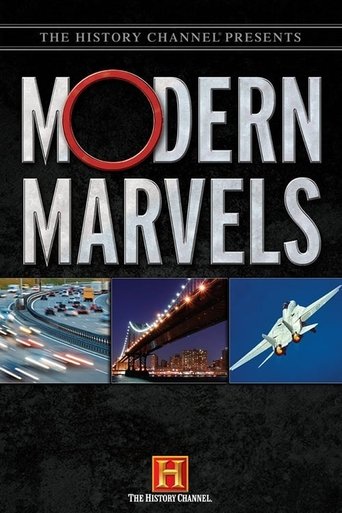
Modern Marvels
1993 · TV series · documentary · 44 min episodes · 23 seasons
Created by Bruce Nash
HISTORY’s longest-running series moves to H2. Modern Marvels celebrates the ingenuity, invention and imagination found in the world around us. From commonplace items like ink and coffee to architectural masterpieces and engineering disasters, the hit series goes beyond the basics to provide insight and history into things we wonder about and that impact our lives. This series tells fascinating stories of the doers, the dreamers and sometime-schemers that create everyday items, technological breakthroughs and manmade wonders. The hit series goes deep to explore the leading edge of human inspiration and ambition.
5 positive2 neutralfrom 7 commenters
Where to watch
No streaming data for this title.
Videos commenters linked
From YouTube links in the comments below. Most are clips and trailers; “Full” means the uploader says so.






7 comments on Hacker News
There’s a lot of Modern Marvels episodes available on YouTube now. I’ve been watching them as nostalgia TV: https://youtube.com/playlist?list=PL4F4CD715F1A3E6C7
There are a couple of TV series I know of that do this sort of thing. Check out Connections with James Burke, Modern Marvels, and Genius of the Ancient World, for starters. There's another TV series on Netflix that talks about stuff like the development of the bicycle, and the like, but the name escapes me. :(
If you're in the Bay Area, the Exploratorium and the Computer History Museum might be something you'd enjoy along these lines.
I've long felt that the greatest exploration of history every created in entertainment form was the 20-year long show called Modern Marvels[0] on the History Channel. It was the History Channels very first show and since it's beginnings in 1995, Modern Marvels has treated us to 44 minute long explorations of the history of things (infrastructure, buildings, devices, earthworks, vehicles) with a format that avoids the boring and useless. All "5 Ws" are addressed each episode, but instead of focusing on "when" and "who" and "where", it focuses on:
- "What?" What is this thing? What is it's purpose? How does it do what it does? What can we learn from it?
- "Why?" Why was it built? Why did we drive to build something so important? Why should I care?
Only after we understand what it is and why it is, do we start to look at who built it, when they built it, etc (though they sneak in some who and when to contextualize the why quite often (which is great!)). Take for example this exploration of the United States Library of Congress:
https://www.youtube.com/watch?v=kZuXepy0DdY
What a sublime show. And it has such a fantastic narrator and opening theme as well!
[0] - https://en.wikipedia.org/wiki/Modern_Marvels
Do you remember the show Modern Marvels on the History channel? Back when it was about actual history and not reality tv...
My favorite episode was on bathrooms. Did you know that during large gatherings at the Palace of Versailles people would relieve themselves in hallways, stairways, and even in the gardens? Or that dining room seats in medieval Germany had holes with chamber pots underneath so that people could go while they ate?
I miss Modern Marvels.
For conductors that the helicopter cannot safely hover close enough to for the line worker to work on from the helicopter, they sling load the worker below the helicopter, lower him down to the conductor he needs to work on, and he attaches himself to the conductor and detaches from the helicopter, and the helicopter moves away from the lines.
When the work is done, the above is reversed to extract the worker.
There's a segment showing this in "Modern Marvels" episode S11E45, "Wiring America" starting at 23:44 [1].
I've also seen a documentary somewhere [2] that was similar but more focused specifically on line work. That had a clip showing a worker being lowered to a particularly difficult to reach conductor. There were at least 3 horizontal layers of conductors, with at least 3 parallel conductors in each layers, and the one needing work was in the middle horizontally and had at last 2 layers above it.
For that one, they had several dry wooden poles connected end to end to form a kind of chain. They put this together in a dry area, then had a crew carry the pole chain outside careful to not let it touch the ground, so it would not get wet from the morning dew on the ground. One end was attached to the helicopter, which slowly started lifting it, with the crew that was holding it making sure to not release segments until they were sure they would not swing into the ground on the way up. Finally, the line worker was attached to the last segment. From then on, it was similar to the segment from Modern Marvels.
They used the dry wooden pole chain because there was no way to reach the work conductor without whatever was suspending the worker simultaneously touch two of the above conductors, so it was imperative that this not short out things.
I believe they used a pole chain rather than some non-conducting rope because a rope can get tangled in things or wrap around things. The pole chain consists of rigid segments, which are not going to get wrapped around anything.
[1] https://youtu.be/vuRNs50VMJ0?t=23m44s
[2] Probably on the History Channel or Discovery Channel.
This is why it's logistics companies that are investing the most (and the longest) in fully-autonomous and augmented-assistance trucks (http://mashable.com/2016/04/05/mercedes-actros-platoon-europe/#_rbnZ7l0CiqD)
I remember seeing self-driving trucks being tested 15+ years ago on an episode of History Channel's Modern Marvels
There's an episode of Modern Marvels which shows the "banana room" at a national distribution center for a grocery chain. They have a gigantic environmentally controlled room where they can delay how quickly a banana becomes ripe. It's the classic "big bucket being filled by a hose at rate X and being drained at rate Y" highschool physics problem, implemented using bananas :)