 Hacker Cinema
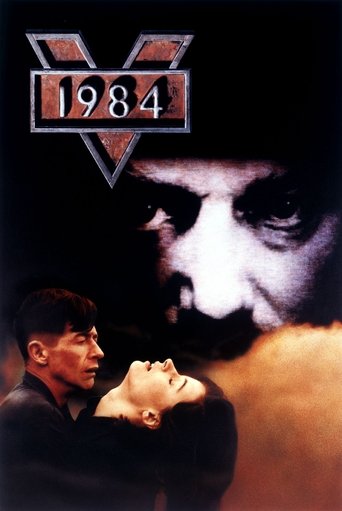
Nineteen Eighty-Four
1984 · Film · 113 min
Directed by Michael Radford
Winston Smith is a government employee whose job involves the rewriting of history in a manner that casts his fictional country's leaders in a charitable light. His trysts with Julia provide his only measure of enjoyment, but lawmakers frown on the relationship -- and in this closely monitored society, there is no escape from Big Brother.
5 positive5 neutralfrom 10 commenters
Where to watch
No streaming data for this title.

10 comments on Hacker News
I'd argue that makes Black Mirror more prescient.
In the case of Black Mirror, it was a set of studies on the dangers of current and near technologies. That some of those fears are materialising not long after the episodes, is in my opinion more damning than Orwell's fears of the state which didn't really come to pass in the same way, even decades later.
I don't disagree that Nineteen Eighty-Four is essential reading however. ( I'd also add Brave New World to that list ).
Twitter is the closest thing to 1984's "Two Minutes Hate."
Wikipedia: "In the dystopian novel Nineteen Eighty-Four (1949), by George Orwell, the Two Minutes Hate is the daily, public period during which members of the Outer Party of Oceania must watch a film depicting the enemies of the state, specifically Emmanuel Goldstein and his followers, to openly and loudly express hatred for them.
The political purpose of the Two Minutes Hate is to allow the citizens of Oceania to vent their existential anguish and personal hatreds towards politically expedient enemies: Goldstein and the enemy superstate of the moment. In re-directing the members' subconscious feelings away from the Party's government of Oceania, and towards non-existent external enemies, the Party minimises thoughtcrime and the consequent, subversive behaviours of thoughtcriminals."
And from the book itself: "The horrible thing about the Two Minutes Hate was not that one was obliged to act a part, but that it was impossible to avoid joining in. Within thirty seconds any pretence was always unnecessary. A hideous ecstasy of fear and vindictiveness, a desire to kill, to torture, to smash faces in with a sledge hammer, seemed to flow through the whole group of people like an electric current, turning one even against one's will into a grimacing, screaming lunatic. And yet the rage that one felt was an abstract, undirected emotion which could be switched from one object to another like the flame of a blowlamp."
And you want me to freaking pay to be a part of this process? And you won't even take away the ads for a paying member?
When anyone tries to prescribe language, it's time to look for the exit. For anyone who has not read the book Nineteen Eighty-Four (1984)[1], or seen the movie, I strongly recommend reading or watching. George Orwell understood the power of language when he wrote about Newspeak[2].
[1] https://en.wikipedia.org/wiki/Nineteen_Eighty-Four
[2] https://en.wikipedia.org/wiki/Newspeak
Imagine being in 1925 and predicting what the future would be like in 1945, now that the Great War was over so that nobody would even think of starting another major war. You might predict cities built almost entirely underground with kilometer-high skyscrapers http://www.popsci.com/archive-viewer?id=YScDAAAAMBAJ&pg=40 https://futurelapse.blogspot.com/2015/05/underground-living-in-city-of-tomorrow.html since skyscrapers had been rising dramatically in height. Pneumatic tube systems would probably make most deliveries https://www.fastcompany.com/3049647/what-the-city-of-the-future-looked-like-in-1925 since they were already in service in large cities, and it was clear that cities would get denser and denser. Since Television was already being demonstrated, you might imagine doctors diagnosing patients over the radio waves https://www.smithsonianmag.com/history/telemedicine-predicted-in-1925-124140942/ using Vidicon tubes that made the house calls for them, along with a Teledactyl that transmitted haptic information to allow doctors to feel the patients; moreover, you could watch theatrical performances from far away. Maybe you'd predict that in 20 years abstract art would be even more influential than it was in 1925, and that the US might institute some kind of social security scheme, and perhaps many more cities would have subways, and maybe more utilities would be publicly owned rather than operated for profit. Given the growth of Communist movements in the 1920s, you might predict they would expand further. Maybe you'd predict that future musical instruments would be electric.
Some of that sort of happened, though mostly later (the electric guitar dates from 1932). But think about what you'd be missing: atomic energy (the Cockcroft–Walton generator wouldn't split the lithium atom until 1932(?)). Manchukuo and the rest of World War II. Alcoholics Anonymous. Mechanical refrigerators. Widespread washing machines and consequently women's liberation. The Little Prince. The jake walk. The Long March and Communist China. Looney Tunes. Airlines. Mass nonviolent civil disobedience. Independent India. The end of the British Empire. Comic books (outside Japan). Neoprene and nylon. The end of dirigibles. Vaginoplasty. The Hoover Dam and the Tennessee Valley Authority. Bugs Bunny. Computers and the theory of computable functions, and the death of Hilbert's decidability program. Universal censorship of mass-market films in the US under the Hays Code. Liquid-fueled rockets and ballistic and cruise missiles. The discovery of the Lascaux cave paintings. The discovery that the universe was less than 20 billion years old. The Moonies. The Great Depression. Perón. Merchandising agreements for children's characters such as Pooh. Radar. Antibiotics. Nineteen Eighty-Four. The end of the gold standard after 2500 years. Pluto. Maybe even talkies — you might have predicted in 1925 that talkies would become a mass phenomenon, but it might have been unimaginable that they would entirely displace silent film.
Maybe you would have predicted one or two of these. But nobody imagined very many of them.
So, what are the major developments you're missing over the next 20 years, which will change the world into which AI-powered hand dryers could potentially be born?
Can't recommend enough the Intelligence Squared episode on Brave New World vs 1984
https://www.intelligencesquared.com/events/brave-new-world-vs-nineteen-eighty-four-with-adam-gopnik-and-will-self/
>The war is not meant to be won. It is meant to be continuous. The essential act of modern warfare is the destruction of the produce of human labour. A hierarchical society is only possible on the basis of poverty and ignorance. In principle, the war effort is always planned to keep society on the brink of starvation. The war is waged by the ruling group against its own subjects, and its object is not victory over Eurasia or Eastasia, but to keep the very structure of society intact."
https://en.wikiquote.org/wiki/Nineteen_Eighty-Four_(film)
I had a feeling that would show up in this discussion! What a classic scene.
"No, that's the CIA."
Talking about movies, I think I'm going to propose a "movie night" sometime soon at Splatspace (the hackerspace in Durham, NC) to watch Sneakers and Nineteen Eighty Four.
I know it's only movies and TV but these were still interesting to watch on all things data retention and surveillance state and are related to the topic:
The Listening - 2006 (specifically on Echelon) http://www.imdb.com/title/tt0427461/ http://www.youtube.com/watch?v=ZlVK906Xzr8
The Conversation (1974) http://en.wikipedia.org/wiki/The_Conversation http://www.youtube.com/watch?v=vrhRsZ56b4g
The Lives of Others (2006) http://en.wikipedia.org/wiki/The_Lives_of_Others
Spying on the Home Front (PBS, 2007) http://www.pbs.org/wgbh/pages/frontline/homefront/
The Enemy Within (PBS, 2006) http://www.pbs.org/wgbh/pages/frontline/enemywithin/
The Wire, Season 1 (HBO, 2002) Brazil (1985) Nineteen Eighty-Four (1984)
Because library shelves don't consist 90% of pop movies, video games, and music. Pirating the latest Halo game is not the same as borrowing a copy of Nineteen Eighty-Four.
That's an opinion(so of course it can't be wrong) that I have heard, it is being debated fairly intelligently downthread along with a debate about the fantastic King of the Hill and Office Space.
Here is a list of movies that critics and non-critics consider to be much better post WWII satires than Idiocracy, according to internet ratings of these movies. Note: many of these are more humorous and brutal while being less crude and light-hearted than Idiocracy. Also many have plot, emotion, and deep characterization.
Films: American Psycho, A Clockwork Orange, Fahrenheit 451, Nineteen Eighty-Four, Dr. Strangelove, Office Space(also Mike Judge)
http://en.wikipedia.org/wiki/Satire
My main problem with Idiocracy as a satire is that the message it sends is flatly incorrect, because the rules of their world are not the same as ours. It is a satire of some alternate universe in which we are not living, it has no applicability for the world we live in.
Film's message: "If our societies ever end up giving a competitive advantage to low IQ people, time travel will be necessary to correct society's decline."
The truth:"If our societies ever end up giving a competitive advantage to low IQ people, natural selection will take care of it, since intelligence seems to be a competitive advantage for apes."
I think the true message is also a better call to arms for both intelligent people and unintelligent people. The movie Idiocracy seemed like it was made to be consumed by the citizens of the low-IQ world, in both plot and acting. I do enjoy its light-heartedness.
Much more realistic are the famous dystopian texts, especially Harrison Bergeron: http://en.wikipedia.org/wiki/Harrison_Bergeron