 Hacker Cinema
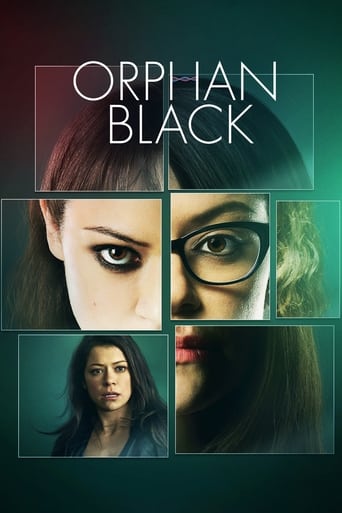
Orphan Black
2013 · TV series · 5 seasons
Created by Graeme Manson, John Fawcett
A streetwise hustler is pulled into a compelling conspiracy after witnessing the suicide of a girl who looks just like her.
6 positive5 neutralfrom 11 commenters
Where to watch
No streaming data for this title.


12 comments on Hacker News
There was an episode of Orphan Black where they were going to impersonate a billionaire. The guy turns up in a suit and gets told, 'A billionaire, not a millionaire, go and put some shorts on'
Try this: look up the most highly rated episodes on IMDB and watch only those. Missing the crummy episodes usually does not interfere with understanding the story arc. Often, I set a minimum IMDB score that I will watch, like 8.5 or 9.0 to capture only the best. This works well with series that:
- take a year or two to find their footing or
- have a large cast (some mediocre) that get their own story lines of no consequence occasionally or
- introduce cast members that don't make it or
- implode towards the final season.
I have done this for many series that are somewhat uneven:
- The Americans
- How I Met Your Mother
- Fringe
- Orphan Black
- Halt and Catch Fire
- House of Cards (watching the ratings allows you to miss all of season 6)
- Arrested Development
- Bojack Horseman
- Veep
- 30 Rock
- Jane the Virgin
- Black Mirror
- The Marvelous Mrs. Maisel
- Suits
- Six Feet Under
- La Femme Nikita
- The Blacklist
- Peaky Blinders
- The Romanoffs
- Ozark
- Westworld (sometimes dropping episodes does not matter)
- Succession
- Borgen
And all of these series have lots of strong episodes.
Series I would not do this with:
- The Bear
- Breaking Bad
- Money Heist
- The Serpent
- Fleabag
- Chernobyl
- The White Lotus
For me, the core is not that you can't "recognize" a face, it's that it is very very hard to form a memory of a face. It's not in the storage, it's in the retrieval.
For example, if I try to picture a person's face, even someone I know well, it's kind of fuzzy. It is hard to describe, but again, it's more like you can't quite remember a face, more than you can't recognize a face.
So, I put faces together into mini-shapes. Nose-shape, hair-shape, eye-shape, teeth shape (how I recognize Kathereine Heigl), etc. I can't put together a whole face into memory, but I can group these mini-shapes, features, etc. into a "faceprint" of sorts.
The main thing I use though is sound/voice. I can recognize voices to an extremely precise degree, all the time in shows/movies, I can recognize actors in costume, full masks, animated movies, etc. without problem. I am sometimes fooled, actually, by people with similar voices, and I'm always saying "these people sound so much alike they should be cast as twins" to which everyone of course thinks I am crazy.
(Orphan Black is an exception because the lead in that show changes her voice with the different characters so it keeps me guessing).
I would invite you to watch Orphan Black and try to figure out which characters are supposed to be clones or not.
The one that really gets me is when they use photographs in film/tv, a character looks at a photo and you know the rest of the audience knows who it is supposed to be, but I have no freakin idea.
Yes - this sort of thing. I find it especially difficult with e.g. TV series where the main actress changes her hair halfway through - I almost always need to ask if it’s the same person.
In “Orphan Black”, It wasn’t until very far in that I realised Rachel was also a clone; without the narrative clue, I just had no idea.
I'm a bit surprised by that comment. I actually find Prime to have pretty good content and typically better movies than Netflix (who's movie library has been shrinking pretty drastically over the years).
If you haven't already watched it, I'd highly recommend Season 1 and 2 of "The Expanse" on Prime. There are a lot of pretty great shows on there as long as you don't rely on DC/Marvel shows for all your entertainment. Other shows that are reasonably acclaimed are:
- The Man in the High Castle
- Avatar: The Last Airbender
- The Nightmanager
- Mr. Robot
- Boardwalk Empire
- Downton Abbey
- Sneaky Pete
- Orphan Black
- Dr. Who
- Veep
- The Good Wife
- Transparent
- Hannibal
- Deadwood
- Curb your Enthusiasm
- The Wire
- Six Feet Under
- The Sopranos
Nothing very specific in mind, probably www.imdb.com/title/tt0399201/ which I believe is a remake, or was remade, and is also an adaptation.
I can’t remember if Orphan Black is about that.
More recently, Altered Carbon or shorter format I saw on Dust toyed with similar ideas.
I can imagine if they rebooted the show, Tatiana Maslany could pull it off without a hitch. It's basically what she's doing in Orphan Black, but she's playing those multiple characters two or three at a time in one episode.
I've watched both in their entirety (so far). I definitely agree that POI is more watchable with a non-tech person. POI had a few stinker eps, especially ones involving "baddy of the week" type standalones or the "very special episode" where we explore the hidden pain of main character X.
The upside is the ensemble is very strong and likable, the writers worked hard to preserve continuity and development of the characters, even a few side characters that only show up one or two times per season, and it rewards careful watching.
My issues with Mr. Robot are they have been overusing some of the tricks you saw in Fight Club for example, and the characters are much more Breaking Bad in that you can like them but not admire them. The portrayal of tech is amazing though, and the direction and editing stays mostly in the "clever homage" of Hollywood genre films rather than straight ripoff of them. The cast is also very good.
And let's not forget the other big genre series, Orphan Black, which I highly recommend.
Michael Crichton explored the chimera idea extensively in the novel "Next". However he was more interested in "manimals" and how society would react to them. The novel also touches upon the idea of patents and ownership of biological organisms including human-like hybrids. The TV series "Orphan Black" also touches upon patents.
Unlike these fictional explorations, however, the NPR story focuses on pig embryos which have been modified to grow human organs such as the pancreas. These creatures, if allowed to develop, would still be pigs, just with a very unusual pancreas.
The eventual solution to growing in vivo organs is to create a human embryo that has just enough of a nervous system to stay alive, but no higher brain function.
Ultimately, all children will donate a few cells in the embryonic stage to this purpose. As you grow up, your brainless clone will also grow and provide a backup set of organs, nerves, etc. that are 100% chromosomally compatible. Perhaps the aging process in a clone can also be slowed down -- cool the body to slow metabolism -- and then we'll be able to transplant younger parts, younger skin, etc.
Bioethicists will debate this for decades, but it's going to happen; the benefits are too great. Of course, eventually we may have in-system cures for many of the problems that today require organ transplants, so perhaps a clone will become unnecessary.
I guess it depends what you're in to and how much you consume. I really like dramas and avoid reality tv. I also tend to watch one episode of something only during weeknights. The last few series I've worked through have been: * The Knick * Parks and Rec * Orphan Black
Next I plan to catch up on the most recent seasons of: * Orange is the new Black * Silicon Valley * True Detective
I seem to find new shows faster than I can catch up to old ones.
There's a new TV series that touches upon this - Orphan Black.
---- Spoilers, obviously ----
So they're clones, and they have a "special repeating marker" of some sorts. One of the clones is a biochemist, and she manages to decode it. Turns out, it is a copyright message covering those organisms and their biological offspring as property of X corporation. -------- Spooky, but wouldn't the message get diluted after reproduction?