 Hacker Cinema
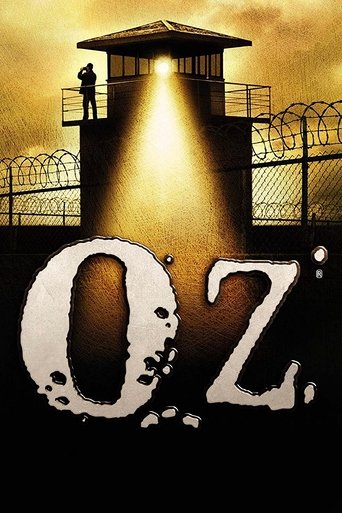
Oz
1997 · TV series · 60 min episodes · 6 seasons
Created by Tom Fontana
The daily lives of prisoners in Emerald City, an experimental unit of the Oswald Maximum Security Prison where ingroups - Muslims, Latinos, Italians, Aryans - stick close to their mutual friends and terrorize their mutual enemies.
8 positive1 negative7 neutralfrom 16 commenters
Where to watch
No streaming data for this title.
19 comments on Hacker News
I remember as a 14 year old boy with HBO I specifically looking for the “Nudity” warning on late night TV Shows. Teenage me was very disappointed by the TV Show “Oz” (which is about life in men’s prison).
> three strikes laws
The three-strikes law is pure abomination, I've first learned about it watching "Oz" (the TV series) in the early 2000s, couldn't believe that that was real (I don't live in the States). 15 years have passed and there is still no real conversation about abolishing it.
you just need one corrupt guard, or somebody who is willing to close their eyes. guards are only people and being on shift talking with and being exposed to those confined will eventually make them empathic, as they realize many of the prisoners (majority but not all) are just people who never had a chance (grew up in orphanages or on the street, or often just homeless looking to escape the cold of the winter by doing a small crime to get there on purpose). There is one common theme among all of them: poverty and/or trauma. Once you see it (and being a guard exposed to them all the time you will see it unless you're a heartless or dumb sh!t) all the binary thinking and indoctrination starts cracking. This is where the bribe comes in since the person bribing also just fulfills a need (addiction, social interaction or whatever).
Instead of Prisons: https://www.prisonpolicy.org/scans/instead_of_prisons/chapter1.shtml
Anyone looking for some Netflix/Chill which is also edutainment about prisons and that doesn't paint the problem as binary (good vs evil) I highly recommend Oz https://www.imdb.com/title/tt0118421/ or (a more recent show about the streets and problems in LE) The Wire https://www.imdb.com/title/tt0306414/ <-- needs at least 2 or 3 times watching because it's incredibly dense!
Edit: this is also an incredibly good read https://mises.org/library/defending-undefendable
I’d add Tom Fontana’s “Oz” [1] to the list, to this day I keep track of its excellent actors by saying “I’ve seen this guy on Oz before” whenever I see a former Oz actor in a movie or a newer series.
[1] https://m.imdb.com/title/tt0118421/
Because it's not that good. It was good for its time, but TV today is different and better than TV was in 1999. People were still watching laugh-track sitcoms when Oz was in its prime.
I love Oz, watched every episode during its initial run. But it was not a critical darling at the time.
The bigger sin is not mentioning Larry Sanders. That was a cultural milestone during its time in the same way Sopranos and Sex and City Were. Curbed feels like its spiritual successor.
And of course the one that started it all for HBO in the early 90s, the one that broke the mold for an adult sitcom, from the creators of Friends - Dream On.
I find the “Haunting of the Hill House” to be really, really good. Not perfect by any means, but definitely above average. I’ve also heard good things about “Casa del papel” and about some of their documentaries. I personally think they’re the best thing that has happened to us movie-buffs in the last 15-20 years, since HBO first started to broadcast shows like “Oz” and “The Sopranos”.
Though I’m pretty sure they do have their blank spots, too, just wanted to say that there’s also quality in their offer.
I stopped watching Deadwood in the middle of season 2 because the acting was so bad it didn't felt real (but I liked it apart from that)
Oz is still one of my favorite tv show, it has so many good characters and the huit clos format (closed doors) is really perfect for focusing on them
I'd say it's HBC and it's ilk that shifted things. Long story arc TV shows with the same artistic ambitions and standards as movies. It's debatable where it began. First I remember is Oz but I've read people claim it goes as far back as Hill St. Blues.
In the UK we had a series called GBH that blew me away as a young person. I keep meaning to rewatch it to see if it's as good as I remember.
Well before these even. HBO has been pioneering the edgy, interesting, original content model for television shows since the 80's. 1st and 10, Larry Sanders Show, Oz, Real Sex, America Undercover, Not Necessarily the News, and on and on...
Netflix has obviously run with the idea though. I'd love to see Netflix and HBO merge actually.
Exactly, the tv show Oz by Tom Fontana covers the subject entirely. When Tim McManus tries to build a micro-society to prepare convicted fellows to live in a real society, it shows how it's very hard and that many disciplines such as psychology, sociology, philosophy... are very much needed.
After reading these two articles, I can't help but wonder if the depiction of prison life in US, as seen in Oz [0], wasn't that far from truth.
I still would want to get some background (and financial interests) on the author. The build-up of the article culminates the third chapter from the end:
Abolishing prisons and releasing all the prisoners would amount to a deregulation of criminal punishment. It would mean letting the private sector determine how best to prevent ourselves from getting robbed. In high finance, the laissez-faire approach has proved to be a disaster; for petty crime, it would be a boon.
So, the antidote to the proposed solution will be more gated communities and private police forces guarding these sanctuaries? Considering that the article avoided pointing at the financial incentives of the prison industrial complex system, I can't shake a feeling there are some other financial interests behind this article.
[0]: http://www.imdb.com/title/tt0118421/
try and go to the guardian when you're in prison because a guy insulted you and you'll probably be seen as a snitch for the length of your sentence. Trust me, I've seen the whole Oz series (http://www.imdb.com/title/tt0118421/)
It depends on the channel lifetime movies fit that stereotype where HBO runs shows like OZ that are far less simplistic. However, one of the positives of cop shows is jurry's now want hard evedence like DNA where they used to be far more willing to rely on circumstantial evidence which resulted in a lot of false convictions.
I guess a lot of people have seen Oz or documentaries about prison life in USA. I think the legitimate question would be - is solitary punishment not preferable to the life in general population?
Two things:
Scale -- HBO is significantly larger when it comes to production capacity. HBO can also have far more shows in production at one time. That scale is partially a product of capital, but also one of point number 2:
Experience -- This one can't be underestimated. HBO first started toying around with original content and series in the early 1990s but it wasn't until Larry Sanders that the show really started to resonate beyond the periphery. Even then, the established TV world didn't start to pay serious attention to HBO until the late 1990s, when you had a swath of hits become bonafide cultural phenomenons (Sex and the City and The Sopranos were hits of a massive global scale beyond anything that cable, let alone premium cable, had seen up to that point).
Netflix has had to start from ground zero. They are essentially right now where HBO was in 1997, when HBO started to shift from acquiring content to paying for original content (Larry Sanders) to making the content in-house (Oz).
Now, granted the current world moves faster -- and Netflix is already potentially approaching the 1997 spot in just two and a half years with this strategy -- BUT content is also now more expensive (The Sopranos and Sex and the City were not $100m shows for a total of 26 episodes like House of Cards is), competition is fiercer than ever and the overall economics of television are not as advantageous as they once were.
I would also say that a third advantage is cable. Yes, cable is an advantage. Why? Because cable often serves as free (or nearly free) advertisements for HBO shows and the bundling of HBO for 3 months free or half-off or whatever is a huge driver in subscribers. Now, Netflix can replicate this, but they'll need to do it at a price and obviously they'll need to assess if giving the cable companies 30% of their monthly revenue is worth the advantages of being bundled.
None of this is insurmountable, but just as starting a movie studio from scratch is hard -- pivoting from a pure distributor into an original content creator/distributor is hard too.
The thing that bothers me most about this is I credit HBO for leading the charge with innovative content that as a whole brought TV to a much higher level. They took big chances even when it wasn't profitable to do so.
I've had a serious love affair with the network beginning with Dream On, The Larry Sanders Show, then moving on to Oz (yeah it was a 'male' soap opera I guess :), Sopranos, 6 Feet Under, Deadwood - which I didn't particularly _love_, but highly respected, and most of all The Wire (best thing to ever grace the screen IMO - they lost $$ on it throughout its run)... and then I killed my cable sub and haven't seen anything of their's since.
Now Mad Men and Breaking Bad are my two favorite shows, they're both on AMC, and I can easily purchase each season on iTunes HD for just north of $30. Every episode is available hours after they originally air. I'd pay twice that much.
Of course, the problem is HBO is just too tightly coupled to big cable. They're one of the main attractions, and as such the kickbacks they get are tied to contracts that prevent them from wresting their content to any great degree. Until this model changes, their A content won't see the light of day, and more draconian measures are likely to be put in place to thwart piracy. It's not HBO itself per-see, but HBO as a proxy for big cable; as a defense mechanism to prop up a flailing business model.
It's worth keeping in mind that The Wire is a product of HBO, and cable TV. They are now well established, but they were once upstarts in their own way.
HBO got its start showing rewarmed mainstream Hollywood movies, months or more after their theatrical releasee. This though was enough to make them one of the few bright spots on the vast wasteland of Gilligan's Island and Bewitched reruns that was cable TV. For that, cable operators were able to extract a premium. From there, they branched out into various bits of original programming.
Then came original programming like Oz, Sopranos, the Wire. This was TV that people regarded as art, and as art, superior to anything on network television and hollywood movies.
Other examples to consider, early Miramax and Merchant/Ivory.
Rather than "TV makes people feel lonely", that's more like "Sitcoms make people feel lonely".
Could you not turn the argument around, and say that watching shows like Oz, The Wire or Dexter where the other people definitely aren't having fun makes people feel better?