 Hacker Cinema
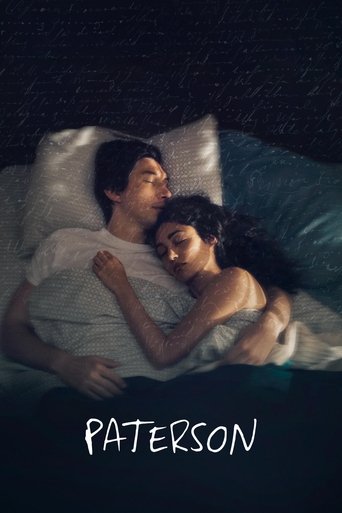
Paterson
2016 · Film · 118 min
Directed by Jim Jarmusch
A week in the life of Paterson, a poet bus driver, and his wife Laura, a very creative artist, who live in Paterson, New Jersey, hometown of many famous poets and artists.
6 positivefrom 6 commenters
Where to watch
No streaming data for this title.
Videos commenters linked
From YouTube links in the comments below. Most are clips and trailers; “Full” means the uploader says so.





6 comments on Hacker News
I recommend watching the film Paterson, with Adam Driver (a bus driver in the film)
you should watch this: https://en.wikipedia.org/wiki/Paterson_(film)
If you have seen Paterson by Jim Jarmusch, you might also like this analysis of the film with supporting arguments from Wallace’s “This Is Water”: https://m.youtube.com/watch?v=RnGvWTRQ9j4
You're right, also television! But also other things. Which makes me think of the products that I use that are algorithmically built for addictiveness - not to say all products are initially built with the intention of being addictive, but products gradually become so and a company then unethically pushes new features that will further the addictiveness since that keeps the user coming back/on the product. An example of the latter is Netflix or Spotify. Netflix, last time I checked, now auto plays previews of shows on the main page - a way to get the user to be intrigued, stay on the product, and keep watching more shows. Spotify, while a revolutionary product, I find is addictive - millions of songs a user has yet to listen to? Well, then that is more of a reason for the user to plunge into two hours of music searching and while the user is at it, why not create a playlist for every occasion that might occur.
The latter two examples being poor examples, but yet, there are products/services all around us which manipulate our mind. I have always been keen on building something, a product or service, something morally and ethically just - no advertisements, no gimmicks, etc. I.e. Spotify should have a optional pop-message say: "You have been listening to music for five hours. You should let your ears rest and make some pumpkin pie." Or from Netflix: "You have just watched the entire season of two shows. You should really go lay under a tree in a park and eat some grapes." Again, the latter two examples are not likely, they are dream-like features but this is what I dictate to be a movement towards more healthy products/services to which we need.
In modern day, we must then be extra aware of what we consciously consume and put in our head day in and day out in our everyday life. We might even decipher if this is what we want to consume, if it is healthy, if it is the way we want to lead our lives. The latter being an approach I took to deciding to stop: watching, reading, and listening to the news, bookmarking countless of articles I find (Pocket, the bookmarking saving tool, is particularly overwhelming), sticking to just a few websites I regularly visit, not using/having any social media account, etc.
Above all, I'll finish this comment off with two of my favorite quotes and a video about everyday virtue that I think is appropriate in regard to the article and something teenagers should come to know:
Thomas Merton: "The greatest need of our time is to clean out the enormous mass of mental and emotional rubbish that clutters our minds.”
Andrei Tarkovsky from Sculpting in Time: “Modern mass culture, aimed at the 'consumer', the civilisation of prosthetics, is crippling people's souls, setting up barriers between man and the crucial questions of his existence, his consciousness of himself as a spiritual being.”
Everyday Virtue, an analysis of the independent film Paterson with support from ideas of David Foster Wallace (it's about awareness, normal and ordinary everyday life, etc): https://www.youtube.com/watch?v=RnGvWTRQ9j4
Bus driving is an addictive Zen like experience
The movie "Paterson" addresses this exact situation. A poet who drives a bus. Very good movie I recommend anyone interested in this topic to watch it.
The recent movie 'Paterson' is perhaps an interesting illustration of a character who is apparently content in an unskilled job. The title character is a bus driver whose passion is for poetry which he writes during breaks, partly inspired by the people he sees while driving around (so perhaps the job is somewhat aligned with his passion, there). Also blessed with an extremely stable home life, Paterson radiates a zen-like modesty, acceptance and contentment.
Of course it's just a movie, but then Bukowski was a poet whose works are 'just' books (and movies) themselves. Not disagreeing with you - I would hate to feel stuck in an unskilled job also - just throwing this out because I think it's interesting.