 Hacker Cinema
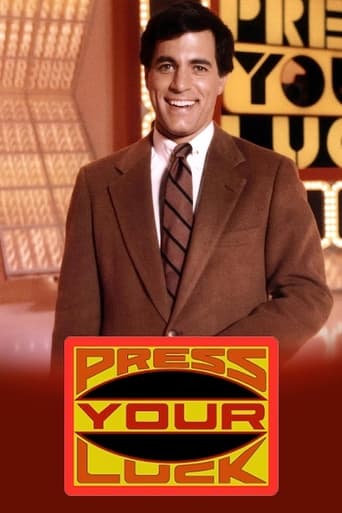
Press Your Luck
1983 · TV series · 30 min episodes · 2 seasons
Created by Bill Carruthers
Contestants collect spins by answering trivia questions and then use the spins on an 18-space game board to win cash and prizes. The person who amass the most in cash and prizes at the end of the game wins.
4 neutralfrom 4 commenters
Where to watch
No streaming data for this title.



4 comments on Hacker News
I haven't changed anything! It's right there in the Wikipedia article - the 1950s frauds were in fact mainly about rigging the shows for entertainment value, ensuring the right contestants won.
The FCC doesn't (didn't?) like the shows being rigged that way, which is why The $64,000 Question went off the air. It also doesn't like the shows being rigged in the network's favour, which is why this episode of Press Your Luck continued to the end despite the producers' misgivings.
I remember an assembly at school that consisted of a multi-image presentation called Eye to Eye. In terms of content I think it fell into the typical early 90s don't-do-school, stay-in-drugs messaging of the time, but I was fascinated by it because it was driven by nine computer-controlled, precisely timed slide projectors arranged in a 3x3 square with accompanying audio playback; and supplemented by a 16mm film projector that occasionally replaced the center slide projector and provided "video" in the center of the square surrounded by images from the other eight projectors.
By switching slides on a "rolling" schedule, the slide projectors could achieve very smooth fades and transitions. Combined with the accompanying audio, it made for an effect that was almost movie-like, showing characters moving and speaking more smoothly than you would expect a slideshow to be capable of.
The humble slide projector is far more capable than one might guess, and has played a central role in all manner of visual presentation: the infamous "Big Board" from the gameshow Press Your Luck, for instance, consisted of slide projectors showing the various cash amounts, prizes, Whammies, etc. onto screens around the perimeter of the board, while border lights around each screen turned on to highlight which one the player would win if they hit the stop button. Famously, this arrangement was not random and super exploitable.
Now of course, the slide projector has joined the rotary phone and the floppy disk on the scrap heap of once-ubiquitous technologies that vanished after their moment passed.
The big thing about the Press Your Luck incident that people seem to overlook is that finding the flaw was half of the con, exploiting the flaw was the much harder part. (that is, getting selected to being onto the show, answering the toss-up questions, and getting the patterns/timing correct). It was more-or-less luck that everything worked correctly, and as noted in the documentary, the con almost failed at each point.
The Monopoly incident in comparison is just boring manipulation of insider information.
Somewhat unrelated, but there is a great documentary on Michael Larson; who figured out a software randomness flaw in the game show Press Your Luck, and exploited it live on TV to the tune of $110,000. In that day, $110,000 was an obscene amount of money to win on a gameshow. No game show was awarding even close to that.
https://www.youtube.com/watch?v=nzNMCXWCZzQ