 Hacker Cinema
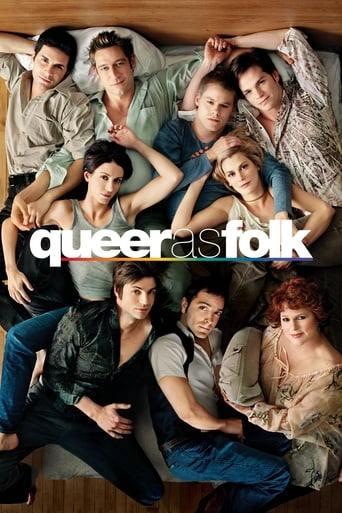
Queer as Folk
2000 · TV series · 5 seasons
Created by Daniel Lipman, Ron Cowen
Brash humor and genuine emotion make up this original series revolving around the lives, loves, ambitions, careers and friendships of a group of gay men and women living on Liberty Avenue in contemporary Pittsburgh, PA. The show offers an unapologetic look at modern, urban gay and lesbian lives while addressing the most critical health and political issues affecting the community. Sometimes racy, sometimes sensitive and always straight to the heart.
3 positive4 neutralfrom 7 commenters
Where to watch
No streaming data for this title.


7 comments on Hacker News
You don't understand, it's terrible to censor movies but absolutely vital to make sure people can't make movies I disagree with.
edit: It's funny, I wouldn't be happy about a version of the old HBO series Rome reedited with anything gay taken out, but I'd be absolutely excited to watch a version of Queer As Folk with all the gay stuff edited out.
> I think you misunderstood her. She was saying that being transgender in that role was central to the character. It was the point of the movie. However, whether a character is black or not doesn't really matter (anymore). That's why we don't use blackface masks anymore.
A good example of this may be the US version of "Queer as Folk", a dramatic series on Showtime from 2000-2005 [1].
Most of the main characters were gay, but only a little under half of the actors that played them were gay. Another actor was bi, and the rest were straight.
But you could not tell from the performances which were which. The straight actors were as convincing as the gay actors, even in scenes involving serious erotic action.
[1] https://en.wikipedia.org/wiki/Queer_as_Folk_(U.S._TV_series)
As a gay person born in the early 80s, I vividly remember how "normal" gay jokes were in movies all through my childhood and teen years. Although I didn't fully realize I was gay, a subconscious part of me did, because I remember how uncomfortable it made me each and every time. It was such a standard trope:
Gay joke happens in movie
Entire theatre groans, goes "Ewwwwww"
It was just standard formula. It started changing right at the end of the 90s / early 2000's with televisions shows like Queer as Folk, and Will and Grace, that treated gay people like normal human beings.
> TV Shows and movies and music trends all make it much more acceptable in the mainstream.
What you see in mainstream media is the mainstream-approved version, but it's nowhere close to representative. Queer As Folk had more diversity in representation in a few seasons than the decade of culture that followed it.
Maybe, maybe not. What's interesting about the HBO/Showtime/etc. model is that it specifically encourages programming diversity, as the original article discusses at least a bit. Many people are willing to pay the surplus on their cable bill just to follow their one or two favorite shows, and few of the audience watches all eight (or however many). What this means is that whereas when a network adds a new show, they're trying to maximize its viewership on its own to maximize ad revenue, HBO only cares about adding new viewers that aren't already a part of their audience -- if a new show is only of interest to people already in the target demographic of an existing show and, therefore, probably already subscribers, nobody new will subscribe and the show won't pay for itself. As an audience member of their content, then, you're not expected to watch all of the shows, but you get the opportunity to watch a few that are probably more-narrowly-tailored to your interests than would be expected of network programming.
So yes, I would like to just be able to buy Game of Thrones, but I'd also, personally, like to be able to just buy Deadwood or (on Showtime) Queer as Folk, and I think if every show had to justify itself to network executives on raw viewership numbers instead of on audience-broadening power, those shows would never get made; their audiences are too niche compared to their production costs. I certainly appreciate the opportunity to see at least some content that's not aimed primarily at 18-35-year-old straight men.
Of course, this is the kind of reasoning that justifies 100-channel cable packages instead of a-la-carte cable channels, so take what I'm saying with a grain of salt. But I think the expectation that a-la-carte show purchasing could really work, economically, is probably not realistic (and this without even getting into the issue that it'd be tough to pay for a $75-million Game of Thrones season at a dollar an episode).
Not opining on how good it is: the script matters less than the execution.
Have you ever watched Coupling? It is an extremely funny British sitcom (ignoring the 4th season, which is just "funny", but not as good as the first 3 seasons, with the exception of a couple of episodes).
It was also successful in the US. So, an american version with american actors was made, as is customary (see e.g. The Office, Queer as Folk, Being Human, etc, etc, etc.)
It had exactly the same texts for the expisodes I watched. It had reasonably good actors. But it just wasn't funny. I gave it the benefit of doubt. Then rewatched the british. Still funny. Then the american. Not funny.
(Successful conversions like "the office" go their own way, rather than stay true to the original)
The best script is useless without a matching excellent delivery. And a lesser script is still excellent with the right delivery. (Think about how Seinfeld would look if done by your other favorite comedians who are not Seinfeld/Louis-Dreyfus/Spadowski et al)
I like Mike Judge's past work. I'm going to wait until I see it executed before I have an opinion.
As one of the poeple who broke the anonymity of the first Netflix Prize dataset, here's my take on why this is an issue we should worry about.
First, some links: Paul Ohm's paper on the consequences of re-identification for privacy laws and public policy: http://papers.ssrn.com/sol3/papers.cfm?abstract_id=1450006 Ohm's article about Netflix Prize 2: http://freedom-to-tinker.com/blog/paul/netflixs-impending-still-avoidable-multi-million-dollar-privacy-blunder Our FAQ about the re-identification attack on the first dataset: http://www.cs.utexas.edu/~shmat/netflix-faq.html
An excerpt from our paper, showing the kind of information you can learn about a person just from movie preferences:
First, his political orientation may be revealed by his strong opinions about “Power and Terror: Noam Chomsky in Our Times” and “Fahrenheit 9/11,” and his religious views by his ratings on “Jesus of Nazareth” and “The Gospel of John.” Even though one should not make inferences solely from someone’s movie preferences, in many workplaces and social settings opinions about movies with predominantly gay themes such as “Bent” and “Queer as folk” (both present and rated in this person’s Netflix record) would be considered sensitive. In any case, it should be for the individual and not for Netflix to decide whether to reveal them publicly.
A quote from Paul Ohm on why this is problematic even if no one cares about movie privacy:
The "accretion problem" is this: once an adversary has linked two anonymized databases together, he can add the newly linked data to his collection of outside information and use it to help unlock other anonymized databases. ... Because of the accretion problem, every reidentification event, no matter how seemingly benign, brings people closer to harm. Had Narayanan and Shmatikov not been restricted by academic ethical standards (not to mention moral compunction), they might have connected people to harm themselves.
He then goes on to postulate the "database of ruin":
It is as if reidentification and the accretion problem join the data from all of the databases in the world together into one, giant, database-in-the-sky, an irresistible target for the malevolent.
At a first reading, this might all sound like science fiction, but it's a lot more plausible than most people think. On my blog http://33bits.org/ I have several more examples of re-identification. And let's not forget that there are companies such as Acxiom and Choicepoint which already specialize in aggregating every available piece of information about people, and then selling it.