 Hacker Cinema
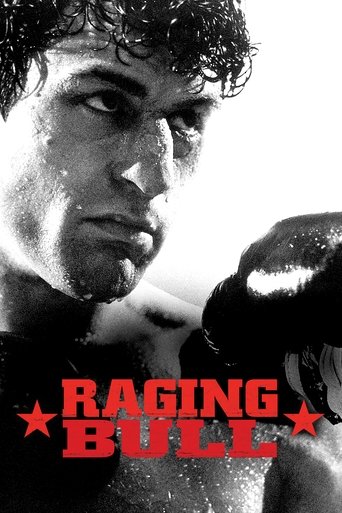
Raging Bull
1980 · Film · 129 min
Directed by Martin Scorsese
The life of boxer Jake LaMotta, whose violence and temper that led him to the top in the ring destroyed his life outside of it.
1 positive1 negative9 neutralfrom 11 commenters
Where to watch
No streaming data for this title.

11 comments on Hacker News
Aside from writing and directing films like "Raging Bull" and "American Gigolo", Paul Schrader as film theorist has christened the genre of long movies as "Slow Cinema." In his thesis "Transcendental Style in Film: Ozu, Bresson, Dreyer", Schrader argues that the deliberated depictions in lengthy movies transforms the act of the ordinary into a realm of transcendence.
He has produced a famous diagram where he identifies acclaimed filmmakers like Tarkovsky, Akerman (mentioned in article), Weerasetakul, Tarr as practitioners of slow cinema[1].
[1] https://www.indiewire.com/wp-content/uploads/2018/05/figure18.jpg?w=725
---
Personally, these long films were an experience in themselves:
- Sátántangó, Bela Tarr, 7 hours 18 min
Tarr depicts the countryside as a slow, humdrum experience. By confronting viewers with the elongated pedestrian experiences, the film accentuates the subtle rhythms in everyday life.
- Hitler: A Film from Germany, Hans-Jurgen Syberberg, 7 hours 22 min
Perhaps bombastic, and even pretentious, but Syberberg has successfully constructed his own world from his poetic sentiments. It laments on how the noble "Germanism" has been (as put by Susan Sontag) "retroactively tainted" by Hitler.
- Nostalghia, Andrei Tarkovsky, 2 hours 5 min
I know this isn't as long as the other titles, but the penultimate shot of the film is 10 minutes long. It depicts a man walking around holding a candle. While very little happens, the parsimony of the shot directs the audience's attention to the sparse movements, which compounds the until the action is resolved.
I seem to recall the guidelines here being against list-articles, but this is the NY Times so I guess it's a reputable source.
Anyhow, the items from his acting career are:
- Early headshot (picture) and type-written résumé
- A fedora (hat) from "Mean Streets"
- An actual taxi driver's license from preparing for "Taxi Driver"
- Dog tags from "Deer Hunter"
- "Raging Bull" annoted script
Cool items, and I guess a really nice move by him to donate personal stuff like that for future generations of film buffs to admire. :)
It isn't that movies like The Deer Hunter are slow, necessarily. It's that the scenes are doing things other than advancing "the plot". Things like revealing a hidden character trait or depicting the quality of the protagonist's world. I remember someone telling me that The Zero Effect (1997) was "too slow", when I thought it was moving along at a fast clip; I finally realized it was the difference in what we were getting out of (or looking to get out of) the movie that accounted for our differing perceptions.
Not that that can't be done poorly, either. But The Deer Hunter never struck me as slow, and I'm a kid who grew up with Star Wars as my template. But I got really into what we might call (erroneously) "character-driven" movies in the '80s.
(Dammit, I liked Chariots of Fire, but there was no way it should have taken Best Picture over Reds. Same with Ordinary People and Raging Bull.)
It's funny, I think your Ordinary People vs Raging Bull comment excellently underscores the original article.
Raging Bull is a cinematic masterpiece. As "art as art" it is sublime. It is a love letter to film.
Ordinary People is an emotional masterpiece. As "art as therapy" it is sublime. It is a love letter to humanity.
When people "steal" from Raging Bull it's fairly obvious and usually surface level.
Plenty of people stole from Ordinary People, too, it's just harder to spot because what they stole is more psychological and subtextual.
Just as a simple example, the most iconic televison show of the last 30 years (The Simpsons) cribbed way more from Ordinary People than Raging Bull.
If you look, it's easy to spot the influence throughout the series' run. But there's no single iconic shot like their Raging Bull slo-mo homage in "The Homer They Fall."
What does it even mean, to remember, to steal, art...?
I chose "idyllic", expecting titles like Kiki's Delivery Service, but all the recommendations were either fighting or sports-related movies (Raging Bull, Southpaw, Rocky, etc). Sometimes there's also an issue where the same page loads inside the video frame.
Good idea, just needs a little more polish.
Looks to be a different source from the OP, but let's go down the chart for 1980 past the top ten:
https://www.boxofficemojo.com/year/1980/
Kramer vs. Kramer (book)
Ordinary People (book)
Popeye (comic)
The Shining (book)
Cheech and Chong's Next Movie (sequel)
Caddyshack (original - franchise starter)
Friday the 13th (original - franchise starter)
Brubaker (book)
The Jazz Singer (remake)
Flash Gordon (sequel/remake)
Bronco Billy (original)
Raging Bull (book - biopic)
Maybe you should go back a few decades until you can find a time when the top 20 were mostly originals. Would have to be before the Star Wars/Jaws blockbuster era, probably.
As just one more point of reference for this song's cultural power: whereas the greatest movie about boxing, Raging Bull, made such wonderful use of highbrow music like the Intermezzo from Cavalleria, the greatest boxing movie, the first Rocky movie, in its own way, makes wonderful use of more familiar touchstones. In particular, an instrumental "Silent Night" plays jarringly in the background of the dramatic climax scene, where Adrian stands up to her brother. Masterful.
https://www.youtube.com/watch?v=fxriLTLhyyY
Except if your taste is not right smack in the mainstream, those services have a terrible selection even combined.
I went to JustWatch and even pretended to be an American, just to make it easier on them.
First option, The Exterminating Angel. It's a classic, part of the list of 1000 best films by the NYT, and less than 60 years old. Nope, not even one service has it.
Second choice, Lore; still foreign, but it's a film from 2012, made already in the streaming era! Apparently I got to subscribe to "Fandor", so the price is now $40/month.
Third, let's give them an easy win: Missing, made in the US and owned by Universal! Yet another service, so called "Starz", for $9/month more.
Fourth, an American classic, they have to have Raging Bull... and no. Now it's something called "MaxGo", which from what I can tell costs another $10/m.
These were literally 4 of the 5 first movies I searched for, and we're already at your $60/month, and still missing one! It's not reasonable.
If Netflix was trying to ensure that what I was mostly likely to watch next had the highest star rating, no wonder they gave up on it. Our opinion of the quality of something is not a good predictor of our likelihood of watching it.
Their users are surely not confused about that. So why does Netflix want to present a prediction as a rating? Is it to flatter their users by telling them that the thing that feels instantly gratifying right now is actually an amazing movie? "Hey, great choice. Billy Madison is a five-star movie. What? Why would you feel bad about not watching Raging Bull instead? It's a two-and-a-half star movie at best."
In other words, Netflix, like Facebook, like Doritos, is engineering itself for maximum addictiveness without regard for honesty. It will shelter you from even what you know and reassure you that whatever triggers a pleasure response in your brain is the best. Relax and enjoy it.
The truth is that we consume easy things a lot more often than we challenging things. It would be exhausting otherwise. But the best things are often the most challenging. We know that, we know that easy movies are just a way to kill time, but Netflix wants to do us the service of helping us forget it, because then we might be 1% more at ease when we watch Netflix and 1% less likely to switch to another service.
Not also how all of those are fantasy movies for kids and adult geeks. No Raging Bull or American Grafitti or Apocalypse Now or Three Days of The Condor, etc etc.
IMDB reports that 2322 movies were released in 1939 alone, is it really surprising that there were a handful of good movies among them?
1980 for comparision, IMDB lists 6007 movies (8000+ if you include TV movies), and contains modern (popular) classics such as Stir Crazy, Superman II, Empire Strikes Back, Airplane!, The Blue Lagoon, Ordinary People, Urban Cowboy. The Shining, Caddyshack, Raging Bull, Friday The 13th, The Fog, The Blues Brothers.
Hmm, looks like 1980 was a much more 'classic' era than the 40s for hollywood, but you wouldn't have heard that from film buffs in the 80s.
Hollywood has always been a great abuser of the 'sling lots of shit at the wall and see what sticks' approach to 'greatness', they're just slinging a lot more shit these days.
Even if we take a really contemporary year and do the same study, we see a pattern of greats no matter what year, take 2005 at random:
Batman Begins, Sin City, V for Vendetta, Revenge of the Sith, King Kong, Brokeback Mountain, Harry Potter/Goblet of Fire, Serenity, Charlie and the Chocolate Factory, Mr & Mrs Smith, Wedding Crashers, Munich, Saw 2, Hostel, Hitchhiker's Guide to the Galaxy, Madagascar, Pride & Prejudice, Land of the Dead.
Ah, but the movie buff will point out that they're not established classics like Gone with the Wind, or Wizard of Oz. Not yet, anyway.
Edit: Btw, for 2005, the number of movies was 28,000+. Is it any wonder that there is a lot of formulaic stuff in there as well?