 Hacker Cinema
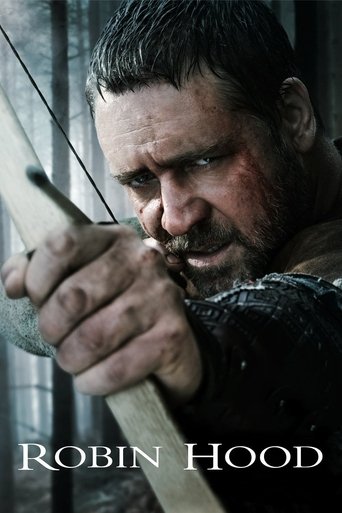
Robin Hood
2010 · Film · 140 min
Directed by Ridley Scott
When soldier Robin happens upon the dying Robert of Loxley, he promises to return the man's sword to his family in Nottingham. There, he assumes Robert's identity; romances his widow, Marion; and draws the ire of the town's sheriff and King John's henchman, Godfrey.
5 negative6 neutralfrom 11 commenters
Where to watch
No streaming data for this title.


11 comments on Hacker News
> Disney did not create Snow White, Bambi, Robin Hood, or Peter Pan.
I believe I stated above that I support reducing copyright periods (to the lifetime of the original author would be appropriate IMO, if the copyright is held by an individual, and I would be open to a more aggressive schedule for corporate copyrights). AFAIK all of Disney's adaptations of these stories would be allowed under that rule; some of these original stories are centuries old. But no, I don't think Disney should be able to immediately adapt a book I've written and not give me a cent out of the billions they will make off the adaptation. I would sell more books that way, sure---except I actually wouldn't, because in that world I have also lost the ability to monetize my work. So it's more accurate to say that somebody else would sell more of my books, or that I would give away more of my books.
And yes, it's more appropriate to call these adaptations. Fan fiction is more in the vein of original stories using (somebody else's) established characters and settings.
> To a large degree individual artists do not hold copyright for their work, they often sign it away (especially musicians and authors) in exchange for signing, advances, and distribution.
"To a large degree" is obviously meaningless, but a good author's agent will retain your core copyright and other rights (e.g. film adaptation, publishing/distribution in other countries, etc.).
> I think they will still be financed. Take books, I don't think bookstores will want to vertically integrate from book discovery through printing and retail stores. Consumers will still need ways to identify reputable book publishers to limit what they purchase next.
You are conflating production and distribution. If there is no copyright, the second a single copy of a work becomes available it will be scraped and offered by every distribution platform in the business, who are all free to curate their "storefronts" however they please. The difference is that they don't have to pay a cent for production, royalties, or anything else.
As an example, say I publish a new short story on my Patreon, which I use to support my writing---the idea being that if people want to read my shorts they have to pay for access. In this new regime, that newly posted story is going to appear on Amazon and every other big platform within hours, for cheaper than my Patreon membership or even free. And if I am an established name, there is no reason Amazon can't put my book front and center in their KDP feeds, etc.
The same goes for any other publishing model. The author and publisher (if applicable) immediately lose all ability to get a return on their investment, except to the extent that they can organically attract people to the correct listing on the correct distribution platform, which will have to be price-competitive with other listings.
It's the same story for paper books, too. B&N can just print copies of my book and display it front and center in their stores, without even asking me, and certainly without paying me anything.
And the same goes for other types of media. Why wouldn't it? This is why I say the commodity slop is all that will be left---that kind of IP synergizes best with the massive marketing efforts and platform consolidation that will be required to recoup your investments in content. Not much might even change in that world.
> The 0.00001$ per stream for musicians? Or the 1$ residual checks for reruns?
There is always going to be a long tail, and there are always going to be great artists who go unrecognized and unrewarded. It's also true that monolithic modern platforms like Spotify are going to leverage their position as gatekeepers to squeeze artists as far as possible. But it's ignorant (or possibly disingenuous, and anyway categorically incorrect) to claim that the above means nobody is getting paid substantial amounts for their work via these mechanisms. I suggest you seek out the authors of some of your favorite recent novels (if you read) and ask them whether losing royalties would have a substantial impact on their finances and ability to keep writing.
> You can just go write your own fiction, right now. You can invent your own original characters and setting and plot and go write it. You will automatically own the copyright to your own work; there is no other party who must "bless" your efforts.
I keep going back to the old-school Disney example because it's easiest to see: Disney did not create Snow White, Bambi, Robin Hood, or Peter Pan. All of those movies are highly influential and core to Disney and the culture of people growing up with them. And they're all fan fiction, or would be considered as such, and be impossible to produce and monetize if Disney had to live with the same copyright restrictions they impose on the rest of us.
If I want to now go and recreate my own movie based on one of the original texts, I think it would be next to impossible since the threat of lawsuit (even if I use none of their IP and would eventually win) would make financing impossible.
Fan fiction has been turned into an edge case by the current copyright system. Putting your own spin on the stories you grew up with used to be the norm.
> my specific concern is for individual artists who hold the rights to their work
To a large degree individual artists do not hold copyright for their work, they often sign it away (especially musicians and authors) in exchange for signing, advances, and distribution.
> what effect do you think abolishment of copyright will have on the production of films that are actually good? Who will finance them when it's impossible to directly monetize them?
I think they will still be financed. Take books, I don't think bookstores will want to vertically integrate from book discovery through printing and retail stores. Consumers will still need ways to identify reputable book publishers to limit what they purchase next.
> I think commodity slop will be the only thing that gets funded anymore
One could argue that this is what has always dominated funding. Most revenue and shows have been for artistically devoid pieces of media (especially in movies).
> No artists are relying on royalties and similar payments for their work.
The 0.00001$ per stream for musicians? Or the 1$ residual checks for reruns?
Disney was founded on Mickey Mouse. Yes, they made major motion pictures out of old myths and legends, like Cinderella and Robin Hood, but those stories have always been public domain and you can write a book or movie about them with no problem.
In all the documentaries I've seen (e.g. Robin Hood, Avengers Infinity War, etc.) blacksmiths are for spouting exposition and building the hero's super weapon montages.
I have been more entertained by watching Lars Anderson do archery for five minutes than any other archer on film, ever. Honestly, it was more entertaining and more memorable to me than any of the fake archery shown in the Hunger Games, Robin Hood or Lord of the Rings. I can't remember another archery video that went viral.
Perhaps some of the claims are a little hyperbolic and self congratulatory, but you can't say "all this guy is good at is marketing". Please. It obviously took practice and skill to perform some of those stunts and I just don't understand why dissenting voices always need to cut people down instead of just making their case.
> This is entirely voluntary.
Indeed, and I've pretty much done it. But it takes effort. You need credible replacements for the mindless time, and then you need to actively push yourself towards the new stuff as opposed to the old stuff.
The credible replacements is everything. If you commute by car, you need either:
-Some audiotapes/audiobooks/podcasts
-Someone to carpool with
-Some way of not driving any more (car service if you're wealthy enough, taking the train or bus otherwise)
...otherwise you're going to listen to the radio. What else is there to do while driving?
So it takes some effort. Totally doable though. I just calculated out how much time I spent on pop culture this year - Only one movie (Robin Hood, meh - I would've seen Inception except I was in the back provinces of China when it was released, and then it was gone from theaters when I was back in civilization), less than ten hours of TV (mostly tennis), no pop music except what was on when I was wandering through stores playing music or at a bar, no newspapers, and a few hours of trashy magazines while sitting in an aeronautical engineer friend's bathroom (why he reads them is beyond me, but it wasn't a terrible use of time while in his bathroom).
But this is only possible because I've got a list of stuff to do - a Kindle loaded with good books, an mp3 player loaded with audiobooks/podcasts, Hacker News/LessWrong/Google Reader loaded with good blogs, Lichess.org for when I want to play a game of Chess, and a list of temples/mosques/ruins/parks/beaches to go to.
It's not enough to just "opt out" - you need to "opt in" to some comparable activity to fill your time.
No, not "acceptance" in the that sense, it's more of an "understanding". I get it when someone does something audacious like that; and I think the glorification of banditry is well entrenched in our culture. Countless Hollywood films, Bonnie and Clyde, the wild west, Robin Hood, etc.
While I consider crashing your competitor's servers like purse snatching; hurting the weak. It's pathetic, passive-aggressive shit that doesn't require neither boldness nor skill. I hate incompetent, gutless crooks in a very "if you're gonna do something, do it big" sort of way.
If not the 'worst evar', this has been a summer when supposedly safe "pre-sold" properties like Robin Hood and Prince of Persia fell flat - critically and commercially. With so many licensed films coming down the pipe, that has to put the fear of god into a few movie executives.
Aren't they suppose to compare this year with some of the other years
Of course not. That would be mindful. This is a mindless nostalgia piece, right out of central casting.
The fun thing to do when one of these articles arrives on the radar is to see which cherry-picked "classics" are being name-checked:
"The Godfather," "Jurassic Park," "Casablanca," "Gone with the Wind," "My Fair Lady" and "The Matrix,"
These lists are always carefully constructed. In this case we have two extremely popular classics from the 1930s, generally regarded as among the best films ever made. That's to establish your street cred as someone who has actually seen some great movies. Then one film each from the 60s, 70s, early 90s, and late 90s, to ensure that every one of your readers over the age of thirty has something to be nostalgic about, and that they believe that the author is sufficiently "hip". (No sense in listing too many films from the 2000s; twentysomethings don't read newspapers.)
Then I got as far as this line:
Where once there was "Robin Hood: Prince of Thieves," there is now "Robin Hood," prince of duds.
This line is a dead giveaway, because "Prince of Thieves" was not a good movie, let alone among the best Robin Hood movies; it was redeemed only by the presence of Alan Rickman. Why, then, is the movie praised here? Because the writer really needed to write a cute sentence, reality be damned.
That's about all you need to read. The rest just wrote itself. It can read itself as well.
"Whether we are talking about fake Kevlar vests... or a bolt that fails on an airplane engine, we cannot afford to purchase fake goods. This is not just about the new Robin Hood movie," said Biden.
Maybe my interpretation is wrong, but the "logic" seems to be: piracy is about copyright (one kind of intellectual property) infringement, counterfeit goods are about trademark (another kind of intellectual property) infringement, therefore they should be in the same bag. That's a bit of a stretch, isn't it?
People wouldn't associate pirates with Johnny Depp if they hadn't made a movie showing how cool pirates are, starring Johnny Depp. Hollywood likes to make movies glamorizing criminals -- public enemies, goodfellas, princes of thieves: crime is cool, except when it's happening to us.
Perhaps we should call it "stealing" instead? No problem, as long as people don't associate it with Russell Crowe in Robin Hood (coming to a theater near you; check your local listings).