 Hacker Cinema
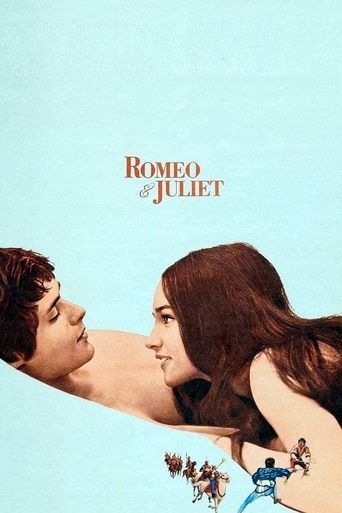
Romeo and Juliet
1968 · Film · 138 min
Directed by Franco Zeffirelli
Romeo Montague and Juliet Capulet fall in love against the wishes of their feuding families. Driven by their passion, the young lovers defy their destiny and elope, only to suffer the ultimate tragedy.
1 negative10 neutralfrom 11 commenters
Where to watch
No streaming data for this title.



12 comments on Hacker News
Nope. Schoolhouse Rock, multiple Monty Python films, The Last Samurai, The Magic Schoolbus, Romeo and Juliet... but never any Charlie Brown.
Romeo and Juliet would be child porn today.
There’s a TV channel for old shows/movies here. Clothed nipples are obscured. A sci-fi movie, the plaque on the NASA satellite with nude human figures was obscured. Who will protect the aliens?
Tipper Gore and Jerry Falwell lost the battle, but they won the war.
I remember the teacher talking up Romeo and Juliet and being fairly unimpressed. But when I read King Lear, I was electrified- that scene with the king ranging around in the field while the fool says smart things is really good IMHO. I saw the Scottish Play put on by my high school theater and it was also great.
Over time I've come to appreciate his fragments: "But soft! what light through yonder window breaks? Tis the east, and Juliet is the sun..."
It came as a big surprise after reading and parsing out whole plays that other kids in my class were just reading some short guide and talking like they understood it.
THe best movie version of the Tempest is Forbidden Planet, which can also just be viewed purely as science fiction.
Dan Harmon is a great storyteller, but this system, and indeed all these "universal story structure" systems all either:
1) Are so generic they doesn't say anything useful (like a horoscope which fit everybody).
2) Only matches some select stories.
A good litmus test is if the system is compatible with Shakespeare's Hamlet. Given how populuar and well-regarded the play have been for centuries, we can safely say it is the system rather than the play which is at fault if the play does not fit the system.
We immediately notice that Hamlet does not "Then return to their familiar situation", since he dies (along with most other characters). Also it is not really clear he have changed. Indeed, the genre of tragedy does not match the requirement to have the protagonist safely home in the end, so Romeo and Juliet is also out. These are not obscure examples, these are the most famous and well-regarded plays in the English language.
TV-shows like Rick and Morty does tend to have the characters safely home in the end, so they can start in the "zone of comfort" in the next episode. On the other hand the characters rarely change. Even if they learn some lessons, they have usually forgotten them by start of the next episode. So I'm unsure if the system even matches Harmons own writing.
The paper takes three books (Romeo and Juliet, Lilly of the Valley, and Martin Eden) and has readers score four points in them for feeling.
Not just any readers mind you! But readers that are "used to reading texts instead of watching movies and YouTube"
The resulting values are then fitted to some curve or other. Unsurprisingly, fitting four points works just fine.
This apparently supports their key hypothesis "that love is a second-order phase transition occurring in the human brain under the influence of hormones, such as dopamine and serotonin". That the brain or hormones have something to do with love, I'm ready to believe, how it ties in with non-youtubing readers of Romeo and Julliet, not so much.
I also saw Blade Runner in its original theatrical release, and it's still the version I prefer. In this case I think the studio heads did Scott a backhand favor by ending the film as they did.
Spoilers:
If, as depicted in the original release, Deckard is human and Rachael is a replicant, then the movie is a true love story. The message of a true love story is that the Other is as deserving of love and dignity as I am. It's the message of Romeo and Juliet, Frankenstein and To Kill a Mockingbird, to name three offhand.
Whether your allotted lifespan is four years or threescore and ten, if you understand that you don't know how much time you really have, then you are entitled to the full measure of decent regard and respect the melancholy of that understanding earns. Batty bought that respect for Deckard and Rachael's sake. Thus the original ending is moving, and completes the film's overall themes.
If Deckard is also a replicant, as subsequent versions try to establish more and more explicitly, then of course he's going to want to be with Rachael. It's a no-brainer, it's no sacrifice, and there's no moral revolution of the characters. In which case I don't really know what the movie is supposed to be about. Boy robot meets girl robot, boy robot loses girl robot, boy robot gets girl robot? Boring. Definitionally cliché.
I suppose the realization of it is supposed to be some kind of shocking twist, but to me it simply empties the film of meaning.
I read an annotated version of Lolita. I suspect I would not have made it all the way through an unannotated version. The annotations were astonishing to me. Pointing out literary references that were either unknown to me, or that I knew but did not, on my own, connect. I missed a key plot element (being followed), that was illuminated by the annotation. I've also read erotica and a small amount of porn. IMHO, Lolita doesn't come close to being porn. It's just go too much going on _beyond_ the sexuality.
The issue of being drawn to a 12 year old is .... complex. When Shakespeare wrote Romeo and Juliet, 13 was the age of consent, and Juliet was 13. Evolutionarily, once a woman is ovulating, I assert it's 'natural' to be attracted to her, regardless of how young she is or the age difference. BUT in a modern world, the power differential between an adult male and a 12 year old, or 14 year old (Sue Lyons was 14 when she played Lolita in the Stanley Kubrick film) is too large to condone. The potential for psychological damage to the younger person is vast. So we've made it illegal. But my sense is that it has become tarred with too broad a brush. "Unthinkable that any moral person could have these desires" seems to be the theme in much of the book-banning crowd.
And, as others have pointed out, it was rape, which is despicable, and does not 'glorify' the sexuality, but it's done in a complex (literary) way that makes it possible to miss the rape element. !!!
> The problem is that this is very much a rear-view mirror perspective.
But analyzing art is a rear-view mirror perspective. History judges what is great art. Not the present audience.
You ramble about the same thing over and over again - human condition. Sure. That's a part of it. Silly pop music, formulaic romance novels, etc all have that. But what separates actual great art from entertaining art is it's affect on language/culture/thought/etc.
Whether marvel movies will be considered great art has nothing to do with "human condition" or how it emotionally affected the audience today. It'll be judged in time by its affect on language/culture/thought/etc. Any silly drone can create art that touches on the human condition. That's the easy part.
Shakespeare's hamlet, romeo and juliet, etc aren't considered great art because it "moves" you.
> and great art taps into this unchanging set of idealized forms.
No. Practically every art does.
It's a bit of an itch I've been scratching for a few years.
Most especially, given two or more instances of what you suspect to be the same or a substantively similar work, how can you assess this in a robust and format-independent manner, programmatically?
For works with well-formed metadata, this isn't an issue.
For identical duplicate copies of the same file, a hash is effective.
But for the circumstance most often encountered in reality --- different forms and formats derived from different sources but containing substantially the same work --- there is no simple solution of which I'm aware. As examples, say you have a reference document The Reference Document.
How do I determine that:
- An ACSCII-only textfile
- Markdown, HTML, DocBook, and LaTeX sources
- PDF, MS Word (which version), PS, DJVU, ePub, or .mobi files (sling any other formats you care to mention).
- Hardbound and paperback physical copies
- Scans made from the same or different physical books or instances, versions, and/or translations.
- Audiobooks based on a work. By the same or different readers.
- Dramatic performances, films, video series, comic-book adaptations, etc., of a work. (Say: Hamlet or Romeo and Juliet. What is the relationship to "West Side Story" (and which version), or Pyramus and Thisbe?)
- Re-typed or OCRed text
... all refer to the same work?
How do you define "work"?
How do you define "differences between works"?
How do you distinguish intentional, accidental, and incidental differences between instances? (Say: translations, errata, corrections, additions for the one, transcription errors for the second, and scanning or rendering artefacts for the third.)
If you're working in an environment in which instances of works come from different sources with different provenances, these questions arise. At least some of these questions are prominent in library science itself. It's the technical mapping of digitised formats I'm focusing on most closely, so the physical instantiations aren't as critical here, though the presumption is that these could be converted to some machine-readable form.
In bibliographic / library science, the term is "work, expression, manifestation"
https://www.loc.gov/marc/marbi/2011/2011-dp03.html
The interesting point underlying this rather silly discussion:
The genre of "tragedy" is nearly forgotten today, while having been extremely popular throughout history.
In most modern fiction we have a hero which is supposed to be virtuous and sympathetic ("likable"). If they have flaws they will either be insignificant and endearing, or the hero will overcome these flaws through the arc of the story. The villain is the antagonist in the story, and is a bad guy, but is eventually defeated by the hero through the strengths of the personal qualities of the hero. The hero is often a "nobody" in the beginning but achieves some respect and status at the end, while the bad guy gets justly punished for his evil deeds.
A tragedy is a completely different genre. In a tragedy we have a great person which is brought down by destiny and their own flaws. The protagonist of a tragedy is not supposed to an ideal of virtue. The author of the article seem surprised that Hamlet is not idealized but rather acts both stupidly and unfairly. But look at the other tragedy protagonists - Richard II, Richard III, Macbeth, Othello, King Lear, Romeo and Juliet. They are all severely flawed and make disastrous mistakes. We are supposed to empathize with these characters, not sympathize.
On the other hand the they are not getting "justly punished" either. Richard III is clearly an evil man, but Othello is the manipulated victim. Romeo and Juliet is not doomed through their own actions but through the destiny of their families which they are not able to escape. And poor Ofelia. A tragedy is not moralistic in the way that everyone get their just desert - destiny can be completely unfair.
So how could anyone designate Hamlet as the "worst villain" compared to someone like Macbeth or Richard III? Probably because the writer thinks Macbeth and Richard III are supposed to be "bad guys" but Hamlet is supposed to be a "good guy", and his flaws therefore are less acceptable. E.g if a bad guy is sexist, we consider it consistent with his badness, but if a good guy is sexist we consider it as if the author condones sexism, which is more problematic. But this is reading Hamlet if it was a Hollywood movie, not a tragedy.
So why have tragedy gone out of fashion to the extend that a person writing about Shakespeare does not understand the genre? Probably because in modern society we believe in meritocracy and the pursuit of happiness. We are supposed to take control over our own destiny, and so cannot believe that we have flaws which cannot be overcome, or in an unfair destiny which we have no say over.
> What about Romeo and Juliet? What about the Bible ( Jesus )? What about Socrates? Our cultural icons committed suicide.
Jesus didn't commit suicide; sacrificing yourself for others is quite different from deciding you don't want to live anymore.
As to your other two examples, what of them? Maybe reading Romeo and Juliet is an unhealthy thing for depressed people to do. Has anybody studied that? "[New thing] can't be bad because [old thing like it] exists" isn't an argument.
It's also possible that watching a movie that's entirely about suicide, with dramatic music and visuals, has more of an emotional effect than reading a play that includes suicide.
> So we do simply block everything anyone can say is bad for a small segment of the population?
I wouldn't say "let's use the law to censor this". But I wouldn't celebrate, promote, or support it, either.
I don't mean "on the stage" so much as the way Shakespeare -- and other public domain works, like Sherlock Holmes, Frankenstein, or Dracula -- forms the nucleus of new works of art. Every few years a new director or actor will put their spin on Sherlock Holmes -- two movies starring Robert Downey Jr, one staring Ian McKellan, and two on-going TV series. Romeo and Juliet is the basis for like a hundred movies, sometimes with tragic endings and sometimes with happy ones.
Retelling well-known stories with slight variations or twists is something humans have been doing for millennia.