 Hacker Cinema
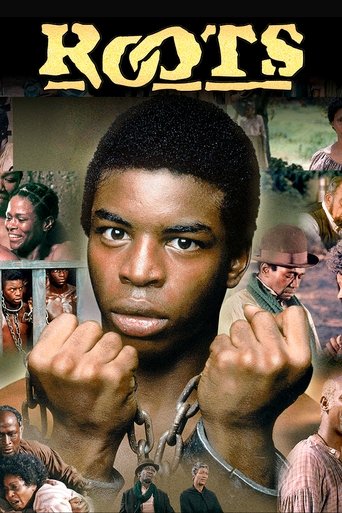
Roots
1977 · TV series · 90 min episodes · 1 season
Created by Alex Haley
The epic tale of celebrated Pulitzer-prize winning author Alex Haley's ancestors as portrayed in the acclaimed twelve hour mini-series Roots, was first told in his 1976 bestseller Roots: The Saga of an American Family. The docu-drama covers a period of history that begins in mid-1700s Gambia, West Africa and concludes during post-Civil War United States, over 100 years later. This 1977 miniseries eventually won 9 Emmy awards, a Golden Globe award, and a Peabody award, and still stands as the most watched miniseries in U.S. history.
3 positive7 neutralfrom 10 commenters
Where to watch
No streaming data for this title.
Videos commenters linked
From YouTube links in the comments below. Most are clips and trailers; “Full” means the uploader says so.



11 comments on Hacker News
The Playboy interviewer is Alex Haley, who conducted many notable interviews for Playboy magazine. He had another memorable interview with George Lincoln Rockwell, the leader of the American Nazi Party. Rockwell made sure Haley wasn't Jewish as they were arranging the interview, but was shocked to learn that the interviewer was black. He did seem to have a grudging admiration for Haley, as he continued corresponding with letters opening with "To my V.I.N." (N being the n-word).
Haley later went on to author many notable titles, including The Autobiography of Malcolm X (as ghost-writer) and Roots, which turned into a monumental TV series. Part of the show contains a reenactment of the meeting with Alex Haley and George Lincoln Rockwell, each played by James Earl Jones and Marlon Brando: https://www.youtube.com/watch?v=Z8SxzNdX1MQ
This is a key point that I worry is hard for modern users of the Internet to wrap their heads around:
In that era, TV channels were a tightly-regulated, very-rare resource, and as a result the information carried upon them rapidly diffused to everyone because there simply weren't that many alternatives to turn to for information. In terms of the attention economy, attention was relatively cheap if you could get onto the channel; you had a completely captive audience with few distractions if they were using television at all.
LeVar Burton once opined in an interview on NPR's Fresh Air that the most special thing about the miniseries Roots was that because of its timing, it's one of the last dramatizations on racism that more-or-less an entire generation of Americans experienced. Once cable brought the number of channels from dozens to hundreds (and HDTV later pushed it into the thousands), the cost to fixate a message in front of every household skyrocketed. There's more content than ever to experience, but the odds of any two people having experienced similar content have commensurately gone way down.
It's entirely possible that the era of the cultural touchstone is nearly over (though firms like Disney certainly make a go of it with 300-million-plus dollar movie investments).
> depict ... discrimination of protected groups or of individuals or groups based on protected characteristics
So like, if I purchase or rent various movies that depict racism, is Paypal going to fine me or amazon?
For example https://www.amazon.com/Roots-The-Complete-Miniseries/dp/B000SLTU02
This almost crosses over into "Old Man Yells At Cloud" territory, except the author is self-aware of how easy it is to become a simple complainer without peeling back the surface to understand how we got here. Credit to Ed Zitron for taking the extra step.
There was an excellent interview with LeVar Burton once (I can't remember where, it might have been on NPR's Fresh Air) where he talked about the significance of the TV miniseries Roots, in which he starred. One key thing he mentioned is that Roots was one of the last shows that one could credibly assume "everyone with a television saw at least some of it." Because it came out right on the cusp of the explosion of cable television into the mainstream market and HDTV after it. For a specific generation of Americans, Roots is a common touchstone exploration of the grim history of slavery in the US. Recreating something like Roots today (something with both the wide reach and willingness to shine light on ugliness of the story) would be almost impossible. When there were a half-dozen stations to tune in, a message on them was seen by "everybody" (because even if it made you feel uncomfortable, what were you going to do if you had rabbit years? Tune in the wiggly-lines nightly news? Turn the TV off?) But with dozens and then hundreds of stations, that is no longer true.
For all the complaint about consolidation of social networking, the Internet has had a massively-disintermediating effect on media (entertainment media in particular, but also news and technical; most people may get their basic facts from Wikipedia, but all other online sources of basic facts are exactly the same distance away from the consumer). It has become drastically harder, far more expensive, to get a message to everyone now. The "filter bubble" is the other side of the coin to the broadcaster's modern dilemma: if something actually is important, how do we get it in front of people?
> This one is truly outrageous - "depict"??? There goes 5/6 of human culture. I seriously doubt you can find much literature or cinema that doesn't "depict [...] hatred or discrimination of protected groups or individuals".
Of course the policy as written is outrageous, dumb, and silly even by clown world standards. You couldn't make Roots or many other thought-provoking works today with a proper reading of that policy.
However, the real goal of this policy probably isn't to dictate actual policy into stone tablets for the masses to follow. The real goal of the policy probably is to give PayPal carte-blanche to do whatever the hell they want to dictate culture and impact politics without getting sued.
If you become annoying or a political adversary of PayPal's management, they can find something to ban you and hurt you with.
If you technically violate the policy, but aren't their opposition, I'm sure you will be ignored.
A few more great books that beget great films:
* The Silence of the Lambs * The Shining * Shawshank Redemption (novella but I'll allow it) * Brokeback Mountain (same) * No Country for Old Men * Little Women (there are a few versions to choose from but I would choose the 1994 adaptation myself, thought he 2019 version was very good) * Requiem For a Dream * Lolita * Roots (mini-series but I think we should allow it)
That's what I can think of off the top of my head.
Roots in the 1970s (and The Thorn Birds afterwards) was notable for being a widely-viewed blockbuster miniseries, so the concept was there; without streaming, it was just hard to get an audience to watch every episode at the right time.
I remember the ham-fisted "The Day After" miniseries when I was in highschool. It was the biggest TV event since the miniseries "Roots" in the late 70's (watch that and you'll never look at "Reading Rainbow" or Geordi La Forge the same way again). It was a super cheesy depiction of nuclear war and the days that follow.
I was too young for the "duck and cover" drills of the 50's, but my generation (X) knew that global thermonuclear war (heh) had no chance of survival.
Toward the end of the 80's and early 90's, fear of nuclear war tapered off after The Wall came down. In fact, Sagan was harassed by the GOP and Right-wing pundits for claiming that if Saddam burned the oil fields, we would experience a nuclear-winter around the equator.
The 80's were nuts tho: Reagan & Gorby's nuclear standoff was pretty fucking insane in hindsight: mutually assured destruction is in the DNA of the modern right-wing movement.
Jeez, even Sting wrote a #1 hit about it in 1985 using a melodic theme by Prokofiev.
Those were the days?
- Teddy Wilson was mocking the "white genocide" conspiracy theory. He's also white.
- Dadito Calderone was making a joke about people who pretend to be concerned about crime in black neighborhoods when really they're trying to demonize black people as criminals.
- ka5sh, and possibly Brian Clevinger, is quoting the TV series Roots.
- Bobbie Oliver was talking about a movie in which a black man escapes slavery by killing his captors.
- Shay Stweart Bouley was sharing a story with an intentionally provocative title
- Tracy Bommeisha-Ann Clayton was ironically using a painfully exaggerated black accent.
- Yasser Lester is saying something similar to Nick Hanauer telling plutocrats to beware of pitchforks and torches.
None of these people were actually advocating for killing white people, nor or they making these jokes in a targeted way that would constitute bullying. Furthermore, many of these tweets are many years old, which indicates that they were found by scraping the bottom of the barrel.
FWIW I can easily imagine an angry, old white man calling a 30 year old white man 'boy'
Have you ever actually seen this?
Or, failing that, have you ever read the Alex Haley book "Roots"? or seen the television series based upon? There's an entire scene of protagonist Kunta Kente being whipped savagely as the slave master repeatedly asks "what's your name boy" to dehumanize him and strip him of his birthright and birth-given identity, changing his African name to a white, Anglo-Christian name.
I can't think of a better example than that of how that word came to be weaponized against an entire group of people to the point we have come to now.
"Boy" to black people (hi there, black person here) has a LOT of history of being blatant, unambiguous and pretty darn direct.
Although...
I suppose it's easier if one hasn't lived that life though to rest their laurels on what they "imagine" versus what people like me continually have to point out actually happens because we're the ones living through it.
Agreed, mainly because the period is so alien to many sub-40s Americans today. Also resonant: Islam, race, ugly American politics. It's an easy read, written by Alex Haley, who also wrote Roots. (Don't read the book (Roots) if you can find the more culturally significant mini-series. LeVar Burton was an icon in the US in the late 70s, well before he boarded the Enterprise.) The Spike Lee movie on Maclolm X is interesting, but a significantly different experience than reading the book.