 Hacker Cinema
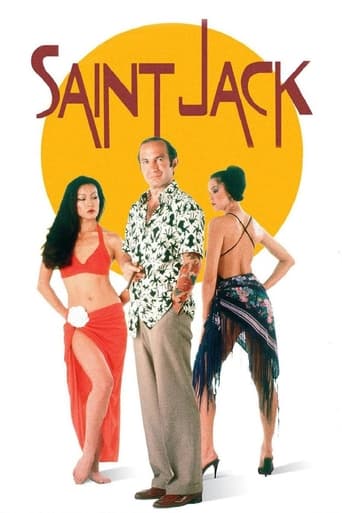
Saint Jack
1979 · Film · 115 min
Directed by Peter Bogdanovich
Jack Flowers is an American hustler trying to make his fortune in 1970s Singapore in small time pimping. His dreams of building a fortune by running a brothel himself and returning to the States is materialized when he is offered the opportunity by the CIA to run a brothel for the R&R activities of U.S. soldiers on leave in Singapore.
2 positive1 neutralfrom 3 commenters
Where to watch
No streaming data for this title.


4 comments on Hacker News
I object to your tone, and I don't understand why you're taking it with me, or wrongly assuming that I didn't see 'The Deer Hunter'; I did see it. I had heard rave reviews about 'The Deer Hunter' but as things happen, I only got around to seeing it ~15yrs after it was released. It was decent, De Niro and Cazale are standouts, but not as great as the accolades it had been showered with. I like most De Niro (Scorsese, Cimino, or other director), but for a slow-boiler character study of a man's descent into insanity, 'Taxi Driver' (or the little-known but superb Danish film trilogy 'Pusher' (1996-2004-2005)) are IMO far superior. Or maybe even Takeshi Kitano. As far as TDH goes, I think the last chapter suffers a break in coherence, and it doesn't advance the narrative to see De Niro unravel in slow-motion at the end. As far as anti-Vietnam war films go, Bogdanovich's 'Saint Jack' made the point more deftly; we don't necessarily need to see people literally blowing their brains out to get the point that they've been systematically dehumanized. Perhaps it's the Oscar hype machine rather than Cimino's directing that's responsible for the perpetual hype around 'The Deer Hunter', and the lack of hype around Nicolas Winding Refn. In any fair universe, foreign directors like Refn would have won an Oscar for his early work, regardless that it was in Danish; which is a Hollywood attitude that persisted until 'Parasite' (2019).
Be assured I've "watched old films" aplenty. (I referenced 'Alphaville' above, earlier; and the David Lynch 'Dune'. I was even gong to reference Tarkovsky). My comment wondering if Godard was ever considered to direct 'Dune' is obviously praise for his work.
Have you seen Pusher Trilogy? or Bogdanovich's 'Saint Jack'? How do you think they compare?
(Also, 'The Deer Hunter' running time is 3h3m, so the "you can't spend an hour just watching someone else's creation" misassumption is offbase for multiple reasons. Ask questions, rather than make wrong assumptions.)
Saint Jack is a favourite. https://en.wikipedia.org/wiki/Saint_Jack_(film)
You're going to have to be very specific about what you mean by "homogeneity" to tighten up this argument. Other comments farther down-thread precede mine in time, but I thought I would group some discussion of some of the disputed factual points here, because I agree with a thoughtful earlier comment that "This is a meme that should die, because it isn't based in any fact, but is mere speculation." Show the work if you want us to believe that this is a significant issue.
Looking at a list of countries by population,
http://en.wikipedia.org/wiki/List_of_countries_by_population
I am reminded that Sweden is the most populous Nordic country and that the Nordic countries rank about the same in the world rankings as Singapore, an amazingly multi-ethnic country.
It is hard to remember anymore that Singapore was a very, very poor country when it achieved independence (after being expelled from the Federation of Malaysia in 1965). Singapore was settled earliest by ethnic groups similar to those in current Malaysia, with a big influx of wretchedly poor agricultural laborers for plantation labor during the British colonial period. It was not expected in the pre-independence period (which extended into my lifetime) that Singapore would ever be prosperous. (You can watch a videotape of the movie Saint Jack, which was filmed in Singapore, for a reminder of the poverty in Singapore as recently as in the early 1970s.)
But the early leadership of independent Singapore strongly emphasized effective generally available primary education (without at first even making school attendance compulsory) and studied the best international examples of sound textbooks and effective teaching practice.
http://www.merga.net.au/documents/RP182006.pdf
School pupils in Singapore from my generation (born in the late 1950s) grew up in a country that was extremely poor (it's hard to remember that about Singapore, but until the 1970s Singapore was definitely part of the Third World). People from Singapore are so ethnically diverse that Singapore has four official languages from four different language families. All the school pupils were educated in a foreign language (the language of schooling in Singapore has long been English, but the home languages of most Singaporeans are south Chinese languages like my wife's native Hokkien or Austronesian languages like Malay or Indian languages like Tamil). Official surveys by the Singapore government
http://en.wikipedia.org/wiki/Demographics_of_Singapore#Languages
show that as recently as 1990, Singapore had no majority language among the various languages that people speak in their homes, and the plurality language category was category including more than one language, none of which are even one of the offical languages of Singapore. Yet young people growing in that generation, going to school in a language they generally didn't speak at home, received very thorough instruction in mathematics and science and other subjects.
Today Singapore is prosperous, and one set of projections suggests it is on track to be the richest country in the world on a per-capita basis by 2050.
http://globalpublicsquare.blogs.cnn.com/2012/08/15/singapore-worlds-richest-country-by-2050/
From the opinion piece kindly submitted here, which is by mathematician and popular author on mathematics John Allen Paulos:
"I’ve visited Singapore a few times in recent years and been impressed with its wealth and modernity. I was also quite aware of its world-leading programs in mathematics education and naturally noted that one of the candidates for president was Tony Tan, who has a Ph.D. in applied mathematics. Tan won the very close election and joined the government of Prime Minister Lee Hsien Loong, who also has a degree in mathematics."
Indeed, it is hard to remember anymore that Singapore was a very, very poor country when it achieved independence (after being expelled from the Federation of Malaysia in 1965). Singapore was settled earliest by ethnic groups similar to those in current Malaysia, with a big influx of wretchedly poor agricultural laborers for plantation labor during the British colonial period. It was not expected in the pre-independence period (which extended into my lifetime) that Singapore would ever be prosperous. (You can watch a videotape of the movie Saint Jack, which was filmed in Singapore, for a reminder of the poverty in Singapore as recently as in the early 1970s.)
But the early leadership of independent Singapore strongly emphasized effective generally available primary education (without at first even making school attendance compulsory) and studied the best international examples of sound textbooks and effective teaching practice.
http://www.merga.net.au/documents/RP182006.pdf
People from Singapore are so ethnically diverse that Singapore has four official languages from four different language families. School pupils in my generation (born in the late 1950s) grew up in a country that was extremely poor (it's hard to remember that about Singapore, but until the 1970s Singapore was definitely part of the Third World) and were educated in a foreign language (the language of schooling in Singapore has long been English, but the home languages of most Singaporeans are south Chinese languages like my wife's native Hokkien or Austronesian languages like Malay or Indian languages like Tamil) and yet received very thorough instruction in mathematics.
Today Singapore is prosperous, and one set of projections suggests it is on track to be the richest country in the world on a per-capita basis by 2050.
http://globalpublicsquare.blogs.cnn.com/2012/08/15/singapore-worlds-richest-country-by-2050/
Chapter 1: "International Student Achievement in Mathematics" from the TIMSS 2007 study of mathematics achievement in many different countries includes, in Exhibit 1.1 (pages 34 and 35)
http://pirls.bc.edu/timss2007/PDF/T07_M_IR_Chapter1.pdf
a chart of mathematics achievement levels in various countries. Although the United States is above the international average score among the countries surveyed, as we would expect from the level of economic development in the United States, the United States is well below the top country listed, which is Singapore. An average United States student is at the bottom quartile level for Singapore, or from another point of view, a top quartile student in the United States is only at the level of an average student in Singapore. I've been curious about mathematics education in Singapore ever since I heard of these results from an earlier TIMSS sample in the 1990s.
So regardless of whom we elect in the United States, why can't we be curious about what we can learn from other countries that have handled diverse language backgrounds of elementary pupils better than the United States has, and have enjoyed sustained, rapid economic growth for longer than the United States has?
ESPECIALLY NOTE THIS PART OF THE POST ABOUT MATHEMATICAL EDUCATION AND DEMOCRACY
Just yesterday, I learned from another Hacker News participant, one who grew up in one country and now lives and works in another, about the latest revision of the article "Word Problems in Russia and America"
http://www.de.ufpe.br/~toom/travel/sweden05/WP-SWEDEN-NEW.pdf
by Andrei Toom, a Russian mathematician who has lived in the United States and now teaches in Brazil. The document is long (98 pages) but well worth reading. Toom's conclusion is very striking.
"34. Conclusion
"Having read this article, somebody may think that I connect poor education with democracy. I do not. History connects them sometimes, at random as it seems. What I do think is that democracy has many aspects and free elections of political leaders is just one of them. Quality of education is not determined by quality of political structure and can deviate from it for better or worse. Let me illustrate this idea by two examples. There are 2354 problems in [Berez], a few dozens of which contain Soviet political propaganda.
"This is an example:
"Problem 59 How many years passed from the French burgeois revolution till the Great October socialist revolution if the former took place in 1789? (p. 17). [P: revolution]
"Here the political bias is evident, but from the mathematical point of view the problem is fair: the correct answer is arguably 1917 − 1789 = 128 . Soviet leaders wanted such problems to indoctrinate Soviet ideology along with teaching mathematics, but only half of their wishes came true: students learned mathematics, but got rid of the Soviet rule. Some rushed to the West taking jobs from those who were raised on problems like this:
"Problem 60 A national magazine surveyed teenagers to determine the number of hours of TV they watched each day. How many hours do you think the magazine reported? [St.1], p. 79. [P: TV]
"It may seem very human to use this problem in class: every student will be able to say something and nobody will be completely wrong, so nobody will be frustrated. But when these kids grow up, they will regret the years wasted on such shallow 'problems'."
To sum up, there isn't any necessary relationship between numeracy (which many, many people in Taiwan have because of very effective primary mathematics education there) and democracy and freedom (which the people of Taiwan won largely through peaceful protest movements even though their own former dictatorial government told them that they were culturally unsuited for free elections and a free press). I have followed the economic development and political liberalization of Taiwan closely since the 1970s, having lived there for six years of my life, and it is definitely empirically possible to have politicians who have strong math skills and win elections and to have genuinely free elections and deep protection of civil liberties. Why not the best? Why not seek all of the best features we can learn about from other countries for the country we live in?
AFTER THE LAST EDIT I STILL HAVE AVAILABLE:
Yes, I am speaking about both Singapore (the country mentioned in the submitted article that opened the thread) and Taiwan. Singapore is a good example of mathematics education, but a (relatively) bad example of democracy. Taiwan is a good example of mathematics education, another example of a poor country becoming prosperous by educating the masses, and also an ever improving example of democracy in a cultural context with a long history of tyranny. To sum up, improving mathematics education in the United States is a good idea, and several countries can provide good examples to the United States of how to do that. To the point of the submitted article, it would be good for voting behavior and legislation in the United States if the broader masses of the citizenry had better numeracy.
One other top-level comment made a very important point, the point I was thinking of making when I first read the title of the submitted article before reading its content.
"The largest punishment for those who are not interested in politics, is that they'll be governed by those who are."
Maybe the best solution would be to teach politics to scientists, and not the other way around?
One of my motivations for participating on Hacker News, where most participants are trained in technical subjects, rather than the foreign language (Chinese) undergraduate degree and law degree that I have, is that I think it is important for technically trained people to understand democratic politics and the representative legislative process better than most do. I try to do my part as a mathematics educator (my current occupation) to show Americans an alternative model of mathematics instruction, and I am gratified to have clients of all ethnicities from multiple countries who know that it is possible to do better in mathematics education than is done in America's public school system. I try to do my part here on HN to remind all our friends that politics is the art of compromise, and policy trade-offs have to be carefully considered and presented to stakeholders with persuasion rather than only with statements about what is correct. I enjoy the intellectual exchange here precisely because my years of living abroad and studying public policy sometimes give me something different from the consensus view to say here, and I correspondingly learn from people here who have a perspective besides that which I have gained from formal education and work experience. Let the scientists enter politics if they will, but let them do so with their eyes open.