 Hacker Cinema
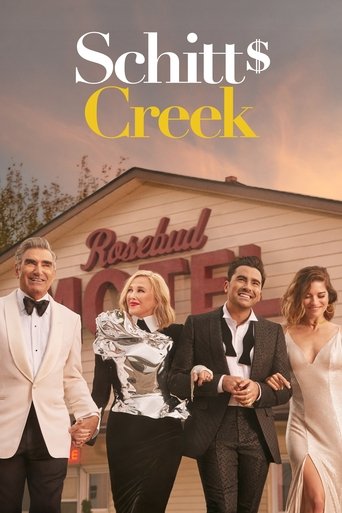
Schitt's Creek
2015 · TV series · 22 min episodes · 6 seasons
Created by Eugene Levy, Dan Levy
Formerly filthy rich video store magnate Johnny Rose, his soap star wife Moira, and their two kids, über-hipster son David and socialite daughter Alexis, suddenly find themselves broke and forced to live in Schitt's Creek, a small depressing town they once bought as a joke.
4 positive8 neutralfrom 12 commenters
Where to watch
No streaming data for this title.
Videos commenters linked
From YouTube links in the comments below. Most are clips and trailers; “Full” means the uploader says so.




12 comments on Hacker News
Parent comment was (I think), specifically talking about sitcoms from what I understood.
Sitcoms are - and I know this is a little condescending to point out - comedies contrived to exist in a particular situation: situation comedy → sitcom.
In the old day, the "situation" needed to be relatively relatable and static to allow drop-in viewers channel surfing, or the casual viewer the parent described.
Soap operas and other long-running drama series are built differently: they are meant to have long story arcs that keep people engaged in content over many weeks, months or years. There are throwbacks to old storylines, there are twists and turns to keep you watching, and if you miss an episode you get lost, so you don't ever miss an episode - or the soap adverts within them, their reason for being for which they are named - in case you are now behind with everything.
You'll find sports networks try to build the story arc around games too - create a sense of "missing out" if you don't watch the big game live.
I think the general point is that in the stream subscription era, everything has become like this "don't miss out" form, by doubling down on the need to see everything from the beginning and become a completist.
You can't easily have a comedy show like Cheers or Married... With Children, in 2026, because there's nothing to keep you in the "next episode" loop in the structure, so you end up with comedies with long-running arcs like Schitt's Creek.
The last set of sitcoms that were immune to this were probably of the Brooklyn 99, Cougartown and Modern Family era - there were in-jokes for the devotees, but you could pick up an episode easily mid-series and just dive in and not be totally lost.
Interesting exception: Tim Allen has managed to get recommissioned with an old style format a couple of times, but he's had to make sure he's skewing to an older audience (read: it's a story of Republican guys who love hunting), for any of it to make sense to TV execs.
I assume you mean it's not really worth watching if it's currently on broadcast TV?
Surely there's a huge list of old broadcast TV network shows that are worth watching, and that still suffer from the ad-break problem to various degrees.
Obviously I'm pulling from a wide time-period, and I'll probably get some of these wrong because I'm not in the the US and don't quite grok the network/cable divide, but off the top of my head, I think these are/were all worth watching: Seinfeld, Buffy the Vampire Slayer, Freaks and Geeks, Arrested Development, 30 Rock, Community, Schitt's Creek, The Office, The X-Files, various Star Trek series, Cheers
That list could be easily improved on, but I assume it's missing your point anyway if you were only talking about current broadcast network TV (if it exists :) )
"Any portrayal of a husband" on TV?
Comedies often have some mockery built in, and comedies aimed at kids in particular like to take shots at authority, but there are a lot of examples I can think of in just the general-TV-millenial-vibe-y things I've watched over the past couple of decades. More than the "bumbling dad" type, I'd say, from things I've seen in the zeitgeist (I guess one recent super typical example is Rick and Morty, though everyone sucks there):
* Arrested Development: Michael is the most competent of the bunch. His father was also quite competent, if an asshole and eventual criminal. But, you know, that put the "sit" in sitcom...
* Luke from Gilmore Girls is pretty consistently more sane than Lorelai, turns out to be a good dad too IIRC; other fathers include a loser and a number of very successful businessmen, teachers, etc.
* King of the Hill: doing his best, often the most sane of the bunch
* Bob's Burgers: haven't watched a ton of this but from what I've seen Bob is a goofball but respectable and wholesome, kinda a Hank Hill. Not a lazy Homer
* Parks and Rec: Ben Wyatt is a pretty positive character
* Brooklyn 99: Terry is practically a superman of competence and seems to hold is own with his wife and kids. Holt is a supremely competent husband. Boyle is a goofball generally and in dating, but that does not really extend to his eventual marriage and child, where he seems to be doing quite well.
* Schitt's Creek: Johnny is the competent center of the family surrounded by comically exaggerated crazy wife + kids
Dramas seem even further away. Where do Breaking Bad or the Sopranos land?
It’s absolutely possible to have LGBTQ (main) character and plot lines while totally avoiding all political/ideological themes. Schitt's Creek (TV Series 2015‑2020) is a fantastic example.
> shows are mostly watched within a year of its original air date.
This depends a lot on what else is available. One of the most successful shows on netflix this past year was Suits, a show that was released 12 years ago. Even before the strike old shows do very well on streaming services. Schitt's Creek gained huge popularity two years after it's original air date.
> So much choice that there isn’t any specific shows that people watch because everyone else is watching and will talk about it on Monday during lunch (a la Game of Thrones)
That's why streaming services have started to withhold episodes and only allow you see one episode a week. They want to control who is watching what and when. When people can watch whatever they want to on their own schedule they might not get around to shows immediately and advertisers don't like that. It also makes it harder to control the conversation on social media.
The Tick was canceled after it didn't get enough views just 6 weeks after release, but as you said, there is so much to watch right now, and so much else besides TV competing for our time, that those kinds of metrics are meaningless.
It'd be better for netflix to make sure their library is filled with quality and to have confidence that audiences will find those shows on their own time than to worry about how many people are watching the newest thing immediately and cancel anything that doesn't show immediate success.
One thing I've noticed about my watching habits is that I won't put on a super intense, prestige TV show after work usually (maybe if it's Barry, damn, Barry is so good). Instead I'll watch something lighter or more repetitive like House MD or Schitt's Creek. Now k-dramas are not quite old school network television, but they're certainly more of a palatable affair than your average Showtime or HBO show. I wouldn't be surprised if Netflix realized that for every marquee top tier Emmy winning show, there's hundreds of people just turning on something to watch in the background that is familiar but slightly different.
Really, this isn't a new discovery. Soaps have existed since before television. But it is interesting how instead of one long-lived show, it's now a multitude of similar but different shows.
> contractors can write off the expense
there's an opportunity cost for that expense. it reminds of this episode of Schitt's Creek - https://www.youtube.com/watch?v=hg1Uk60rBsc.
You are misrepresenting those definitions a bit. Or they are poorly written.
Showrunner is a thing, TV projects have them. They are the 'nexus' - both creative and a bit operational of the show. Like the 'founder' and 'visionary' of the show. They also kind of 'make the show happen'.
Dan Levy is the 'Showrunner' for Schitt's Creek.
Just type the name of your favorite TV show along with 'showrunner' and you'll see who it is.
Usually will be 'creator' and 'writer'. They will probably get a producer credit. Note that 'showrunner' is generally not a specific kind of 'credit' but that a feature 'credit' isn't really a title either. 'Exec. Producer' can mean anything. Or nothing.
The 'director' in TV is generally less important.
For film, usually the Director kind of plays that role as the lead visionary, especially if they pitched and raised the money, got the team together, got the actors to sign up etc..
Producers are generally not directly creative visionaries.
Maybe it isn't a ponzi scheme (I'm no expert) but even after looking up all the acronyms (and maybe especially after looking them up) this sounds like an episode of Schitt's Creek.
But let me try to actually understand.
You provide liquidity to a pool in exchange for a token and accumulate trading fees, while maintaining ownership of your capital.
Ok, first of all this sounds like a bank. But it's decentralized? So what happens when someone has a majority of governance tokens on your DEX?
> but they just don't want to keep them around for long if they think they are not working, because unlimited airtime does not mean unlimited funds.
This makes sense in the abstract, but watching season 1 of the The Office (US) suggests that if NBC had the same view, we wouldn't have one of the most popular long-term binge-watch shows, for which streaming services are paying $500mm now.
As the article mentions, Schitt's Creek apparently had a low-rated first season, but since the execs in charge didn't have the mindset you describe above, it survived long enough to become the award-winning more popular show it is now.
Netflix may not be doing anything wrong here, but if they're not careful, it may bite them hard in a few years as their reputation continues to grow.
A lot of the shows they've cancelled just weren't that good, even the ones I watched.
They hold up 3 shows as an example, Stranger Things, Game of Thrones and Schitt's Creek. The first two were smash hits after season 1. Schitt's Creek was a really good show from the start but it wasn't well known until later seasons. It didn't "hit it's stride" it built up it's audience over time. The quality was always there.
The shows Netflix is cancelling aren't even close in quality.
Canada's national broadcaster (the CBC) is funded out of general tax revenue, which I appreciate. Extremists on both sides complain that it leans too far the other way, which is probably a good sign overall. Certainly the CBC coverage pulls no punches when discussing our famous Liberal government scandals.
Other than as a news organization, another part of why it exists is to purchase and stimulate the developments of home-grown content (Little Mosque on the Praire, Schitt's Creek, Kim's Convenience, etc). For this reason, it has sometimes raised eyebrows in the past when it has purchased licenses to air mainstream Hollywood films, especially if doing so competes against private broadcasters like CTV.