 Hacker Cinema
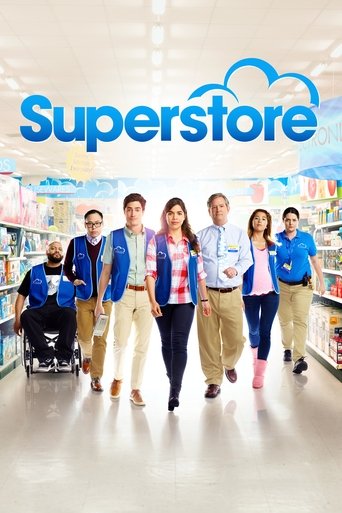
Superstore
2015 · TV series · 6 seasons
Created by Justin Spitzer
A hilarious workplace comedy about a unique family of employees at a super-sized mega store. From the bright-eyed newbies and the seen-it-all veterans to the clueless summer hires and the in-it-for-life managers, together they hilariously tackle the day-to-day grind of rabid bargain hunters, riot-causing sales and nap-worthy training sessions.
4 positive5 neutralfrom 9 commenters
Where to watch
No streaming data for this title.


9 comments on Hacker News
Not a bad thing necessarily, but some part of the plot, and usually with things going awry or emphasizing the scammy nature of blockchain.
Examples: Shameless season 11, The Simpsons S31E13, Superstore season 5, the good wife S3E13, greys anatomy S14E8, big bang theory S11E9, Billions season 5, some later seasons of Mr Robot, etc
If you like those sitcoms then you would probably like stuff on Hulu: Animal Control, Abbot Elementary, Superstore, Only Murders, etc. You can also rewatch Always Sunny, ER, and a bunch more. (Oh and "Dave" which is new and brilliant).
HBO's entire catalog is full of bangers, many of which I still haven't seen yet.
TLDR: Discusses how popular TV shows of the '90s like "Friends," "Seinfeld," and "Cheers" portrayed characters spending most of their time hanging out at cafes, diners, and bars. These shows depicted work as an afterthought or a joke, with the characters prioritizing their social lives and relationships. In contrast, modern shows like "Succession," "Superstore," and "Industry" emphasize work as all-consuming, leaving little room for personal connections outside of work. The article suggests that the decline of places for people to socialize, such as bars and parks, has contributed to the loneliness epidemic. It argues that shows like "Friends" and "Seinfeld" provide a cure for loneliness by depicting characters who prioritize social interactions and spending time with friends.
Also covers a study conducted by the Canadian design firm Happy Cities in Seattle called "the lost-tourist experiment." The study involved an actor pretending to be lost on two different street corners, one with a blank wall and one with shops and cafés. The results showed that people were four times more likely to stop and offer help on the street with shops compared to the street with the wall. The article highlights the importance of having more things to do in a community to encourage interaction and engagement among people
No need for you to bashing netflix if you don't like their content.
Its $10 per month, 2 coffees.
I also do watch a lot of tv shows and movies for the last 15/20 years (also stuff besides mainstream) and there are pretty good tv shows on netflix. Stranger Things, The Umbrella Academy, Better Call Saul, Russian Doll, Love Death and Robots (the last season was weirder than usual though), Space force (super quirky, love it!), The Witcher, Arcane, Superstore, Squid Game
I either watch a netflix series that I've seen multiple times before (Office/Parks & Rec/Superstore/Arrested Development) or read a book series I've read before (flip flopping between Harry Potter and the Discworld series). They're not boring, but they don't stimulate me as much, and if I miss a chapter, or a half an episode, so be it.
> but I can't just close the book and forget about it.
When I'm reading for sleep, It's closer to reading to the point of dropping the book rather than closing it and deciding to go to sleep fwiw!
Pretty sure this was lifted from an episode of “Superstore”.
https://en.m.wikipedia.org/wiki/Superstore_(TV_series)
This is a very wrong understanding over how unions work these days.
Union "bosses" don't control raises, promotions, or hours, and haven't for several decades. Union bosses simply don't have the power they used to have (and for some reason, are still portrayed as having in TV or movies). The Irishman, for example, is based on a decades-old perception of union bosses that was only ever true of the NY-based unions...decades ago.
"Superstore" on NBC is actually a pretty accurate portrayal of how unions work in real life: pretty mundane, and not all that different from being non-unionized.
> Presumably, for lower budget movies, direct to streaming becomes more common although it's hard to say what that means in terms of what works economically.
Lower-budget productions, in general, are increasingly being produced as cable or streaming TV shows instead of movies nowadays.
Vox even did an article on the phenomenon the other day, pointing out that it's resulted in a number of shows being poorly-paced because they were originally written to be movies before they were padded out to be TV shows: https://www.vox.com/culture/2019/6/19/18660602/tv-streaming-long-chernobyl-superstore
I was watching a sitcom called Superstore a little while ago, features the employees in a Wal-Mart like store, and the protagonist got a promotion to the head of the store. There was a whole plot line about how her wage was now in the 6 figures, and I was incredulous until I did a bit of research - Wal-Mart store managers can absolutely make that much money while their employees live in poverty.
How you could make that much and expect loyalty and sacrifice from your staff who make a fraction of that, I won't ever know.