 Hacker Cinema
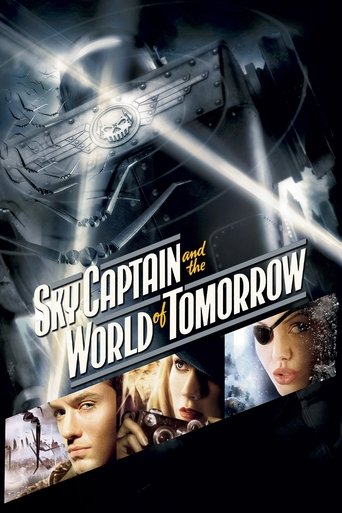
Sky Captain and the World of Tomorrow
2004 · Film · 107 min
Directed by Kerry Conran
When gigantic robots attack New York City, "Sky Captain" uses his private air force to fight them off. His ex-girlfriend, reporter Polly Perkins, has been investigating the recent disappearance of prominent scientists. Suspecting a link between the global robot attacks and missing men, Sky Captain and Polly decide to work together. They fly to the Himalayas in pursuit of the mysterious Dr. Totenkopf, the mastermind behind the robots.
3 negative3 neutralfrom 6 commenters
Where to watch
No streaming data for this title.



8 comments on Hacker News
I remember the Argus C3!
Lesson: Technology moves ahead and certainly did for photography! We have gone through several steps of astounding.
In the 9th grade, to take pictures and be more popular, I wanted a camera. So I went shopping, saw expensive Leica cameras, etc. Then I saw an Argus C3 -- I had a shot at saving enough lunch money for that. So, I started saving. My parents happened to see my savings and asked what I was doing. Dad was nice, chipped in some more, and returned from work with a good Argus C3 collection, including a light meter, carrying case, flash, etc. He had bought all that at a good discount at the US Navy base where he worked.
Mom was the secretary at a church so knew a lot of people in the congregation including one, a sports photographer for a local newspaper. Hearing about my interest in photography, he volunteered to take me on a photo shoot!
So we went to the next basketball game of my school. We decided not to use flash but just to use available light where in the dark room he would push the film, Kodak Tri-X, to a higher ISO speed than the default 400.
So, at the game I exposed a full roll of the film. Then in the dark room of the newspaper, he pushed the film to ISO 1600 or some such, and we made some 8 x 10" prints.
The prints were good! For printing, he cropped the images to make more interesting composition.
The next school day, I took the prints with me, and, yup, instantly I, or at least the prints, was popular!
For developing I got a little unit that worked without a darkroom, that is, worked in a room with normal lighting.
To help me make a darkroom, dark enough for printing if not for developing, out of the bathroom, Dad put some shutters on the outside of the window. Someone gave me an old enlarger.
Alas, the enlarger was for 4 x 5" Speed Graphic camera film. So, to enlarge a 35 mm negative from the Argus C3 to an 8 x 10" print, I would have had to have put the photo paper on the floor with the enlarger head maybe 10' higher!
Basically soon I found that developing and printing 8 x 10" images was for me in the 9th grade with associated meager financial resources, in short, too expensive.
So, I retreated to Kodak Kodachrome color film and color slides!
But with a little more money, working with black and white 35 mm film and that Argus camera could be not wildly expensive, easy to do, with some nice results, and a lot of fun.
About then I had a girlfriend, the prettiest human female I ever saw, in person or otherwise. We went outside where she leaned back against a tree trying to look pretty -- she was very successful -- and I exposed the roll!
Alas, eventually in moving, off to college, etc. I lost those color slides and the whole Argus C3 collection.
The Argus C3 was the main prop in the fun, curious, heavily CGI (computer generated images) movie Sky Captain and the World of Tomorrow with, e.g., Gwyneth Paltrow carrying around the Argus!
Later when my career was going well, my wife had a girl friend who visited us and brought a Nikon SLR (single lens reflex) camera. I was hooked! Soon my boss at work was taking a trip to Japan, and I paid him enough to bring back a nice collection of Nikon camera equipment. These items I did NOT lose and still have! The lenses, the whole collection, are astounding!
There is a lesson: Actually, in usual practice, the Nikon equipment is not as much better than the Argus equipment as might be guessed: Some wide angle, telephoto, macro, f1.2 lens, although gorgeous optics, just is not much more useful than the f3.5 lens and the rest of the Argus. For the Argus, just don't try to take pictures in nearly impossible conditions and, instead, stay closer to ordinary pictures with ordinary light.
The Nikon equipment is still useful: Just have the film developed to a CD (compact disk) of JPG (joint photographic experts group) files!
But technology moves ahead: Glancing at the description of the iPhone 12 Pro Max, it's back to astounding-land again. It's unfair to call its photo capabilities those of just a camera.
So in ~100 years we have had several levels of astounding, Kodak Brownie, Speed Graphic, Leica, Argus, Nikon, SLRs with electronic sensors, smartphones, soon the iPhone 12 Pro Max, and maybe in other form factors much more.
Since now we are in line for billions of people with very capable little shirt pocket cameras, movie cameras, CGI and editing capabilities, etc., we should see a river, no, rapidly flowing oceans, of content, the best of it well into astounding-land.
When electronics started growing in importance, some people expected a lot, but did anyone really expect what we have now?
(1) Britain will exit from the EU, and there will be more such exits.
(2) The major countries will make big and somewhat successful efforts to increase the birth rates.
(3) Internet content, especially video, will grow quickly in volume and variety with a lot of quite high quality.
(4) The one size fits all mainstream media will change or shrink, likely shrink, as new media with great variety will explode.
(5) Small team, inexpensive, but innovative, entertaining, and often quite popular video story telling will grow quickly. The better funded effort will make a lot of use of computer generated images, e.g., extrapolation of and big steps up from the movie Sky Captain and the World of Tomorrow.
(6) Trump will win in 2020, dominate the Republican party, and do at least some good recruiting promising players for the future. Also in 2020 the Trump Republicans will win the House. Due to the Republican victories, the Democrat party will be lost wandering in a desert at least for Trump's second term. But then some Democrats will get serious and rebuild the party. By 2030 we will have two strong political parties both going for the center of the road voters. Some of the news media, on the Internet, will report the news objectively and with considerable depth and, thus, greatly help US government.
(7) We will have some big surprises in astrophysics.
(8) We will have some big surprises in exploration of our solar system, especially asteroids.
(9) We will have some big surprises in progress in curing diseases, maybe even mostly cure cancer.
(10) The economists, the Fed, etc. are getting enough understanding of how to get full employment, rapid growth, low interest rates, and low taxes. The growth in the economy will will reach a level which pays off the national debt quickly.
(11) Home schooling via high quality materials on the Internet, as Web pages, PDF files, and video clips will grow quickly as will corresponding testing and certification. Tens of thousands of families will have their 12 year old children through current college STEM field materials. Generally the Internet will do much better in instruction for skills, crafts, professional development, etc.
(12) The US will start deploying nukes for electric power again, sometimes for the grid and other times, with small nukes, for just local housing or plants.
(13) A major fraction of Internet traffic will go via satellite, especially in poor or sparsely populated areas.
(14) There will be at least one moon base with humans there for months at a time.
(15) The James Web telescope will yield astounding results.
(16) The Mideast oil states will grow quickly in sophistication and development.
(17) Supersonic passenger planes will return.
(18) Automobile manufacturing will be much more highly automated with some cars with prices under $10,000.
(19) The Internet will enable significant flows from the most crowded areas to less crowded.
(20) There will be a lot of one day and same day deliveries for consumer shopping, including for refrigerated and frozen items.
(21) There will be a lot of retail selling direct from the factory, in the US or other countries. So, some item that costs $10 now may sell for $2 -- generally prices will fall. I.e., quite broadly the middleman will get disintermediated.
(22) New house will get a lot cheaper: (A) The move to rural land will lower the costs of lots. Such lots will use water wells and septic systems and, thus, lower costs of utilities. Internet access can be via satellite and, thus, from anywhere, e.g., some house in the woods, a boat on a lake, a cabin on a mountain top. Houses can be manufactured and just delivered to a site and be ready to move in in two days or so. Otherwise, there will be larger manufactured components for just Lego style plug together houses.
(23) Medical research will make good or better progress in control of obesity.
(24) Warehousing will become nearly fully automated.
(25) Automation in manufacturing will expand rapidly.
(26) New materials, e.g., carbon fiber, Kevlar, plastics, adhesives, etc. will grow quickly for cars, buildings, etc.
(27) There will be much more fossil fuel extraction from the continental shelves of the continents, especially in Asia.
(28) Solar power with batteries and fossil fueled backup generators will become much more popular due to more rural housing that, finally, needs no connections for electric power, telephone, Internet, water, sewer, or anything else, thus greatly lowering the costs of rural housing. Such rural housing will also drive more home schooling based on the Internet. Small communities, of say, a dozen homes on some 100 acres of land will grow up and maybe have their own small nuke for electric power, including for home HVAC.
(29) Generally cost of living will go down significantly due to some of the above -- buying direct from factories, much cheaper housing, cheaper cars, more automated manufacturing, due to home schooling, no more school taxes and, thus, much cheaper local taxes, due to rural living, much less in government services, e.g., snow plowing, traffic lights, road and sewer construction, and, thus, much lower taxes.
(30) Due to (29), etc., a much higher birth rate.
(31) Due to the information via the Internet, much better informed voters and much better politics and government.
(32) Also heavily due to the Internet, much cheaper alternatives to traditional college.
(33) The US will solidly stop the flows of illegal drugs into the US, and Mexico will make a lot of progress recovering from a narco state.
(34) The US will make good progress toward astoundingly capable unmanned jet fighter planes.
(35) CRISPR techniques will make astounding progress in plant and animal breeding.
(36) Generally a lot of prices will get pushed down due to lower prices for oil and natural gas from fracking, continental shelf drilling, and ANWR drilling, higher agricultural productivity from better seeds, feeds, equipment, and computer based information, more automation in manufacturing, direct selling from factories to end users, more efficient order processing, warehousing, and shipping, generally more computing and automation. But the low interest rates are causing lots of capital investment, low unemployment, and higher wages. Higher interest rates would risk depression from prices falling from the improved efficiencies and higher unemployment; so interest rates need to stay low to avoid recession due to falling prices.
Monsters (https://en.wikipedia.org/wiki/Monsters_(2010_film)) is my response to that. The problem with "Sky Captain and the World of Tomorrow" wasn't that it was low budget, it was that it decided part-way through to become (relatively) high-budget. A carefully constructed film with $500,000 budget made $4.2 million back on good, but limited, effects. The problem is Hollywood's approach; instead of making a handful of single-A movies, it's all either B movies or AAA.
Video games were (?) having the same problem, so-called "indie" developers have largely stepped in to make single A-quality titles.
> "Sky Captain and the World of Tomorrow" started as a low-budget picture rendered on Macs. In that film, if nobody touches it, it's CG. Ended up costing $70 million. Worldwide box office $50 million. Fail. "Iron Sky" was made for €7.5 million. Worldwide box office $11.5 million. Fail.
I know very little about the film industry, but is the box office the end of it? I was presuming that there was always some kind of long tail of modest cash flow from stuff like video rentals (days of yore) or online streaming services (present day). Is this a wrong assumption?
Production cost is a problem, and technology has made it worse. Look at that long, long list of animators and technicians at the end of any effects-heavy film today. A cast of thousands.
In the late 1990s, when I was working on physics engines for animation, I was talking to a major Hollywood director. He'd done some of the first films that had both live and photorealistic CGI characters. He wanted to get the cost down, so he could make $20 million movies. At $20 million, he could direct; at $100 million, he was running a huge operation that had to have everything pre-planned in great detail.
His model was the early CGI cartoon, "Reboot". Reboot was a weekly half hour cartoon made by a staff of about 30. He wanted to get to that level of productivity at theater quality - make a 2 hour film in a month with 30 people.
That didn't happen. Not even close.
It's been tried. "Sky Captain and the World of Tomorrow" started as a low-budget picture rendered on Macs. In that film, if nobody touches it, it's CG. Ended up costing $70 million. Worldwide box office $50 million. Fail. "Iron Sky" was made for €7.5 million. Worldwide box office $11.5 million. Fail.
There were successful low budget directors in the past, Roger Corman being the prime example. (His autobiography is titled "How I made a hundred movies in Hollywood and never lost a dime".) It's harder to do that today. Viewers today expect incredible production value. Most TV shows have more production value today than 70s movies did. Hollywood has so many people on set because they bring a team together on short notice to do a job, then disband the team. They need many competent people with different skills to make that work. If you cut corners, it looks like Youtube crap.
On big movies, we've mostly replaced set painters and carpenters with people who sit at workstations and do the same job with CG models. "Big" is now cheap, but "detailed" remains expensive. Procedural visual content generation can generate good landscapes and vegetation now (check out SpeedTree), but as yet, nobody has been able to procedurally generate one convincing block of a city street seen at ground level. Making GTA V cost $265 million. Not seeing an incoming reduction in production cost.
Netflix has no huge advantage. HBO is in the same position - they make content to sell to their own customers, and know exactly what sold. Data collection is retrospective. Trying to figure out what movies will be box office failures in advance remains hard. That's why Hollywood generates so many sequels - predictability.
Movies really are full of falsehoods big and small. Scenes showing car interiors usually involve matte effects so that they don't actually have to drive the car in natural light settings. Fight scenes are dance choreography with foley "thwack" sounds. Daytime scenes are shot at dawn or dusk, where the lighting is most forgiving. Nighttime scenes are shot with ample additional lighting so that the actors show clearly. Dialogue is unnatural and written around plot conveniences according to the strict "three-act" structure. Scenes containing dialogue are typically composed of dozens of different cuts, with long takes and ensemble performances being the exceptional cases. Characters walk through doors that are apparently part of the same location, but are actually completely different sets.
And that's describing movies as they were made 40 years ago, before Star Wars renewed film's direction towards pure spectacle. Since "Sky Captain and the World of Tomorrow" it's been possible to make a production that is essentially a live-action cartoon, with actors and a few props superimposed on an otherwise fully CGI world. This is the route that every new blockbuster movie has taken. Even the shots in "Fury Road", which are based on a lot of real vehicles and people doing real stuntwork, have undergone a massive amount of post-processing.
Also worth noting is that the particular ways in which "realistic" things are represented change over time as our understanding of the world shifts: Films depicting war scenes in the 50's or 60's might use WWII or Korean War footage as the inspiration, with large units rappelling or parachuting in, adopting a slightly hunched stance and shooting bursts from the hip to liberate(or oppress) a place or people. Films after the Vietnam war are more likely to focus on small groups engaged in wilderness survival, maintaining communications or finding hidden enemies. The two types of film use different effects and foley, and that isn't purely a matter of budget or technology! The whole aesthetic changed, in a more complex way, to reflect the new design goals.
When you watch films that are very low budget and keep things simple, they tend to look ordinary, because they don't have all this production gloss put on top; their falsehoods, where they show up, are more the ones inherent to film and to storytelling, and not visibly designed effects.
In the 1990s, when I was working on animation software, I was told something like that by a major Hollywood director. He'd directed some of the early films that had both animation and live acting. The costs were high. What he really wanted was to get the overhead down, so he could make first-rate films for about $20M.
At the time, "Reboot", the first all 3D cartoon, was being cranked out at one episode per week by 30 people. He was hoping the technology would let him produce feature films with a similar sized staff. The idea was to pull in set models from a "digital back lot", green-screen in the actors, and go.
The technology didn't deliver that. Instead of a cast of thousands of actors, we now need thousands of animators. Look at the credits for any action movie today. There's just too much custom modeling, artwork, move matching, and manual editing of the edges of clipping paths. (The last two are outsourced grunt work and likely to be automated soon.) Viewers wanted photorealism, and that requires as much detail work as set-building.
People have tried to do CG action features on the cheap. "Sky Captain and the World of Tomorrow" was supposed to be one. But that cost $70 million, and only made $54 million. (The semi-noir look didn't help. Done better, it might have been a franchise like Captain America.) Iron Sky (budget $10M, box office $8.1M) almost a decade later had much better effects; the CG isn't as obvious.
Other than low-budget horror features, most notably "Paranormal Activity", there haven't been many successful low-budget action movies in recent years.
Google "Kerry Conran"
He spent a few years working on his computer making a short film to please himself. The short earned him a big budget ($40 million) to develop a feature film based on his story and ideas. The project, Sky Captain and the World of Tomorrow, starred Gwyneth Paltrow and Jude Law and was directed by Conran.