 Hacker Cinema
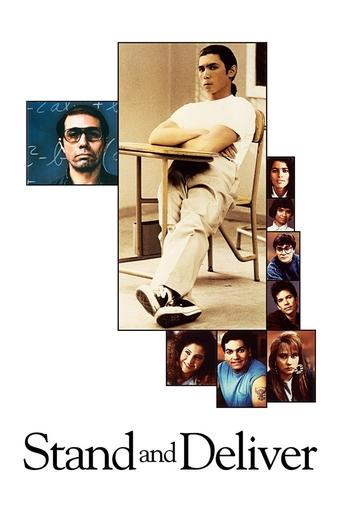
Stand and Deliver
1988 · Film · 103 min
Directed by Ramón Menéndez
Jaime Escalante is a mathematics teacher in a school in a hispanic neighbourhood. Convinced that his students have potential, he adopts unconventional teaching methods to try and turn gang members and no-hopers into some of the country's top algebra and calculus students.
8 positive6 neutralfrom 14 commenters
Where to watch
No streaming data for this title.





15 comments on Hacker News
> But this is an issue with any identification problem, there are false positives and false negatives. If we have a bunch of laws mistakes will be made.
So be cautious when adding yet another imperfect system onto all of the rest. Especially one with such disparate weightings attached to it.
> It seems to be pretty confused about how kids get their political opinions.
It's not confused. Most children get their political opinions based on:
A) Whether or not they felt they had supportive parents.
B) What they think their parent's political opinions are.
It is thus up to parents to both be supportive of their children, and to affirmatively communicate to their children what their political opinions are. If this happens much more than 70% of children will mimic their parents' politics.
> This is part of skin-in-the-game, right?
It's not your skin in the game, it's your children's skin in the game. Some persons do indeed see people as cliques and tribes, which have interests in lock-step, and believe it is just to have them vote in sync. But I believe that most people are more nuanced.
> For instance how will you form an opinion about whether schools are well run?
You made the mistake of triggering one of my hobby-horses. :D
The way I do this is by knowing what policies helped and hindered me, my spouse, and our siblings while going through school. And then reading the policies promulgated by those running for office (especially of the local school board), and of the school proposals submitted to the voting population as initiatives or referendums. And reading criticisms by teachers, parents, students, other politicians, etcetera. And then weighing all of this data to determine what I think is best, for students like me, my spouse, and our siblings.
Let's say that all of your kids are still in primary school. How are you, as a parent, supposed to form an opinion about whether the secondary schools are well run? How are you supposed to form an opinion based solely on your own kids? Kids are not identical. My wife thrived in a particular pre-school, while her brother later said he thought it wasn't good for him. The schooling choices you make for the eldest of your kids may turn out to be bad decisions for your younger kids. Now factor in that your kids are only a tiny proportion of the school-attending population.
I, at least, have spent a couple of decades researching these schooling subjects. I've watched documentaries on it (specifically Waiting for Superman, and Hoop Dreams). I've seen the movies Stand and Deliver and The Prime of Miss Jean Brodie. I know a bit about the differences between schooling in Scotland, England, Australia, and my home country the USA. I've read Miraca Gross's books on gifted education. I've read John Taylor Gatto's critiques of the education system for regular kids. You're telling me that with all of my knowledge my political power should be much less than your own?
You gain knowledge I cannot by dint of having your kids in the system. I have knowledge that you do not by dint of having gone through a system, as well as having done my own research. Let us both have an equal vote. If you don't like how I vote you can always home school your kids, or send them to a private school (or "public" as they call them in England).
This story reminds me of the man behind the movie "Stand and Deliver" (1988), Jaime Escalante, who in the 80's made his school famous for generating students that passed the Advanced Placement Calculus exams.
https://en.wikipedia.org/wiki/Jaime_Escalante
1982 - 18 students passed, but by 1991 "the number of Garfield students taking advanced placement examinations in math and other subjects jumped to 570".
I like it when teachers teach far and beyond the boring old curriculum and inspire kids far beyond what they thought capable of themselves.
The worst thing about the CMF effort is that it would only deepen the disparities between rich and poor. Public education is often the only shot poor kids have to gain knowledge and skills that might propel them into STEM fields.
Do we need to mail copies of Stand and Deliver to the entire California school board? Or am I the only one that recalls that movie... based on something that actually happened... in California.
https://en.wikipedia.org/wiki/Jaime_Escalante
Hacker Culture, to me atleast is somewhat broad.
Here are some places where I found good representations:
1. Halt and Catch Fire: 70s/80s tech scene. Full stack hackers building products, companies. Depicts the hackers, code monkeys, visionary types, managers, financers- everyone. Also shows the transition of the business scene from analog to digital.
2. Westworld (Season 1 only) is brilliant. It depicts the ambition, the hubris involved in creating something new and grand.
3. The Travelling Salesman: P vs NP is solved. What are the implications, what are the uses, how will the State react? What is the role of the people imvolved?
4. Primer: Mind bending movie on time machine.
5. and 6. Imitation Game and A Beautiful Mind: I believe most people on HN will like these.
7. Agora is a hidden gem not many know about. It is anout Hypatia.
8. Dangerous Knowledge is a documentary about paradigm changing science. Godel, Turing, Boltzmann are covered.
9. Fractals is also a nice documentary with interviews from Mendelbrot.
10. Codebreaker is a mich more accurate biography of Turing that covers other aspects of his, not limited to his codebreaking and homosexuality.
11. Internet's Own Boy: The Story of Aaron Swartz: very nice and left a deep impression in me.
____
I am yet to watch:
1. Hidden Figures
2. Stand and Deliver
3. I'm In
4. TPB: AFK
5. Pirates of Silicon Valley
6. Triumph of the Nerds
____
Harvard Professor Oliver Knill has a list and clips from movies where math appears: https://people.math.harvard.edu/~knill/mathmovies/
____
I came to know a lot of these movies through Kagi search and Reddit search. "Best movies for mathematicians and computer scientists" and similar searches.
> I view this as a function of teacher quality and training, basically. My intuitive understanding is that the slowest non-special ed classes are not places that the "best", most effective teachers want to be involved with.
I guess this is a chicken-and-egg problem. The best teachers don’t want to be there because there are few opportunities to teach, again mostly due to student and community ambivalence. There are positive examples like those seen in the movie Stand and Deliver, but those kinds of teachers are super rare, and often the powers-that-be stack the deck against them (administrators, community, peers, etc.).
Fwiw, one can see expert teaching in low-level non-special ed classes by looking at folks researching low SES education. Most of the outcomes are basically one level of classroom failure improving to a slightly different level of classroom failure (mostly due to relatively low time on task and general ambivalence in the student and community populations).
In general, the scope of what a good teacher can do is relatively limited unless a few conditions exist:
1. Students are relatively similar in terms of ability level — that is, no wide outliers. This is not an issue if each teacher has only 3-4 students, so basically each student will get tailored instruction.
2. The students and their communities value education.
3. Relatively low student-teacher ratios. Note that good teachers get better outcomes than bad teachers even when the student-teacher ratio is bad, but the overall impact is often significantly less.
Anyway, thanks for the comments. I haven’t stretched my mental legs on this topic in a while.
Gifted students will always have AOPS, which my daughter has been doing since 5th grade. Legislating math deceleration is an attempt to fix the symptom (math inequity) but not the cause (likely cultural attitudes and societal expectations).
Legislators should watch the movie "Stand and Deliver".
This scenario was the climax of the movie Stand and Deliver.
> The sky's the limit when we do the things we were "born" to do.
I tend to think the sky's the limit, and we all need good mentors. Check out "Stand and Deliver", another great movie, based on a real story.
This reminds me of the movie "Stand and Deliver"
> The story of Jaime Escalante, a high school teacher who successfully inspired his dropout prone students to learn calculus.
https://www.imdb.com/title/tt0094027/
Referenced in the actual article:
Yom loved the movie "Stand and Deliver," about legendary Garfield High calculus teacher Jaime Escalante's success with so-called unteachable students.
I have taught kids ranging from 6 years old to 2nd year University undergrads. The really young kids were in the setting of a coding bootcamp while the 2nd year undergrads were in a Tutorial. I'm just prefacing my comment by saying that I've experienced a large range of ages and abilities.
I always see this excuse as a failure of the teacher, rather than the students. I believe students want to learn, and the non-motivation is usually a result of something that isn't so hard that the teacher can't get around it. I used to feel that way before and only gear my lessons towards the motivated ones (why should I waste my time on kids who dont want to learn?), but I realized that it was I who was not motivated enough to get through to those kids. The movie "Stand and Deliver" portrays what I'm trying to say in a really fun and useful way.
I think teachers need to be held to a higher standard and blaming their lack of success on students should be the last resort, after everything has been tried. Sure you'll get some really pathological cases where the student is absolutely unreachable, but I think that's so rare that it's not worth talking about.
Early in my career, was at GE in scientific/engineering software. The unit shrank, and I got laid off.
While still on my accrued vacation, sent some resumes and in two weeks went on seven interviews and got five offers. Took the best offer, again in scientific/engineering software, with a nice raise and the next year another nice raise. Soon I was making in annual salary six times what a new, high end Camaro cost.
My wife was in her Ph.D. program in essentially mathematical sociology, and my career was getting much better.
I went for a Ph.D., and got it in some applied math, stochastic optimal control with some algorithms, software, etc.
My wife also got her Ph.D.
That was the good news.
After my Ph.D., my career was totally shot. I was nearly unemployable at anything except academics which I did not want -- I wanted make money, support my wife and myself, buy a house, have and support kids, etc. The academics paid less than I was making before my Ph.D.
Also my marriage was ruined: The stress of her Ph.D. work threw my wife (Valedictorian, PBK, Summa Cum Laude, Woodrow Wilson) into a clinical depression. She never recovered, and her body was found floating in a lake near her family farm where she was visiting trying to recover.
Finally I ended up at the IBM Watson lab in artificial intelligence. I invented some algorithms, wrote software, worked with high end customers, published some papers, and then IBM lost $16 billion in three years, went from 405,000 employees down to 209,000, and the Watson lab went from 4500 down to 1500 with 500 of those temporary, and I was out of work. The guy who walked me out the door was immediately demoted out of management. The guy two levels up, with a corner office, 55 people, a budget, a secretary, was reorganized to have one more level of management between himself and the CEO, given a six month performance plan, and then demoted out of management.
Actually at IBM, due to the costs of commuting, housing, etc., I lost money. IBM never paid me enough to live and commute, certainly not nearly enough to buy a house and support a family. I saved money even in graduate school; at IBM I lost.
Out of IBM, I was absolutely, totally, permanently unemployable for, as far as I could tell, anything at all, anything, at least anything that would pay enough to live and commute to work. I sent 1000 resume copies and got back silence or nothing. Period. I'm a native born US citizen and have held security clearances as high as Secret. I've never been arrested or charged with crime except for minor traffic violations. I've never been in court. Never used illegal drugs or made illegal use of legal drugs. Never been intoxicated. Am in good health. I have proven high aptitude, interest, and accomplishments in STEM fields. I've written a lot of significant software. Yet, I was treated like I had a felony conviction.
But I could still do applied math and write software. I was good at several programming languages, TCP/IP, lots of applications, etc. And I'd had enough experience in business to see how it worked.
So, I thought of a problem that maybe nearly every Internet user would like to have solved, derived some math for the first good solution, drew out an architecture, fast, reliable, and scalable, for the software and server farm to present the solution to users via a Web site, and started writing the software, on Windows in .NET, ASP.NET, ADO.NET, etc. with Visual Basic .NET.
As of last Friday, I got all the planned software running.
So, I have a few, small revisions, and then will load some initial data, give a critical review, do alpha and beta tests, load some more initial data, plug together a server, get Windows Server and SQL Server from the Microsoft BizSpark program, go live, get publicity, run ads, and hopefully get users and revenue.
Advice: ASAP do not be an employee. Instead, start, own, and run a business.
Technology can be a big advantage, but for technical topics, except for just a hobby, say, mathematical physics, learn what you need when you need it for your business and otherwise strongly minimize the effort you expend on learning, say, C, C++, Java, JavaScript, Jquery, .NET, Web frameworks, C#, Python, Ruby, etc.
For the business, get some barriers to entry.
One of the very best approaches to business is just something with a strong geographical barrier to entry. So, if work hard and smart, actually can do okay, say, support family, get kids through college, have a good retirement, by doing well running a few fast food restaurants, a few gas and convenience stores, having lots of crews mowing grass, running a big truck, little truck business, say, in auto parts, plumbing supplies, electrical supplies, other industrial supplies, running a good, local building materials company, being a manufacturer's representative, running several pizza shops, a popular Italian red sauce, family restaurant, an auto repair shop, etc.
With such a business, when the kids are old enough, can also get the wife and kids involved, which can solve lots of serious problems and be just terrific for the family. The business education and career start the kids get helping in the family business easily can be much better than any Harvard or Stanford MBA.
A simple and not wrong way to look at STEM field Ph.D. degrees is as a US Federal Government supported labor supply for highly speculative, leading edge parts of US national security and not so much for anything else. Indeed, when my career was doing well, mostly I was around DC working on US DoD projects.
Mostly the US commercial world just deeply, profoundly, bitterly hates and despises the high end STEM work done mostly for US national security.
Only for a short time just before I went for a Ph.D. did I have money enough to buy a house, but then I didn't. Since then I've never had money enough to buy a house and, thus, haven't. And, after our Ph.D. degrees, my wife and I were never in a position to have kids, so I never had any.
I owe my brother's widow a major chunk of change.
If my startup works, then I'll be able to pay back my brother's widow plus a lot, buy a house, etc.
Mostly I recommend, stay the heck out of technology.
With some high irony, there's a movie Stand and Deliver about teaching calculus to high school students in a poor, Hispanic area of Los Angeles. The idea is that calculus can be their ticket out of poverty.
Some of the evidence the teacher gives for the value of calculus is to tour some Los Angeles area aero-space firms -- right, US DoD again.
At one point, a girl in the calculus class is torn between working hard on calculus or working in the successful, family Mexican restaurant of her parents.
So, the calculus teacher goes to the restaurant, talks to the owners and parents of the girl, and claims that calculus will help their daughter.
I know calculus, advanced calculus, mathematical analysis well beyond, and many important applications. I've studied calculus, taught it, applied it, and published original research in it. I know calculus.
On the claim of the calculus teacher, that is, calculus compared with the restaurant, I call BS. Total upchuckable, delusional, wacko BS.
For that girl, on average, working in the successful, family Mexican restaurant run by her parents and, thus, learning the family business, was by far, a wide margin, much, much better for her education, career, and life than anything reasonable from calculus.
The girl's parents were fully correct. The calculus teacher was nuts.
In particular, the US Federal Government doesn't grant H1B visas for workers in successful, family Mexican restaurants in Los Angeles but does strongly fund US college education in STEM fields.
In a STEM field, are essentially working in a market run by the US DoD and funded by the US Congress mostly only for US national security. So, it's very much not a free market. Indeed, for a while the US NSF had economists analyzing how many immigrants the US should fund in STEM field graduate programs to keep down the labor cost to the US DoD. It's a managed market, a rigged game.
For a career, you are better off running a family restaurant or any of a long list of other ordinary business opportunities.
But, if you are in technology, then maybe you can do a project, sell it off for a nice bundle, enough for you and your family to be fixed for life -- if so, then go for it.
Yes! Your quote reminded me of Jaime Escalante, the calculus teacher portrayed in Stand and Deliver. In the movie, he teaches some completely unprepared kids calculus and they pass the AP exam. In real life, he taught for years and set up feeder programs so the students would be ready. More here: http://reason.com/archives/2002/07/01/stand-and-deliver-revisited
Thanks for posting this article. It was extremely well written, so much so that I just bought some of his books. It feels like this should be a movie. Sounds more inspiring than Stand and Deliver, Freedom Writers, etc.
With all due respect, I think this is a bunch of jibber jabber. Sure, I can agree that all blame cannot be solely rested on the students. However, this bit:
"21st century students just aren’t going to do that"
That's just hogwash. It is nothing more than an appeal to vanity. Furthermore, students should take some of the blame. When the issue is about asking for too many extensions, playing video games rather than studying, etc I'm sorry but it is just delusional to think that Billy gets high instead of writing an essay simply because he has not been inspired by Michele Pfeifer.
Those movies that the author here cites never really show the actual work the fictional students have to do. Maybe the author should have watched "Stand and Deliver." The idea that students have been "mentally maxed out" by all their little electronic toys is also completely laughable.
The "look at me now; I'm so successful because I write Ruby on Rails code and I left school because I was disenfranchised" is sort of juvenile, to just be honest.In most colleges, there is a great education to be had if you pursue it. In college, you should take some responsibility for your own education.