 Hacker Cinema
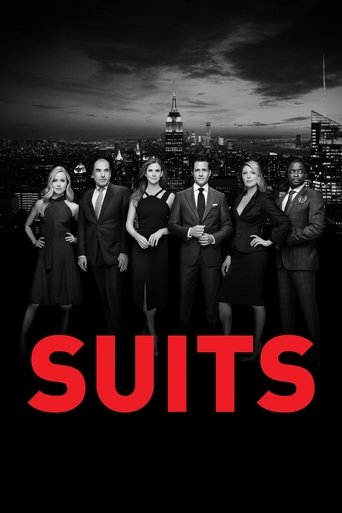
Suits
2011 · TV series · 42 min episodes · 9 seasons
Created by Aaron Korsh
While running from a drug deal gone bad, Mike Ross, a brilliant young college-dropout, slips into a job interview with one of New York City's best legal closers, Harvey Specter. Tired of cookie-cutter law school grads, Harvey takes a gamble by hiring Mike on the spot after he recognizes his raw talent and photographic memory.
2 positive5 negative35 neutralfrom 42 commenters
Where to watch
No streaming data for this title.






43 comments on Hacker News
Yeah, I am loving the public mudslinging over shit from 10 years ago, like high school girls fighting. This is like the FAANG version of the TV show Suits. We can call it FAANGs and use Midjorney to create the cover art and give the actors vampire fangs.
On a more serious note, it seems like any hyper competitive company eventually spirals into an awful, toxic working env.
Thinking that people in charge can correctly identify the bottom/top X% of their employees on some sort of metric is fooling oneself into believing those in power are better than those below them. It’s going to be 10% of _something_.
One episode of Suits comes to mind.
Let’s be honest, firing people reduces cost, because humans are expensive, and executive and ownership class want to keep costs down and profits up. That’s it.
Framing the narrative in terms of firing the worst performing employees puts the blame on individuals.
In a health company, of course if you can’t perform the duties of the job you should be helped to get to that point (if employer is nice) and let go if you eventually can’t. A firing of 100s of 1000s of people at once is a failure from the top in terms of planning.
I don’t know about officially sanctioned releases, but I feel like I’ve watched entire movies through YouTube shorts at this point… there’s a really simple grift that rockets to the top of the algorithm and also pushes people into a pipeline for other clips of the movie:
1. Clip a movie scene and crop it for vertical aspect ratio (maybe some AI is used here to choose the focus point of the scene)
2. Add royalty-free background music and possibly other tweaks like mirroring the video
3. Title it something generic that doesn’t acknowledge it’s a movie/show, like “College dropout beats Harvard Law grads to the job” for the scene from Suits (Note: for shorts, the title doesn’t matter if it’s algorithmically chosen to play next… in fact at this point the more relevant title is the optional link to a different short… the real title is barely visible)
4. Do not mention the name of the movie/show in the title or description
There are hundreds of accounts producing these shorts on an industrial scale. It’s easy to see how the automation works and also why it’s successful. It’s clickbait (people want to comment or ask for the title, or correct the title to mention it’s actually from a movie); it’s addicting (it funnels people into watching more clips from the same movie… funny how YouTube knows to do that but not that it’s copyrighted, btw); it’s self-optimizing (if the algorithm doesn’t surface the next short, people go looking for it specifically); and of course, it’s automatable (everything from curation to editing can be automated, and just a sprinkle of AI is apparently enough to obfuscate the automation).
What’s fascinating is that YouTube hasn’t stopped this. The shorts algorithm can obviously detect the similarity between clips from a movie, but the copyright/spam detection algorithm can’t detect the same.
While your chances of winning are lower without a lawyer, they’re nowhere near what you’d see on an episode of Suits. It’s more akin to what you’d see on Judge Judy without the cameras and irritating preaching from a judge.
there's a scene from the tv show "suits" that has always stuck with me:
the show is set in a law firm, and in this particular episode they needed to lay off some of their associates. a young, newly-promoted lawyer was tasked with drawing up a list of the associates and marking the ones who she felt should get the axe, based on their performance. so she comes up with some metrics, goes through the associates' work, and ranks them based on the resultant numbers, saying that the bottom few could be let go.
there is one employee, brian, who ends up near the bottom of the list. a more senior person takes her aside and asks why she recommended brian be laid off, so she brings out the metrics and rankings and points to him near the bottom. the senior person asks "okay, so who are the top associates in your list? can you point them out on the seating chart?". turns out, the top five associates were all brian's neighbours, and the reason was that he was really good at helping people when they were stuck with something. but of course that affected his own individual contributor numbers, and there were no metrics for "helped someone else out but didn't get credit for it".
Based on wikipedia original viewership numbers, the office UK saw about 63 million views during its original run, and the US show saw about 1,463 million, so it definitely was the more popular show by orders of magnitude.
It also seems to be on-again-off-again the most streamed TV show in a given year, competing with the likes of Friends, Suits, and Grey's anatomy. I can't find UK stream numbers to compare, but it doesn't seem like it's ever made one of the top 10/25/etc lists that netflix or neilson publishes.
That's presumptive on having Internet at all, but even so people make poor economic decisions all the time. Think of title loan and paycheck loan places, grocery shopping at the dollar store. You get the idea. And the fact that at times movies can be released to dvd before they're released to streaming. For that matter even if it's available to stream it may not be available to stream on your service. Does you no good that Suits is currently on Netflix if you're a Hulu subscriber.
Try this: look up the most highly rated episodes on IMDB and watch only those. Missing the crummy episodes usually does not interfere with understanding the story arc. Often, I set a minimum IMDB score that I will watch, like 8.5 or 9.0 to capture only the best. This works well with series that:
- take a year or two to find their footing or
- have a large cast (some mediocre) that get their own story lines of no consequence occasionally or
- introduce cast members that don't make it or
- implode towards the final season.
I have done this for many series that are somewhat uneven:
- The Americans
- How I Met Your Mother
- Fringe
- Orphan Black
- Halt and Catch Fire
- House of Cards (watching the ratings allows you to miss all of season 6)
- Arrested Development
- Bojack Horseman
- Veep
- 30 Rock
- Jane the Virgin
- Black Mirror
- The Marvelous Mrs. Maisel
- Suits
- Six Feet Under
- La Femme Nikita
- The Blacklist
- Peaky Blinders
- The Romanoffs
- Ozark
- Westworld (sometimes dropping episodes does not matter)
- Succession
- Borgen
And all of these series have lots of strong episodes.
Series I would not do this with:
- The Bear
- Breaking Bad
- Money Heist
- The Serpent
- Fleabag
- Chernobyl
- The White Lotus
I find it entirely baffling that the top shows on Netflix are lighthearted shows (usually comedies) that go on for many seasons. Friends, Seinfeld, suits, office, Gilmore girls, supernatural
But… Netflix doesn’t make these kinds of shows. They give small orders of episodes to niche shows and cancel them quickly before they have time to gain an audience.
Obviously they know which shows people watch, but why doesn’t that translate into them making those shows at presumably less cost?
>definitely makes some media more accessible and equitable
I disagree on this bit. Media is only accessible as long as the rights holders decide to play ball with the streaming service(s) the user happens to subscribe to. Constant rug pulling is going on with no sign of it stopping.
Just a few months ago I was watching Suits on Amazon Prime. I was 3 seasons in, and I went to watch (after just watching an episode the previous day) and it was now listed as needing to pay per episode. Netflix bought the rights and it was over there now. Another movie, I started watching and had to pause it halfway through, when I went back to finish it, it wanted me to pay for a rental, because their rights ran out. This is a horrible customer experience.
VHS, DVD, and BD were much more accessible. Region issues aside, if I buy a DVD it will play in my DVD player and no one can decide to take my rights to play it away mid-movie. The way streaming is today, it would be like needing to have a different DVD player for each studio, or if the VHS vs Betamax, or Blu-ray vs HD-DVD battles never ended.
One of my big[] worries is that I will grow old and want to watch the movies from my youth and be unable to because the studio went out of business, or decided that movie wasn’t worth streaming, or one of countless other reasons why access would be lost. It’s the modern day version of the “Disney Vault”, which I always hated as a kid. They’d release VHS tapes for a limited time to create scarcity and drive up demand, then pull it and release something else. My sister’s favorite Disney movie never seemed to come out of the vault.
I actually have a friend who has been messaging me pretty regularly lamenting that he wants to watch some movies from the early 2000s and can’t find them on the couple services he has. He doesn’t really know what to do. He wants to watch some movies, he is paying money every month to these companies, and he isn’t getting the content he is after. These movies are 20 years old, the studios and actors have made their money, there is no reason anyone should need to deal with these roadblocks to access. He has been talking about going back to DVD. What other option does he have? How is this accessible and equitable?
[] it’s a big worry in the realm of media, I know in the grand scheme of things it’s a small theoretical problem at the moment.
> So what I really need to study are the famous openings and the responses to various openings. Seems like a memory game.
That's a bit like saying that mathematics or physics are "memory games", because if you take them seriously, you can't avoid learning tons of equations and formulas instead of being creative (and reinventing the wheel by going from scratch) :)
While memorization is certainly a part of chess:
* Opening theory doesn't matter all that much up until a very high level. Below the master level chess is about 90% tactics. You can pretty much rely on general principles in the opening, and your opponents won't know enough opening theory anyway (so what's the point of eg. memorizing the theory on Sveshnikov Sicilian up until move 15 if you won't ever use it, because your opponents will be out of the book and play something non-theoretical long before).
* Even when opening theory does matter, memorizing it blindly is not enough, and it would be very difficult when done that way. It has to be based on deeper understanding of themes, underlying structures, typical plans for both sides in resulting types of positions, crucial squares to control etc.
I remember this scene in "Suits" (courtesy of YT recommendation algorithm - never watched the entire series, so I don't know the broader context). A guy without a degree walks into a law office, and the boss says "sorry, we only hire from Harvard", but he demands that the boss opens some law book on a random page, and he can quote the book perfectly like a savant. Needless to say, he's hired on the spot : )
This is what people may imagine the work of a lawyer revolves around, but it's not really accurate.
I noticed that the watchtime of `You` was split half-and-half between the new season 4 and the prior seasons 1-3. I was curious about the total results by show, including all seasons. Here's the top 25:
TITLE TOTAL HRS WATCHED ----- ----------------- Ginny & Georgia 967,200,000 The Night Agent 812,100,000 You 766,300,000 Outer Banks 740,400,000 The Walking Dead 738,600,000 The Glory 622,800,000 La Reina del Sur 616,800,000 CoComelon 601,200,000 Suits (2011) 599,100,000 The Blacklist 596,900,000 Manifest 581,900,000 Grey's Anatomy 560,300,000 Wednesday 507,700,000 Gilmore Girls 505,800,000 Breaking Bad 505,000,000 Queen Charlotte 503,000,000 Friends (1994) 448,500,000 Love Is Blind 439,300,000 Lucifer 434,300,000 The Big Bang Theory 420,400,000 Shameless (U.S.) 392,600,000 PAW Patrol 392,300,000 New Amsterdam (2018) 375,500,000 Brooklyn Nine-Nine 358,900,000 Firefly Lane 342,700,000
> shows are mostly watched within a year of its original air date.
This depends a lot on what else is available. One of the most successful shows on netflix this past year was Suits, a show that was released 12 years ago. Even before the strike old shows do very well on streaming services. Schitt's Creek gained huge popularity two years after it's original air date.
> So much choice that there isn’t any specific shows that people watch because everyone else is watching and will talk about it on Monday during lunch (a la Game of Thrones)
That's why streaming services have started to withhold episodes and only allow you see one episode a week. They want to control who is watching what and when. When people can watch whatever they want to on their own schedule they might not get around to shows immediately and advertisers don't like that. It also makes it harder to control the conversation on social media.
The Tick was canceled after it didn't get enough views just 6 weeks after release, but as you said, there is so much to watch right now, and so much else besides TV competing for our time, that those kinds of metrics are meaningless.
It'd be better for netflix to make sure their library is filled with quality and to have confidence that audiences will find those shows on their own time than to worry about how many people are watching the newest thing immediately and cancel anything that doesn't show immediate success.
Harvey AI! Guess those founders were fans of Suits (the tv series).
What's disingenuous about the argument?
The point is that the writers actually got paid significantly more back when Suits was a relatively low-rated cable show than they do now even though it's a global success.
If it had aired on broadcast, the disparity would be even worse, since the residuals for broadcast shows are higher. And for a comparison for a broadcast TV show, the actors and writers of the Gilmore Girls had the same complaints about streaming residuals: they made several times as much back when the show was on the CW than for the Netflix season, even though the viewership of the single Netflix season was several times the combined total viewership of the show in its entire broadcast run.
The writers rejected it over the residuals offer.
For comparison, for most of this summer, Suits has been the most-watched show in the world. When the show was still on cable, a writer said she was paid over $12,000 in annual residuals per episode...For the year to date, the same writer has received $415 (or about $830 annualized) (https://www.ign.com/articles/the-suits-residuals-are-abysmal-amid-wga-strike-shows-writers-proof). This is even though the audience for Suits is now more than 100x what is was before...
Proper version control would ruin all the fun - it would make it easier for unwanted parties (such as e.g. the partner you have office rivalry with, or legal discovery process you're at the receiving end of) to step through the history of your documents, while making it harder for the opposition or other third parties to ship all the juicy history to you by pure accident (i.e. sending the OG Word document with "Track Changes" still on).
(Disclaimer: IANAL, most of my "knowledge" about the legal profession comes from the TV show Suits.)
The entire premise of Suits, the TV show, was that one of the main characters had a perfect memory & that made him good lawyer material.
I found one particular example of the opposite change quite annoying. In the TV Show “Suits”, the premise is that a character Mike has incredible photographic memory, can to read books and evidence at unbelievable speeds. As the show went on, this unique trait was almost completely removed. I think by season 3 it was just gone completely, turning the show into a regular law drama.
Most "tech" shows or hacker scenes are akin to the police procedurals, courtroom dramas, and medical shows that generally don't bear much relationship with what it's like day-to-day for cops, lawyers, or hospital workers. (Hence shows/films like The Wire and Reno 911, My Cousin Vinny and Suits, St. Elsewhere and Scrubs stand out.)
As a founder of a venture-backed startup with first-to-market tech that went through an accelerator in Palo Alto in the 2010s, Silicon Valley is basically entirely accurate. Actually tamer and more restrained than reality in many regards, at least anecdotally.
Too much filler cut scenes and slow dialogue. For example, Suits has notorious slow dialogue and lots of cut scenes hovering over city buildings which add nothing to the script. Watching it at 1.5x makes me miss absolutely nothing and reduces episodes of 45 minutes to roughly half an hour.
> No customer wants to spend X on Shudder, Y on Netflix, and Z on Prime, plus Hulu, HBO, and your cable/satellite fee either. Paying 200 GBP/USD a month is utterly absurd.
When we’re done talking about the quantity of movies, let’s talk about quality.
If an awesome movie goes to the cinema, like Twilight, you’ll be able to watch Werewolf on Netflix. With abysmal plot and acting. If you type Mission Impossible, you’ll certainly get Suits.
The search is so abysmal, always suggesting the same 40 series on and on, that people exchange numeric codes which allow them to discover new categories (but half the titles will be already seen). A/B testing probably shows that after seeing a title for 6 weeks and dodging it, you end up watching it, because, there’s only that.
It’s not that I don’t want to pay $40 a month for 4 services, it’s that even at that price, I still can’t watch the quality movies.
And let’s not even start with ideology-pushing in movies.
I watched a documentary called “Suits” a while back about a corporate legal firm and that convinced me that you are wrong. Those well dressed professionals will use anything you say against you in the court of law!
Can you elaborate on the "new partners must invest capital" part? I've heard of this, notably in the TV show Suits where when the lead character got promoted to partner, he was asked to contribute a lump sum of cash. Sounded nuts to me that a promotion meant you basically got a chance to pay (I know it's actually invest) money.
Probably about as long as they were working on their legal documents. This is literally something that I would expect to see on an episode of Suits not in real life.
> would not care much if Google had a lot of information about me if their goal was something other than influencing me to buy products and services
Ironically, I'm the opposite. I don't care about the advertising targeted at me (I pretty much never bought anything based on targeted advertising). I worry about the knowledge about someone being used to hurt them.
For example, a professor once said that each of us commits 3 felonies a day. With perfect knowledge of people, it brings the specter of selective enforcement. That selective enforcement can be used to blackmail/extort/manipulate anyone you want to.
For a fictional example, check out the TV series "Suits". The "good guys" are always turning the tables on the "bad guys" by digging into their past and finding dirt on them. And vice versa. It's the plot of pretty much every episode. (But of course the good guys do this for good, and the bad guys use it for bad. But in real life, this isn't so simple.)
Even if you think outing people for doing bad things is always a good thing, the data collected on people is often wrong, and innocents get hurt as well. The definition of what is "bad" also shifts over time.
Good luck fighting Oracle's elite lawyers ..
Suits. Season 11 awaits
Not surprising that large companies would have 'stooge' employees in place for just this sort of thing. I have heard of it happening in at least one major store chain here many years ago.
Kind of reminiscent of one of the first episodes in the series 'Suits' where Louis Litt is interviewing a new junior employee for the firm, and he pulls in another junior mid-interview to dress him down and dismiss him in front of the new employee, just to put the fear of his authority and power into the newbie. The 'fired' employee then just goes back to the bull pen to await being called in for the next new recruit interview so he can walk past and be 'randomly' called in.
He's referencing the main character of the TV show "Suits"
https://en.wikipedia.org/wiki/Suits_(U.S._TV_series)
Just spent a minute skimming it and it looks like an episode of Suits, except with real people's lives affected :(
Off topic but Halt and Catch Fire season three was my favorite yet. There is some drama that the characters mostly bring on themselves (Can and Joe) but after watching some episodes of the show Suits (Scandal has the same issue) the drama in Halt and Catch Fire is barely noticeable.
The later season hints at the antagonist being more than that and possibly alludes to some interesting ideas that I won't spoil for other readers.
Yes, the protagonist is smug and intelligent but that's common in a lot of TV shows for a good reason. Would you watch Suits if the character is an inept lawyer? Or House if the doctor is a mediocre doctor doing routine checkups?
And besides, I'd say that most programmers do feel a bit smug in the same sense about your average person clueless about technology.
> If Elliot were to be like Mike from Suits, Mr Robot would need to change the name of the show to Suits.
And it follows that the space of sitcoms is a singleton.
That explains a lot.
> The best route up is hitching your wagon to your bosses wagon. So yes doing some of his work will make him look like a hero, which will get him promoted, and he'll think who is his most valuable / productive underling, which will get you promoted. Hopefully you doing some of his work free's up his time to be more productive in other areas. If your boss is a lazy PHB (Dilbert), get another job.
This is called loyalty, and it only really works in certain kinds of endeavors, and then only certain organizations doing them. TV shows depict loyalty a lot, the thing I notice about these shows is that the stories are always set in "meat-grinder" sorts of fields, and then at the tops of those fields. Suits, set in a high-powered corporate law firm. Entourage, set in Hollywood. Loyalty as a major theme to a show isn't interesting to watch otherwise.
Everywhere else, an interested ladder-climber will always find that it's way easier and cheaper to change jobs than it is to move up in one. Hence the perennial advice to move to a city, where landing jobs is like shooting fish in a barrel for the ambitious. When you run out of steam at one company, get a fresh start somewhere else. Rinse and repeat until you're tired of moving around, then you can start the loyalty path.
It's important to note that the skills you need to convince someone else that you can do a job are way different than the skills you need to convince a power broker to bequeath you with additional responsibilities and the commensurate titles and prestige. It so happens that years of experience working in organizations gives you those skills largely through osmosis.
I like where I am now, so I investigated the possibility of sticking around and trying to move up rather than jump to another company. Even talked to my boss about it. But unless you're at a rapidly growing company, the opportunities for advancement just aren't going to be there and you might be waiting years for your turn. My boss specifically used the words, "you're comfortable" to describe my head space when he said he'd go around and ask if anyone else needed anything to do.
You and everyone else can have the best of intentions, but opportunity is limited and it's hard to make more of it. There's only ever a limited amount of money and perks to go around, and its often politically unfeasible to start rocking a boat by democratizing something that was previously held feudally.
Making the decision to stay at a company is giving up easy access to opportunity in exchange for security and stability. You can always unmake that decision by leaving, often times you can even unmake it the other way, companies will take people that leave back if they like them enough, but you and only you can decide what you want more out of your time on Earth.
A bit off-topic but on US tv shows is ridiculous how actors (esp. main characters) are usually white or black, little or no Asians and Hispanics. "Friday Night Lights" is about teenagers in Texas (1/3 pop. Hispanic) and they are all white or black (they even had an episode or more about the divide), not a single Hispanic or Asian ever (only one secondary character for a bit).
EDIT: Also we laugh now at stereotypes like the token cool/funny black guy in shows form the 90's or so, but now it's about the super aggressive female black lead ("Suits", "Scandal", "How to get away with murder" etc).
Mr. Robot is an absolutely fantastic show -- my only worry is that USA isn't really a network known for this sort of quality, and I feat it'll end up going the route of their other shows like White Collar, Suits, or Burn Notice and become an episodic heist/case/espionage-of-the-day type show.
Mr. Robot (generally) gets tech right. There are a few weird parts and some overwrought moments, but they for the most part get tech/hacking/code better than any other show. Also, it's just shot very well, reminds me a lot of House of Cards first season.
Highly recommended if you have not already started watching.
I agree that one thing that's lost is the ability to discuss episodes with people as a show progresses. Since you never know what episode a person is on you can't really risk discussing things until you're sure the person has caught up. With weekly shows like Game of Thrones for instance, you can feel pretty comfortable discussing an episode amongst other fans. Not sure if that's really something I'll miss when it's gone, but it's definitely a big change with Netflix that ultimately started as a smaller disruption with DVR devices...
I suppose personally my feelings on the matter is even though I might lose the few advantages that you mentioned, the disadvantages far outweigh it and I won't miss the airing of shows like Breaking Bad or Suits that took one season and split them in half with gigantic gaps in between (months or even years), to the point where you can't even remember where the show was going by the time it returns. I like the freedom to watch at whatever schedule I prefer, without any kind of arbitrary limitations that may or may not suit my lifestyle at the time, and the confidence to know I'm going to be able to see a story through from start to finish once devote time to it...
An app, possibly desktop one, which gets two music fragments and tries to figure out the stack of effects that were applied to one of them.
Context: I realised recently that a lot of film/series music is processed, compared to the album version. Specifically, I noticed blues tracks on Suits sound so much deeper than their album versions. I'd like to know how was that result achieved and how to make a chosen track sound as if it was processed for that series.
Reddit is a great site in what it does. And due to its nature, it has tremendous amount of niches, some of which are worth a lot of money if handled properly.
For instance, /r/watches is an active area for discussion of watches. The people who post there often share their new Rolex or their treasured Patek Phillipe. /r/watches is just one of many, many such niches on the site which have a lot of potential value.
My thinking has been that reddit could focus on developing the value in its many product oriented subforums.
Also, interestingly enough, reddit has already sort of created its own new cybercurrency - dogecoin. Though it may not be doing well, I think most of the value in dogecoin was how easy it was to use on reddit.
reddit does need to find a way to monetize. I think it could do so quite successfully due to the nature of it having many high value niches.
I say all this as a big fan of the site and have even been considering making a subreddit finder (so that someone who is a fan of the TV show Suits, for instance, can know that there is /r/suits to discuss the show, which they would have simply no way of knowing if they just landed on reddit's homepage with pictures of Very Round Eggs, to use a current example).
> But as far as I can tell, being a good accountant is mostly a function of good training. I don't hear people described as a "born accountant". I don't see people arguing about whether one accountant is 10X more productive than the average.
Unless the author is an accountant or otherwise close to the field (e.g., talkative friend is an accountant), this is a weak statement. I doubt people not in tech know that people in tech write articles arguing about "born programmers" and "10X" programmers. Such talk is internal to our field.
Most people do know a lot about sports, because sports is very interesting for most people. Accounting and programming, on the other hand, are opaque and boring-sounding to most people. When the author talks about accounting, then (again, unless the author is an accountant or close to the field - I see no mention of either) that could be talk about a stereotype of the field of accounting, not actual accounting.
Just for fun, a non-stereotypical super-accountant is Lewis Litt from the TV show Suits. He's clearly a rockstar accountant in that show, capable of achieving things 100 average accountants can't. Is he a realistic character? I don't know, just like I don't know if the "all accountants are about the same" stereotype is true.
All of this doesn't necessarily undermine the entire point of the article, of course - maybe accounting is not a good example, but some other field could be.
Eidetic memory is vastly different from a memory aid/trick (and click bait). People with eidetic memory are quite literally biologically superior to the rest of us. While the TV series "Suits" is a fiction it isn't far from reality: my late grandmother had an eidetic memory and while she did not have the full range of abilities as the protagonist, she was able to recall any page of a book after rifling through it.
What is still up to debate is whether memories/knowledge can be electronically injected into our minds. I would say it is highly plausible at some distant point in the future, we are already coming to terms with electronically reading our minds.
Felt compelled to post because I hadn't seen Suits mentioned. Modern Family continues to be reliable for laughs and hasn't been added yet. The League is the other show which I find myself laughing out loud at least a few times every episode.
Hell on Wheels surprised me by having a strong second season.
I had high hopes for Copper, but it hasn't really grabbed me in the 1st handful of episodes.
Agree with all the obvious ones:
Homeland, Louie, Newsroom, Sherlock, Game of Thrones, Community.
My wife is addicted to Castle and I've come to really enjoy it too. Since we've caught up to date with that we've now switched over to Person of Interest, which I'm really enjoying.
I've fallen behind with the following and plan to catch up ASAP:
Dexter, Sons of Anarchy, 30 Rock, Breaking Bad.
PS: yeah, I watch a lot of TV :)
As of right now I am not willing to pay the monthly fee to get cable and the like, since it airs at a certain time of day and I'd need to get a DVR to then grab all the shows and whatnot I'd want.
If I could pay a monthly fee of around $20 to get all of the TV Shows I want to watch at any point in time (not even perpetuity but that would be nice) I would subscribe. Hulu+ comes close, but still doesn't have a lot of the back catalog I am interested in, or is hog tied by the content producers and can't make certain content available until 30 days after it has aired on TV (USA's show Suits for example).
I'd love to watch Game of Thrones from HBO, but the only way I can get access to HBO's online site is to have a monthly subscription through my cable provider... that makes my choice simple, TPB or don't watch them at all... either way HBO loses money.
I don't understand why the content industry doesn't see that if they help Hulu+ succeed that they too can start seeing more of the money from that. Instead of screwing over the "cord-cutters" cut out the middle-man (the cable company) and let me subscribe directly for a low monthly price.