 Hacker Cinema
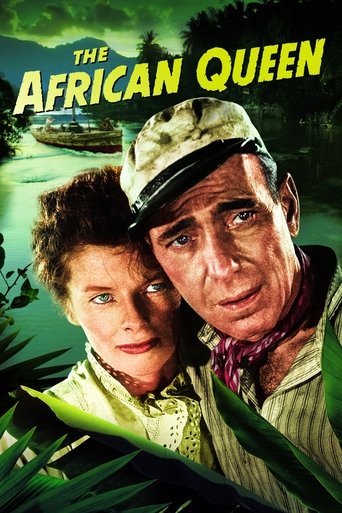
The African Queen
1952 · Film · 105 min
Directed by John Huston
At the start of the First World War, in the middle of Africa’s nowhere, a gin soaked riverboat captain is persuaded by a strong-willed missionary to go down river and face-off a German warship.
1 positive1 negative4 neutralfrom 6 commenters
Where to watch
No streaming data for this title.


6 comments on Hacker News
Are you reading by opening up to page 1 and reading through to the end? Don't do that. I know, I know, spoilers, but unless you're reading mysteries, it's not a big deal. The best fiction isn't just the ending. Everyone knows Captain Ahab dies at the end of Moby Dick, but that doesn't spoil anything.
So, read the first chapter. Read the beginning and end of the rest of the chapters – a few paragraphs, a page, something. Read the last chapter.
Analyze the story: make a list of characters and their relationships to each other. If there are people related to each other, make a family tree. Consider the locations: map them out, especially if they reference real world locations. Get a feel for how the story moves through the world. Tolkien's books are famous for including the family trees of his characters, timelines, and world maps. Do that.
Try reading a novel that's been made into a good film. Follow along reading and comparing the film adaptation to the novel. Something like C. S. Forester's book The African Queen and the 1951 film directed by John Huston.
Pick a novel that riffs on subjects you're already into. Sylvia Plath's The Bell Jar involves psychology as a major plot element, as do One Flew Over the Cuckoo's Nest and Requiem for a Dream. All three have been adapted into excellent films.
A rare early cube farm science fiction story by the author of the Horatio Hornblower series, The African Queen (1935), The Good Shepherd / Greyhound, and The Ship (1943) https://en.m.wikipedia.org/wiki/Horatio_Hornblower -- https://en.m.wikipedia.org/wiki/Greyhound_(film) -- https://en.m.wikipedia.org/wiki/The_Ship_(novel)
Same for African Queen? Huck Finn? Martian Chronicles?
The movie was set in (pre)wartime, when nations were fighting to the death. Violence was the backdrop.
It was remarkable for the human moments, devoid of 'empty and abrasive action' and full of personal drama. Dismissing that is disingenuous.
Lessons? It's a movie. You want a message, use Western Union.
OTOH, I can't imagine enjoying Casablanca in color. Or Citizen Kane, Thin Man, or African Queen. B&W is part of a film's atmosphere, it's different.
I'd never want to see Forbidden Planet in B&W ... and The Day the Earth Stood Still in color? criminal!
During the "golden age" of Hollywood in the 30s-40s, the studios would crank out one movie per week. Stars would often appear in 3 movies per year. Today, stars shoot a film every 3 years or so. E.g. take a look here:
https://en.wikipedia.org/wiki/List_of_RKO_Pictures_films#1940
In 1940, RKO released 55 films, of which they produced 39. That's basically a film per week. And these were feature films.
For the individual stars, take a look at Humphrey Bogart, who starred in 3 films in 1941: The Maltese Falcon, The Wagons Roll at Night, High Sierra. I don't think there was a year in the 40s up to the mod 50s when Bogart didn't star in at least 2 releases per year. In 1951 he was in The African Queen, Sirocco, and The Enforcer.
Today, take a major studio, say Paramount Pictures. It released 11 films in all of 2018.
What happened was JAWS created the 'blockbuster' phenomena, in which the studios made huge money on a small number of very expensive films with huge marketing budgets compared to previous eras. That totally changed the dynamic. It also made actor pay shoot up.
But it has nothing to do with the cost of the prints -- just strategy of whether you want to make a small number of films with tons of marketing spend like in the post JAWS era or a large number of cheaper to produce films with small marketing budgets like the pre-JAWS era.
In many ways, what is happening with TV and Netflix is akin to a return to the studio model but for episodes, where Netflix seems to be able to crank out a large number of relatively cheap but decent quality episodes, and this of course corresponds to lower actor pay per episode.
Overreaction to word fragments has become epidemic in closed captioning of American TV shows.
I've seen this on more than a dozen networks: captions will be masked with Xs if any substring matches any possibly offensive word or phrase, e.g.
XXXXtails for cocktails
XXXume for assume
XXXXX for spade (in the unmistakable context of a shovel, e.g. in "The African Queen")
XXXX for coon (in the unmistakable context of a raccoon, e.g. in "True Grit")
Doo-XXX for Doo-Wop (music)
gimXXXX for gimmick
sXXXpets for snippets
Those are all actual examples from MeTV, H&I, Movies!, GetTV, etc.