 Hacker Cinema
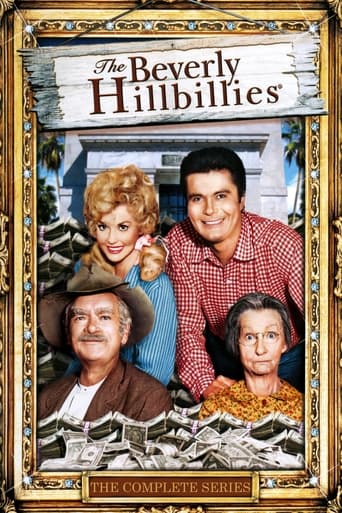
The Beverly Hillbillies
1962 · TV series · 25 min episodes · 9 seasons
Created by Paul Henning
Jed Clampett's swamp is loaded with oil. When a wildcatter discovers the huge pool, Jed sells his land to the O.K. Oil Company and at the urging of cousin Pearl, moves his family to a 35-room mansion in Beverly Hills, California.
1 negative6 neutralfrom 7 commenters
Where to watch
No streaming data for this title.

7 comments on Hacker News
Sadly, in the post-WWII decades, it seems that the American Dream has consisted of getting the hell away from your parents, and/or getting the hell out of this podunk rural town and into the Big City.
Now both of those can be tragedies in their own way. In the 1970s there was a notorious upheaval in TV programming known as "The Rural Purge": https://en.wikipedia.org/wiki/Rural_purge
Basically, a lot of TV series which were set in rural or pastoral settings, were outright canceled in favor of urban shows, including "fish out of water" fare such as The Beverly Hillbillies. And prime time TV has never been the same since then!
So it was inevitable that there have been waves of urbanization, and commensurate de-ruralization. As people got into STEM, they needed to get off the farm. If it was no longer possible to make a living on a ranch, then people needed to get into the cities. Including minorities such as Black Americans, who may find more opportunity on the fringes of society, and less discrimination or injustice, after a while anyway.
And there has been a streak of independence as well. American kids are raised to resent their parents and long for something else. Sometimes they don't know what that is, just that they can't find it at home. So an American kid, especially the boys, they're conditioned and poised to leave home as soon as they're 18. Go far away to college and stay away. Leave the nest behind and make it on your own [even if your family already lived in a nice big city.]
Even I was infected with this so-called "American Dream", and not realizing how good I had things at home, I wanted to get out of there, get far away, make it on my own, but I couldn't. I couldn't fend for myself and I crashed and burned; I hit rock bottom without my family's support. I never should have left in the first place, but now the deed is done.
In the 1950s the propaganda supported the "Nuclear Family" concept, and extended families started splintering. It's often not cool for parents to live with their married, adult children, or to have a large family house that fits everyone. The kids go away and they hole up in 1BR apartments alone, to fend for themselves independently, for better or worse. Women enter the workforce, willingly or unwillingly.
I would say at this point, that whoever has purchased a home and the land underneath it, they're done moving. Perhaps fewer are looking to purchase homes far away from where they already are. I myself decided I'd never relocate again, back in 1999, because it just wasn't worth it anymore, and also because I found myself in a really ideal location that offered no reasons to leave.
I find it odd that you perceive this as a new thing. I'd call it an American trope that long predates me. For instance, "The Beverly Hillbillies" was a 1962 sitcom that played off of it.
> The Clampetts bring a moral, unsophisticated, and minimalistic lifestyle to the swanky, sometimes self-obsessed and superficial community. Double entendres and cultural misconceptions are the core of the sitcom's humor. Plots often involve Drysdale's outlandish efforts to keep the Clampetts' money in his bank, and his wife's efforts to rid the neighborhood of "those hillbillies". The family's periodic attempts to return to the mountains are often prompted by Granny's perceiving a slight from one of the "city folk".
https://en.wikipedia.org/wiki/The_Beverly_Hillbillies
I remember those, and the 'Rural Revolution' that preceded it. Lots of shows in the 1960s like The Real McCoys, The Beverly Hillbillies, Green Acres, Petticoat Junction, Andy Griffith, Gomer Pyle, Lassie, and Hee Haw, until the 'Rural Purge' of the early 1970s.
Then in the mid-late 1970s came those shows and movies you mention, less comedy and more drama, more a sort of glorified frontier days theme. I think some of that might've come out of the 1960s hippie/naturalist trend, although it's a bit different.
I watched them all in the 80s, in syndication on the local channels, and my parents' VHS tapes had a lot (all recorded from TV). But in retrospect there were at least two related but different trends there.
I remember watching an old episode of The Beverly Hillbillies, where an insurance executive was talking to one of his employees, and said:
"The job of an insurance company is to take in as much money as possible, then refuse to pay it back."
They were idealized versions of Americana...
Idealized by city folk, maybe. As one who grew up in a rural area, when I watched the shows it was more "let's make fun of the simple country folk and their strange ways". There was no idealization, most of it were television shows that looked to be written by city people that have never been past their city's beltway, who imagine what country life might be like. Poster children include Green Acres and The Beverly Hillbillies.
I do miss Hee Haw, though. R. I. P., Messrs. Owen and Clark.
The author blames the modern sitcom's remoteness from working and lower-middle class concerns with their creators' immunity from the recent recession. In place of everyday situations, we have shows set in "soundstages and writers’ rooms," the haunts of the out-of-touch in New York and LA. So you wind up with a show with this sort of genesis:
Our creator was once a prominent writer and performer on a comedy sketch show, which aired live every Saturday night from an NBC studio in New York. It ran for 90 minutes. After their time on the show came to an end, our creator decided to pitch a sitcom based on their experiences there. The lead character is the head writer on a comedy show, similarly produced in New York. They must balance their work in the writers' room and their personal life, though this turns out to be difficult. A pilot is made, and our creator plays the lead.
Modern viewers may recognize this as 30 Rock, but it is in fact The Dick Van Dyke Show. It is based not on SNL but on a direct ancestor, Your Show of Shows. Carl Reiner's performance in the pilot may have dissuaded executives from casting him in the commissioned series (hence Dick Van Dyke), while Tina Fey remained the lead in her own version. But otherwise the parallel rings a sight near perfect.
The author stumbles over himself insisting, however, that while The Dick Van Dyke Show did not give vent to working and lower-middle class concerns, it did at least feature characters who "had careers" and were definitely of a class. As if the same were not true of shows like 30 Rock (which is at times obsessed with class difference), or of Parks and Recreation and The Office. These do not depict realistic workspaces, but why place that demand on a sitcom? And why not place the same demand on, yes, The Honeymooners, Taxi, The Mary Tyler Moore Show, I Love Lucy, The Beverly Hillbillies, Green Acres, The Andy Griffith Show, and on and on. In all cases the demands of the form—and in almost all cases the demands of overly long tenures—stretched the premises and the rare attempts at realism very thin.
I think you can make an argument that the most popular comedies available right now—whether on TV or at the movie theaters—are unflinchingly escapist. (Though, as the article notes in its discussion of an episode each of Horace and Pete and Girls, this has not gone unnoticed or unremarked by all of the shows' writers. Still, these two are not the most popular things around by any stretch.) Similarly, Fred Astaire and Ginger Rogers were seen to traipse across exclusive resorts, high-class stages, ballroom floors, and Venice, in elaborate dresses and a "top hat, white tie, and tails"—all during the Great Depression. Sometimes hard circumstances produce a public clamoring for comment; sometimes the public just wants a reprieve.
When I was a kid growing up in the 1950s, I thought I was being deprived because my immigrant parents had a thing about not getting a TV in the house. This actually forced me to grow up as an avid reader, which I realized only years later proved a great long-term benefit.
Back then (and into the 60s and 70s), TV was wholesome enough but highly limited: mainly three networks (CBS, NBC, ABC) that gave us news, variety shows, and old style sitcoms such as the Beverly Hillbillies and a few local UHF stations that mainly featured old movie reruns. Apart from the "all-night" UHF station, most stations signed off by midnight and then went silent for the night, using an "Indian" image or some equivalent to alert viewers to the fact that they were off the air. I would say, throughout that entire period, that TV was for me what I would call a pleasant time-killer. I wouldn't watch that much of it but, after working like a fiend all week doing my studies and working odd jobs to pay my tuition, it was pretty relaxing to settle back into a sofa and just passively watch something - an old movie, a sports event, a stupid comedy, or whatever - without any demands being made upon me. That was the appeal: a mostly mindless diversion with occasional drama when some important news event captured the nation's fancy (e.g., the Apollo 13 drama).
Today, with cable and with digital channels, TV has far more variety with its countless channels and its ubiquitous round-the-clock presence but it remains for me a mostly mindless sinkhole for my time whenever I get caught up watching it, which is not too often. Network news has been largely displaced by wall-to-wall coverage by cable networks of whatever story it is they want to pound to death, with an emphasis on "reality" stories (e.g., what is today's tidbit of information that we can add to the story of the missing teenager who vanished in the Caribbean?). Reality-TV formats are everywhere, creating voyeuristic opportunities to watch people interacting with one another in this or that setting and featuring really nothing more than the personalities of the participants as points of interest. All this and more is for me little more than the "vast wasteland" that Newton Minnow called TV back in the 1960s, with the quality of programming having settled in at a level of almost mind-numbing banality.
That said, TV is nothing more than a medium and will always feature this or that item that is indeed interesting or stimulating. It just is not a good habit to find oneself continually caught up in it. Used selectively, it can be just fine for occasional entertainment or for particular items of news or commentary. Not normally very profitable but nothing to be too critical about either.