 Hacker Cinema
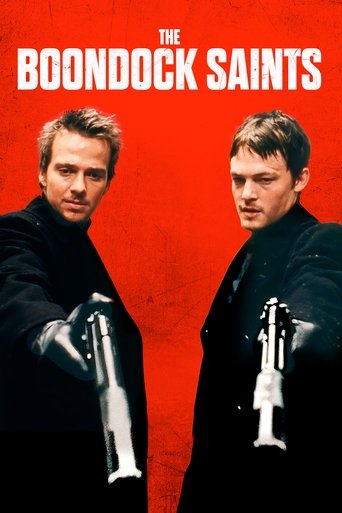
The Boondock Saints
1999 · Film · 108 min
Directed by Troy Duffy
Tired of the crime overrunning the streets of Boston, Irish Catholic twin brothers Conner and Murphy are inspired by their faith to cleanse their hometown of evil with their own brand of zealous vigilante justice. As they hunt down and kill one notorious gangster after another, they become controversial folk heroes in the community. But Paul Smecker, an eccentric FBI agent, is fast closing in on their blood-soaked trail.
1 negative2 neutralfrom 3 commenters
Where to watch
No streaming data for this title.


3 comments on Hacker News
I think that nick was comparing the magazine writer to the detective overly dramatically re-creating the scene of a crime in boondock saints:
https://www.youtube.com/watch?v=MsuH1msEkvM
BTW Boondock Saints is like one of the dumbest movies of all time, they made a behind-the-scenes documentary about how the film failed because of how arrogant the directors/screenwriters were. It's so stupid, it's great
That's a good question. I'm not sure what the other poster had in mind, and I suspect it's not the same, but RT has a bunch of rating problems that would probably become far more egregious for news than they are for movies. (Leaving aside the tricky question of how to translate the formats: is a movie like a news story, or a news source? Does news really have an existing aggregation-worthy source like movie reviews?) RT provides percentage scores for both audience and critic reviews. Those percentages are not averaged scores, but percentage of positive reviews. There's good reason for this in both cases, but it causes a lot of weird side effects.
- For audience reviews, reviewers rate out of 5 stars, and the score is the percentage of reviews at least 3.5 stars.
The goal is to insulate scores from extreme opinions and odd voting patterns. On IMDB, which doesn't do this, a few low scores can destroy a movie's rating, and movies that invite careful analysis are effectively penalized. The Dark Knight ends up rated higher than Schindler's List, but the latter has lots of slightly-imperfect scores with incredibly positive review text.
The basic side effect is the loss of all meaningful score data. That punishes daring movies: 100 4-star reviews equals 100% while 50 3-star and 50 5-star reviews equals 50%, but I would much rather see the second movie. It also hides deep flaws: The Boondock Saints outscores 2001, but a look at the reviews shows that its "rotten" ratings are often 1 and 2-star reviews calling it garbage, while 2001 is full of 3-star reviews like "slow and confusing, but fascinating". Another problem here is that naive binary scores suffer from reviewer skew and vote-bombing campaigns. It's less bad than IMDB because extreme scores are 'softened', but still worse than systems which relate individual scores to the reviewer's other opinions. BeerAdvocate, of all things, takes on this problem with interesting meta-info like "reviewer's average distance from consensus".
- For critical reviews, each review is reduced to a binary opinion and the score is a weighted average of positive review count.
The goal there is to condense varied or absent rating schemes into an aggregation-friendly score and avoid reviewer skew. Metacritic, which doesn't do this, ends up systematically distorted by which outlets review things. Unscored reviews like Ars Technica's (on video games) are skipped, while sites with extremely skewed scores are included by some unspecified weighting system. As a result, Metacritic lists game reviews averaging 75-89 as "generally favorable", but there's a widespread understanding that any major-release product below 85 is terrible. (GameSpot once infamously fired a reviewer for scoring a game 6/10.) It's largely the same problem as Uber and Amazon ratings: does a perfect score mean "exceptional" or "nothing wrong"? RT tries to dodge the problem by saying "good" or "bad", with a weighting to accommodate a reviewer's 'signal strength'.
The side effect here is, again, the total loss of secondary data. RT sometimes gets reviews actively wrong; something like "despite lovely action sequences, this movie is a meandering waste of time" will get parsed as "lovely action sequences". That's probably an automation error, but lots of other reviews can't be clearly declared positive or negative even by humans. And within a categorization, there's a great deal more lost data. Ebert produces 'fresh' for The Avengers because "It provides its fans with exactly what they desire," but he produces 'fresh' for There Will Be Blood by declaring it "A force beyond categories."
- The reason all of this works alright for Rotten Tomatoes is that it's fundamentally answering one question: "will I enjoy watching this?" The Avengers isn't on par with There Will Be Blood, but if you like the description and it's rated fresh, you'll enjoy either one. If you see that critics hate The Boondock Saints and audiences don't, well, you probably know whether you're somebody who likes that kind of cult classic.
But what of news? People already shred Snopes whenever it tries to deal with assessments like "factually correct but misleading" or "incorrect statistic but the real number also supports the same thesis". The entire point of news reviews is to not rely on "will I enjoy this story?", so all the things RT quietly glosses over will become critical problems.
Humans tend to assume that their experiences are normative, and are surprised to see instances where their experiences are not shared. As a personal example, my friends are usually significantly shocked to learn I haven't seen the movie "The Boondock Saints". Yet they think nothing of the fact that they haven't seen Salvador Dali's "Un Chien Andalou", which I have. Our values are informed by our experiences, so we also tend to assume our values are shared by others.
Assuming one's values are normative leads to assuming that the fact they aren't reflected in the world must be the result of some external entity, a secret society, or this nebulous "the system". Instead, if one assumes that one's views aren't normative, then it is clear why one's views are not reflected in the world in aggregate: it's a simple tautology. Occam's Razor applies.
"The system" is not an entity unto itself, it is intractable from the people within it, it is nothing more than the people within it. The "invisible hand of the market" is merely a short-hand, anthropomorphizing term for "the aggregate activity of the people within the poorly defined borders of 'the market'." If something isn't a particular way, it's because "most people" demonstrably do NOT concede your point, or if they do, do not assign such great importance to it as to warrant change.
I don't like that elderly care personnel are paid less than middle managers either, but I'm not suggesting to force everyone else to make that valuation. When you say, "we as a society have to find a way...", and if you are suggesting that way be via government intervention, then really you're saying, "I want to force everyone else in society to pay for my way..." (undemocratic, even totalitarian). Then we have to write a new tax code to pay for it, and we get this situation here in the OP. If instead you are suggesting that you will live by example and proselytize to your fellow man to do the same, then really you're using "the invisible hand of the market" to enact the change you desire.