 Hacker Cinema
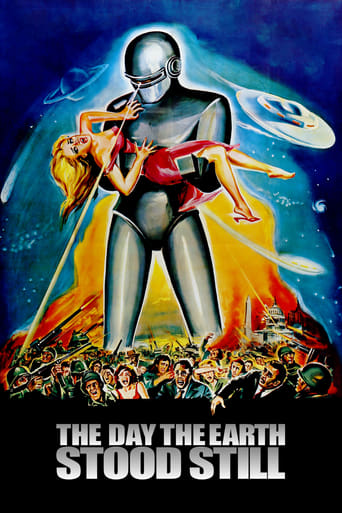
The Day the Earth Stood Still
1951 · Film · 92 min
Directed by Robert Wise
An alien and a robot land on Earth after World War II and tell mankind to be peaceful or face destruction.
7 positive1 mixed10 neutralfrom 18 commenters
Where to watch
No streaming data for this title.

19 comments on Hacker News
"They live" was a cult classic, and great fun if you were a Roddy Piper fan.
Other entertaining films =3
"The Great Dictator" (Charlie Chaplin, 1940)
https://archive.org/details/the-great-dictator-disc-01-title-2
"Day the Earth Stood Still" (1951)
https://archive.org/details/day-the-earth-stood-still-1951
"Invasion Of The Body Snatchers" (1956)
https://archive.org/details/invasionofthebodysnatchers1956_201911/
"The Man in the White Suit" (1951)
https://archive.org/details/the-man-in-the-white-suit_202105
"The Twilight Zone" (1959)
https://archive.org/details/the-twilight-zone-1959-s-01-e-00-original-pilot/The+Twilight+Zone+1959+S01E12+What+You+Need.mp4
https://archive.org/details/the-twilight-zone-1959-s-01-e-00-original-pilot/The+Twilight+Zone+1959+S01E25+People+Are+Alike+All+Over.mp4
https://archive.org/details/the-twilight-zone-1959-s-03-e-15-a-quality-of-mercy/The+Twilight+Zone+1959+S03E24+To+Serve+Man.mp4
https://archive.org/details/the-twilight-zone-1959-s-03-e-15-a-quality-of-mercy/The+Twilight+Zone+1959+S03E28+The+Little+People.mp4
Maybe they might make a Black Mirror episode titled "The Day The Earth Stood Still"
Yeah. It ages well. The Day the Earth Stood Still is on my favorite film list but you have to try to ignore the pretty heavy-handed benevolent alien overlords that know better than foolish aggressive humans theme.
One of the old scifi movies that aged really well.
Others that come to mind:
- The Day the Earth Stood Still
- The Andromeda Strain
This seems appropriate today. It's the ending of "Farewell to the Master", the story on which "The Day the Earth Stood Still" is based. Most people know the movie, the one where the flying saucer lands on the Washington Mall and a human-like character, Klaatu, and a robot, Gnut, get out. In the movie, it seems the human is in charge. But here is the original story:
“Gnut,” he said earnestly, holding carefully the limp body in his arms, “you must do one thing for me. Listen carefully. I want you to tell your master—the master yet to come—that what happened to the first Klaatu was an accident, for which all Earth is immeasurably sorry. Will you do that?”
“I have known it,” the robot answered gently.
“But will you promise to tell your master—just those words—as soon as he is arrived?”
“You misunderstand,” said Gnut, still gently, and quietly spoke four more words. As Cliff heard them a mist passed over his eyes and his body went numb. As he recovered and his eyes came back to focus he saw the great ship disappear. It just suddenly was not there any more. He fell back a step or two. In his ears, like great bells, rang Gnut’s last words. Never, never was he to disclose them till the day he came to die. “You misunderstand,” the mighty robot had said. “I am the master.”
"2010: The Year We Make Contact" is a much more accessible movie that holds up pretty well. It also feels like a payoff after investing so much time being confused/bored by 2001.
I was 11 when "Logan's Run" came out. Yes it's kinda loaded with 70's sex tropes for the first act, but it's also equal parts goofy and a really good film.
The original "The Day The Earth Stood Still" holds up.
"A Boy and His Dog" is a bit crude here and there, but might resonate with a 12yo.
"Quatermass and the Pit" (aka "Five Million Years to Earth") is both intense and fairly tame.
A lot of old TV series hold up - Twilight Zone, Outer Limits, UFO, Space 1999, Star Trek TOS, etc all have some excellent episodes.
I absolutely love "Dark City" and "12 Monkeys" but I'm not sure they'd have held my interest at 12.
Doctor Who, both old and new are excellent. Though I'm partial to the Tom Baker era.
The Stargate franchise is pretty good.
"Moon" (2009) is a bit cerebral but a good SF story.
I would hope their contact would be with real scientists, group psychologists, astronomers, mathematicians and philosophers but I think I know better. Call me skeptical but the movie "The Day The Earth Stood Still" captured perfectly what I foresee unfolding. [1] Governments would step in, someone would do something dumb and we would discover quickly how socially, technically and intellectually evolved we are not. Then comes the disinfection. [2] If I am incorrect please enlighten me.
I am predicating this on the idea that the aliens likely would have come from a solar system that developed in a similar ring of our galaxy that started in the same time as our solar system, totally accepting that evolution would vary wildly. Looking back on human history and see that every time we started to become technically and socially advanced, some narcissistic sociopath leader would abuse religion to lead people into wars and destroy anything that threatens their power, including knowledge and technology. Even assuming evolution was identical between solar systems, I expect we are no less than 4k years behind our neighbors and quite possibly much further behind than that depending on how many times civilization has already been reset and at what rate each species evolved. I admit there are many variables nobody could possibly account for. It is entirely possible we could be millions of years behind or ahead. I do not believe we are ready for this scenario and we should focus on first getting along with one another and working as one species to evolve quickly as one unified people.
[1] - https://www.youtube.com/watch?v=cRLoR0-Xblc
[2] - https://www.youtube.com/watch?v=v_C1Tn_h6lk
I asked ChatGPT. It gave me bunch. I got some I've never heard of. I think I'll look into them.
<ChatGPT>
list 50 interesting movies that explore AI.
The Matrix
Ex Machina
Blade Runner
The Terminator
I, Robot
The War of the Worlds
A.I. Artificial Intelligence
Transcendence
The Fifth Element
2001: A Space Odyssey
WarGames
Westworld
The Machine
Her
The Iron Giant
Automata
The Truman Show
The Prestige
The Martian
The Fly
The Bicentennial Man
Surrogates
The Day the Earth Stood Still
Limitless
Robocop
Electric Dreams
The Island
The Time Machine
The Circle
The Arrival
The Host
The Stepford Wives
The Brain that Wouldn't Die
Frankenstein
The Invisible Man
Metropolis
The Thing
Jurassic Park
Independence Day
Gravity
Artificial Intelligence: AI
Avatar
The Hitchhiker's Guide to the Galaxy
The Matrix Reloaded
The Matrix Revolutions
Inception
Interstellar
The Time Traveler's Wife
The Butterfly Effect
The Future.
</ChatGPT>
OTOH, I can't imagine enjoying Casablanca in color. Or Citizen Kane, Thin Man, or African Queen. B&W is part of a film's atmosphere, it's different.
I'd never want to see Forbidden Planet in B&W ... and The Day the Earth Stood Still in color? criminal!
"Klaatu barada nikto" is a code phrase from The Day the Earth Stood Still to stop the homicidal antagonists from killing you.
It's doubly famous because Sam Raimi recycled it in "Army of Darkness" as an incantation to dispel the curse of the Necronomicon (book of the dead, portrayed as the arch book of black magic in any number of stories), which our hapless anti-hero Ash fucks up and thus unleashes the armies of the dead on a roughly medieval and wholly unprepared world.
If you like campy horror movies, there is so much camp in Army of Darkness that there's barely any room for the horror. It is technically a sequel but it works as a standalone movie. I watched it years before I finally sat down and watched The Evil Dead.
Hands down the best movie experience I've had was this old refurbished theater in my hometown in the 90's and early 00's. Two weekends each month they showed an old movie. Classics from Casablanca, Laurence of Arabia, Fiddler on the Roof, to The Day the Earth Stood Still, Forbidden Planet and War of The Worlds.
Tickets were $4-5, boxes of popcorn and soda's of reasonable size were a $1-2 each, all movies lead with a cartoon and had an intermission.
Best of all the ushers. They would kick you out if you made too much noise and wouldn't let you take your seat if you got up too often.
It's a real shame that movie studios have cut the theaters margin on movies so thin that the theaters can't bring their snack prices down, nor offer a better experience (like kicking people out who can't shut up).
I read farewell to the master in a Hugo winners collection. I then saw "The Day the Earth Stood Still" and felt the movie was much better. The ending of the short story was IMO the weakest part, but ymmv.
Quite a few on this list are sci-fi legends.
Indeed.
"The Machine Stops" is a must-read. It's over a century old and is not dated.
I've always liked "With the Night Mail". Kipling wrote two SF stories, and this is one of them.
"A Logic Named Joe" - the Internet and Google, from 1946.
"Ender's Game", the short story, was of course expanded into a series of books and a movie. The original short story is better.
That's also true of "Farewell to the Master", not on the list. That's the basis for "The Day the Earth Stood Still". The original short story is very rarely seen. Nor is the ending well known. It should be. Wikipedia summarizes it.
"Klaatu" is also a reference to the movie "The Day the Earth Stood Still".
One of the earliest science fiction movies dealt with the question of, "if aliens were to land, how might we greet them?" Answer: "we'd shoot first, ask questions later." (The Day the Earth Stood Still) Sunny outlook on that one, eh?
With calculus, you are already well into ordinary differential equations -- partial differential equations are different, but with calculus you have a good start on the basics of those, too.
A simple ordinary differential equation is below where of course just from calculus
y'(t) = d/dt y(t)
and the equation is
y'(t) = k y(t) ( b - y(t))
So, for the context: t is time, say, in seconds. y is some real valued function of t, that is, y(t), b and k are constants. We are given the value of y at 0, that is y(t) at t = 0, that is, y(0). We want the value of y(t) for t > 0.
Okay, with that, just need to use freshman calculus, for positive time s, integrate y'(t) from 0 to s. This is a simple exercise, without looking up the last dozen times I did that, maybe use integration by parts or some such. End up with a quotient with some exponentials.
Differential equations pop up in motion, e.g., from Newton's second law, AC circuit theory, and some other areas of science and engineering.
Boundary value problems, e.g., vibrating stings, parts of deterministic optimal control, are closely related but, still, significantly different.
Long some of the pure mathematicians went, in a word, "nuts" studying differential equations. The best of the results are good, and some of those are nicely useful. In places the work has nice contact with linear algebra, matrix theory, and vector spaces of functions, functional analysis, e.g., Hilbert and Banach spaces. But hanging over the whole subject is a suspicion that, really, as nice as the general theories are, mostly the applications are just a few, standard differential equations. It's a little like learning everything about civil engineering when really are only going to do framing carpentry, hang drywall, and apply roof shingles.
Once I bought
Garrett Birkhoff and Gian-Carlo Rota, {\it Ordinary Differential Equations,\/} Ginn and Company, Boston, 1962.\ \
I looked through it, saw lots of intricate stuff, but wondered just why I should dig into that. Since then I read a story about Rota about how, apparently, he felt much the same about the material, got stuck teaching the differential equations course because he wrote that book, and wanted, essentially, to f'get about that book and its material!
I had a full college course in ordinary differential equations. Okay: It left me wildly over educated for the differential equations in AC circuit theory. Otherwise I didn't much like the book, the teacher, or the course.
On the advanced stuff, here is some more
Earl A.\ Coddington and Norman Levinson, {\it Theory of Ordinary Differential Equations,\/} McGraw-Hill, New York, 1955.\ \
It has a nice result of Caratheodory, but in general could lose a lot of sleep working through that!
I had a course from a Ph.D. from MIT from the book, apparently long a standard at MIT,
Francis B.\ Hildebrand, {\it Advanced Calculus for Applications,\/} Prentice-Hall, Englewood Cliffs, NJ, 1962.\ \
So, yes, can find out about solutions via infinite series and boundary value problems. The book was very short on proofs, and to take such material seriously I wanted to see the proofs. Now that I know a lot more math, no doubt some of it originally motivated by material in that book, maybe I could fill in the proofs.
When I was at FedEx, I wondered about the cheapest way to climb, cruise, and descend the airplanes, had heard about
Michael Athans and Peter L.\ Falb, {\it Optimal Control:\ \ An Introduction to the Theory and Its Applications,\/} McGraw-Hill Book Company, New York, 1966.\ \
and flew up to MIT and met with Athans, got his course notes, etc. He explained that an application would be a "two point boundary value problem with mixed end conditions" -- okay, I'd had a course on numerical methods for that. But, in the early parts of the book will see something interesting -- fast, and well written coverage of the differential equations material needed for the book. This is an example of a general situation: Sometimes the best place to learn something is in an introduction or appendix written by a real expert who is also a good writer, intended as background for the rest of the book. So, such a source cuts out the tangential, maybe curious cruft can't much hope to use.
At one point after college on my own I carefully read, not nearly new at the time (TeX markup):
Earl A.\ Coddington, {\it An Introduction to Ordinary Differential Equations,\/} Prentice-Hall, Englewood Cliffs, NJ, 1961.
Coddington was not just a grand expert in the field but also a good writer. I really liked his stuff on variation of parameters -- a bit amazing. Note: Can find mention of that in the famous movie The Day the Earth Stood Still -- apparently that math was hot stuff in applied math about when the movie was made.
Can say some quite similar things about partial differential equations -- e.g., there are deep books, some connections with functional analysis (and even the theory of distributions) but the main interests are the partial differential equations of mathematical physics, especially, Maxwell's equations, the heat equation, the wave equation, Schrödinger equation, a wave equation, and the notorious Navier-Stokes equations -- which likely should attack only for limited goals and in somewhat special cases.
Net, unless you have some significant reason for more, I suggest you learn what you need to know, just in time, when and if you need it. But, in that case, as elsewhere, a good pure math background in calculus, and advanced calculus with the proofs, etc. will be good to have.
Here are my recommendations:
* Sunshine: I'll second this one, about a crew on a mission in space, turns into a different kind of film in the second half, which many people didn't like; has breathtaking visuals and a strong soundtrack.
* Her: A guy falls in love with an AI; has a wonderful atmosphere
* Gattaca: Set in a future of genetic engineering and how the protagonist fights against class discrimination
* Ex Machina, this was pretty hyped I'd say, but takes the opposite approach of Her and shows us the dangers of AI
* The Day the Earth Stood Still: a representative of aliens arrives on earth to tell humans to knock off their douchebaggery; still highly relevant today
* Metropolis: a silent film with a powerful score, set in a future with a large class disparity where the workers rebel
Honorable mentions that I'm not sure are really sci-fi: Brazil, The Prestige, Watchmen
My major point is that there are counter-examples, so the biases you point out are likely not the primary motivators for the organizations.
I am not competent to judge the ongoing discussions on diet. Personally, I agree with your last paragraph.
I did try to read the article but it depends on a large amount of background that I don't have.
I note that Feinman references an observational study, so probably does not consider that methodology as shit as you do.
I note also the declaration of interests section, where we learn that "Richard Feinman writes reviews for Fleishman-Hillard, whose client is the Corn Refiners Association and he has received grant support from the Veronica and Robert C. Atkins Foundation." The others work as consultants, are funded by, or in a consulting capacity for Atkins, for companies like Jenny Craig and McDonald's, for the pharmaceutical company Eli Lilly, and for a company which produces a low-carbohydrate meal replacement
If the argument "If your paycheck depends on researching how drugs impact diabetes ..." has merit then surely the argument "If your paycheck depends on researching how refined corn oil and low carbs impact diabetes" also has merit.
Why do you believe Feinman's work is any less biased by money than that of someone funded by the ADA?
For some levity, this topic easily brings to mind Woody Allen's "Sleeper": "You mean there was no deep fat? No steak or cream pies or... hot fudge?" / "Those were thought to be unhealthy... precisely the opposite of what we now know to be true."
As well as a scene in the 1951 film "The Day the Earth Stood still": when one doctor talks to the other: "[He] Says their medicine's much more advanced." / "He was very nice about it, but he made me feel like a third-class witch doctor." ... while handing the other doctor a cigarette. (This caused the audience to crack up when I saw it about 15 years ago.)
Nit picker.
:)
I was watching the original version of The Day the Earth Stood Still, and there was one scene that stood out as marking this film as truly from another time.
Klaatu is talking to the boy, asking him about who the famous scientists are. And the boy knows! And acts as if everyone in American knows!
I gather there are many interesting contemporary scientists, but they simply get no attention in modern culture.