 Hacker Cinema
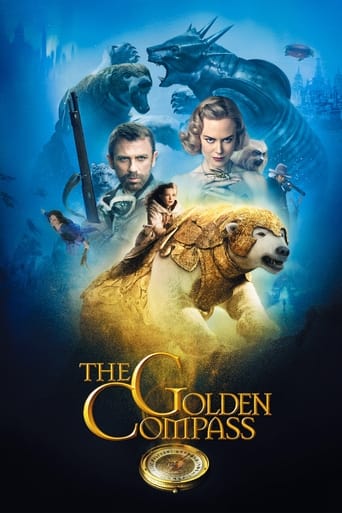
The Golden Compass
2007 · Film · 113 min
Directed by Chris Weitz
In a parallel universe, after overhearing a shocking secret, precocious orphan Lyra Belacqua trades her carefree existence roaming the halls of Jordan College for an otherworldly adventure in the far North, unaware that it's part of her destiny.
6 negative1 mixed4 neutralfrom 11 commenters
Where to watch
No streaming data for this title.


11 comments on Hacker News
This is a good point.
Modern movies try to appeal to everyone. Can't be too edgy or too opinionated, don't want to sick rabid hordes of haters on themselves.
And there's a huge segment of the Western population teetering on the edge of death or living in misery in various ways who are a literal matchbox waiting for a spark, no megaconglomerate film company wants to be responsible for setting them off, to the point where it's safer to sell mediocre and milquetoast movies rather than push an opinionated one and risk blowback.
Look at the Beetlejuice Beetlejuice or the Craft 2. Both movies built on a previous proven winner, both original movies had something to say.
Beetlejuice was not only a quirky romp through the afterlife but also a story about aboriginalism vs colonialism and whether it is right for the aboriginals to do horrible things to protect what is theirs, and also a story about how embracing change can help cross generational divides and how accepting people who are different from you can enrich your life.
It was very opinionated and had a lot of great subcontext. Same with the Craft.
The Craft was, on its cover, a story about what teenage girls would do if they got magical powers, which then turned into a series of biopics of the deep emotional damages caused by indifferent and hateful people. The movie dealt with racism, sexual assault, murder, mental illness, self esteem, and self acceptance all in the context of a teenybop horror movie.
Then you look at their sequels.
Beetlejuice Beetlejuice introduced 3 antagonists, Beetlejuice's wife, the boy, and Lydia's boyfriend.
It started three potential plotlines, the soul sucker, the life swapper, and the gold digger, and brought Beetlejuice in to deal with all three of them.
And then, 80% of the way through the movie, it threw all three of the antagonists and plot lines away and then rehashed the climax of the original movie with a slightly different set of clothes on.
What deeper meaning did Beetlejuice Beetlejuice have? None. No one had any value or made any sense. No one in the entire plot was irreplaceable. No one learned any lessons or grew in any measurable way. Nothing actually happened. They all woke up like they had a bad dream after Lydia's father's funeral, the mother died, the gold digger died, and then the story was over. If the movie had not happened nothing would be different for the characters except that maybe the gold digger would have dug more gold or something.
Then, the Craft 2. It's not a horror movie. It's a teenybop movie where girls get magic and do things with it. They have a trans person in it but she doesn't use her magic to address her transness in any way. There's only a tiny drop of racism, and no one has any real deep issues to resolve.
So, instead, they get David Duchovny in to play as some guy who embodies toxic masculinity, but who is also ineffective and purposeless all the way to the very end of the movie, when all of a sudden he goes murder rapey and then gets easily beaten by the power of feminism and witchcraft.
No one learned anything except GIRL POWER. Nothing really changed for anyone. There were no edges in the movie to explore. It was pointless.
Either sequel could have been much more poignant by touching on real issues that people experience. The Craft 2 could have touched on social media and the need to look like you have a perfect life. They could have touched on what a trans woman would do if she could remold her body with magic permanently or semi permanently like the girl did in the first movie. They could have made Nancy a bigger part of the movie and have her deal with David Duchovny instead of it being a girl power movie, and then Nancy could have taught the girls the things she knows being a former vessel of Manon with 25 years to learn and grow from the experience. It could have gone into a demonstration and discussion on how young women have so much to learn from women even 20 years their senior, and how working together and tearing down walls both of age differences but also gender differences can make the world a better place.
Beetlejuice Beetlejuice could have made a really fun story out of any of the three protagonists and plot lines if it had picked and chose one of them to run with and made the others the sub plots. The gold digger plotline could have been about accepting what is different about you and not allowing others to convince you to mask your weirdness. The life swapper plot could have been about learning how to accept that you're a normal person who grew up in a weird household, and how that doesn't make you weird and that it is possible to make both sides work together as long as each side values the other. The soul sucker plotline could have been played for laughs as at the end we could have seen Beetlejuice about to win Lydia only to be thwarted by his actual wife and dragged off into the underworld by the leg by her (and end up happy in the end, maybe seeing him slowly reinflate after she sucked the soul out of him, he he sex joke). All of those options were thrown out of the window and instead we get a meandering pointless movie that would have been fine if it had never existed.
Good movies have an opinion and something to say. Napoleon Dynamite is a perfect example of this. It's a bad movie in every measurable way. It's boring. It's slowly paced. It has no plot. It's like a 2 hour slice of life Jello movie. But then, the point of the movie gets driven in, that everyone has value.
It's a simple message told in a long and occasionally humorous manner, but because they didn't try to piledrive the message into you when it hits it hits hard.
Bad movies ramble even more than I do and never make a point for fear of popping a bubble. And media franchises know this and choose to make them anyway rather than be at risk of any blowback. After all, most movies released by a large franchise are profitable by default. The number of AAA movies that did not make their cost of production back in the last 10 years is vanishingly small, to the point where movies that only make 150% of their production costs are considered box office bombs and franchise killers. (Like the Golden Compass, that made $370+ million and won academy awards on a $180m production cost and was considered enough of a failure to end the entire series)
They know how to make good movies. They know how to tell satisfying stories that keep people wanting more. They know how to make a lot of money doing it.
So why do they keep not doing it?
I believe it's 2 things.
1: Fear of offending people and having massive blowback because of it.
The outrages over stupid things like the Little Mermaid being black is a good example of this. Who cares what color her skin is? She's a fish. If the story is good and told well then what does it matter?
But I get it, you can't convince someone who wants to be upset and outraged as a distraction for their own personal problems to focus on their personal problems instead of screaming about DEI or whatever 4 letter flavor of the day they have to rage about. This much is understandable. But still, that's no excuse for making a bad movie, they could have far more easily found the rage points and dealt with them and left the rest of a good movie alone.
But that brings me to my second point.
2: It's on purpose.
I've been thinking about this for a while, but I'm starting to believe that megaconglomerate media companies are intentionally making unsatisfying movies that are highly titillating for the same reason that Doritos flavors their chips in just such a way that you never get satisfied of eating them, that final burst of zest and flavor that would put you over the edge always just out of reach.
It's like the torture of Tantalus, satisfaction always being just outside of arms reach, but knowing that it's close, and occasionally actually satisfying the itch (like any good skinner box) keeps us diving in, spending money, buying merch, showing our love and support for the franchises that once scratched the itch for us in hopes that it will scratch it again next time.
They're doing it on purpose because they know that if you didn't get what you wanted out of this movie, you'll go watch another, or a TV show, or read a book, or play a game, something, because you came to get satisfaction. And if they blue ball you just right, you'll keep spending money until you can't afford to spend any more in hopes that you'll finally get what you're looking for.
I think it's on purpose and I think it will keep getting worse until it cannot get any worse, and then it will be replaced with something else that will be massively satisfying for a while at least.
It doesn't work for me.
All icons on mobile look the same to me: I mean, Android's Material Design icons really look the same to me and even the icons from iOS never really stick in my head. That "settings" icon for instance with all the gears looks like a movie poster for The Golden Compass and not a settings dialog. The App store and Adobe Acrobat and many applications have meaningless logos based around a generic triangle...
Once something gets a mobile icon I will struggle to find it, but if I want to find something on the web it is a quick search, often autocompleted when I type a few letters, or easy to find in the bookmarks or maybe my history.
I only read as far as the author's first email to a movie muckity-muck, but if he actually used that tone in his communications with the studio, it is very unsurprising that they mostly ignored and sidelined him.
The movies were, apparently, terrible. I didn't see them myself, but I am sure they're about as good as the other awfully YA-fantasy adaptations from that era that aren't Harry Potter (Eragon, which I'm pretty sure is what the XXXXs refer to and Golden Compass, for example), but this email is not the way that you exert influence over a major creative endeavor.
Edit: I went back and read the longer email. The actual discussion of improvements is potentially good, but the overall tone is one of arrogance and an assumption of superior vision, which is just not the way you make progress.
This wasn’t a cliffhanger ending, it really wasn’t. There were so many points where the movie could have ended on a cliffhanger and it didn’t, instead it ended on a propre “pause”: things aren’t over but they’re also not left hanging.
I was really afraid of it ending like the golden compass movie’s cliffhanger which left me with such an awful taste in my mouth and then didn’t get a sequel…
Surprised / pleased that I'm a quarter of the way there (well, 24/100).
Didn't expect quite that much young adult literature - Harry Potter, Limony Snickett, Golden Compass, The Giver (plus Lord of the Rings). All major film franchises (well, The Giver under production).
Was amazed to see The Phantom Tollbooth. One of my favourite books of all time, though I haven't read it since I was a child and honestly have never met another person who'd heard of it!
Yeah, but The Golden Compass wound up being just a bad movie. I loved the books.
According to Rotten Tomatoes, both critics and audiences thought Chronicles was simply a better movie. Unless you think the critics were somehow swayed by protestors? Seems unlikely.
http://www.rottentomatoes.com/m/his_dark_materials_the_golden_compass/
http://www.rottentomatoes.com/m/chronicles_of_narnia_lion_witch_wardrobe/
There's good and bad publicity, and while the line might be blurred for software startups, it's fairly clear for film studios. Pissing off the conservative crowd in North America comes with some consequences for an entertainment/media company.
Case in point: The Golden Compass. The studio was shooting for a $30 million dollar opening weekend. They grossed something like $8.8 mil. You might recall that leading up to the opening there was a lot discussion (and a few calls for protests) surrounding some of the material in the books.
Compare/contrast "The Chronicles of Narnia". Both movies had similar budgets and targeted the same audience. Chronicles wasn't burdened by a bunch of controversy and pulled in ~$20 mil on the opening weekend.
http://dictionary.reference.com/browse/daemon Pronounces it DEE-mon which is how I've always said it. (The Golden Compass audiobooks and movie also pronounce their spirit animals, called Daemons, as DEE-mon).
I always thought the UNIX term came from the meaning of a subordinate/helper spirit (which is what they are, basically - helper services)
Edit: interchangeably, DEE-mon or DEE-mun
Best visual effects: The Golden Compass
Also nominated: Pirates of the Caribbean: At World's End, Transformers
I saw all three of those movies, and even though GC was supremely craptastic, its effect were beautiful. I loved Transformers and I still think GC had better visual effects.
The Golden Compass movie was really awful. Maybe it's notable that bad movies win Oscars? ;)