 Hacker Cinema
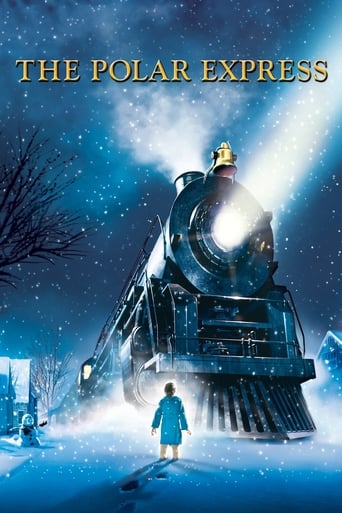
The Polar Express
2004 · Film · 100 min
Directed by Robert Zemeckis
AdventureAnimationFamilyFantasy
When a doubting young boy takes an extraordinary train ride to the North Pole, he embarks on a journey of self-discovery that shows him that the wonder of life never fades for those who believe.
1 positive4 negative1 mixed8 neutralfrom 14 commenters
Where to watch
No streaming data for this title.

14 comments on Hacker News
I do think there's also just a sort of natural goal-post moving when you're talking about something that's hard to imagine. The best comparison in my mind is CGI in movies. When you've never seen something like the Matrix or Lord of the Rings or even Polar Express before, it's wild, but the more you see and sit with it, the more the stuff that isn't right stands out to you.
It doesn't mean it's not impressive, but it's hard to describe what isn't realistic about something until you see it. A technology getting things 90% right may still be wrong enough to be noticeable to people, but it's not like you could predict what the 10% that's wrong will be until you try it, and competing technologies may not have the same 10% that's wrong.
That movie didn't do well, but in retrospect, it is amazingly good compared to the dead eyed CGI people of the Polar Express, made three years later!
Happy Christmas Eve! I agree, HN is a great community.
So, what movie are we watching tonight?
I have a penchant for The Polar Express because I love how deep in the uncanny valley it goes, plus the absurdity of Santa appearing as a totalitarian dictator before his adoring fanatic minions somehow gives me great joy. Wandering around the abandoned factory floors and listening to the elf's last minute wrapping up of business reminds me of more than a few Christmas Eve's at work in large office buildings trying to get that last bit of code pushed before the break.
But, you know, Elf is good too.
Prediction: This is going to reduce the cost of producing non-stylized animated motions and lead to a lot of movies that look something like Polar Express.
> After all, could you really, badly, critic a 30’s movie because it is not shoot in HD?
1930s films did "shoot in HD". Most films were either 16mm or 35mm, both of which have more than enough fidelity to represent video at 1080p or higher without loss of quality. Here's a copy of Wizard of Oz on 4K UHD: https://www.amazon.com/Wizard-Oz-Limited-Anniversary-Collection/dp/B07WT62PPT
A more realistic take is could you criticize 1920s films for not shooting with sound, and the answer is yes, absolutely. Films went from almost entirely silent to almost entirely talkies in roughly 3 years because of massive, unprecedented, and immediate commercial pressure to do so. Audiences ate up even mediocre talkies and shunned silent works now considered classics. The only reason colour film adoption wasn't similarly fast was because of Technicolor's monopoly.
Flash forward to the 1990s, where cinema as a medium was very sophisticated. Now look at blockbusters beginning to use CG rather than animatronics. The airplane in Air Force One. Jar Jar Binks in Phantom Menace. Hell, take the 1997 re-releases of the Star Wars trilogy which inexplicably added garbage like CG Jabba the Hutt. The purple stuff in The Langoliers. Even going back to Lord of the Rings, even going back to the Hobbit, even going back to "early" Marvel films there are tons of moments where CG is jarring. The Polar Express -- an excellent and heartwarming Zemeckis film -- is mostly known because no one likes the dead-eye CG. Yes, absolutely, technical barriers have affected peoples enjoyment of film and still do!
In video games the most obvious period of time that is conspicuously a donut hole is the Playstation 1 / early 3D era. The PS1s 3d games featured really quite nauseating affine texture warping due to a lack of hardware correction support. Here's one video of many talking about this: https://www.youtube.com/watch?v=x8TO-nrUtSI Early 3d controls are atrocious -- the "tank controls" of Resident Evil are famous for this -- because controllers initially didn't have analogue sticks and when they did, they didn't yet have basic paradigms around how to best use them. The Nintendo 64 was built around analogue control, which is why Mario 64 works so well, and yet it has a completely rotten camera system because there's only a single analogue stick and the c-buttons aren't a good substitute. And that's the PS1/N64. If you go back to the earlier era of 3D, especially on the Super Nintendo, you find low framerate, awkward controlling messes with flat polygon shading. Try playing an unmodified copy of StarFox or Stunt Race FX, I dare you.
No one is saying to throw Casablanca out with the bathwater, just as no one is going to throw Super Mario Bros, out with the bathwater. I'm not saying that technical issues mean we should never play old games or watch old movies. I'm saying that it shouldn't be surprising that people do count technical issues as part of the reason why they prefer newer stuff.
I also think the article misses widely when it pretends that "old ways" of making games don't exist today. Games are made in now-dead genres, with now-dead mechanics, all the time. They have commercial budgets at least as large as they ever did and large, warm communities. In many cases, the original teams working on games in the 1980s and 1990s still make games. I can't find an example in the article where you can't find similar games to play today.
The article mentions that isometric games would be anathema today. Disco Elysium is one of the most acclaimed games of the last few years. Wasteland has two recent sequels, both well liked. Hades is also one of the most acclaimed games of the last few years. Age of Empires IV retains a basically isometric perspective for an RTS. Diablo Immortal just launched and Diablo 4 is coming. Huh?
The article mentions unnamed youngsters not liking the real-ish time mechanics of Titanic Adventure Out of Time, or the difficulty of the puzzles, feeling that they're too punishing. I doubt it. Majora's Mask (1999) is considered an excellent Zelda because of its time mechanics. Dead Rising (2006) was one of the first major hits of the HD era of video games and it's on a fixed timer. Final Fantasy XIII-3 (2013) uses a similar mechanic, and while the game is often criticized for being terribly written nonsense, it's not because of the mechanic.
Or if not the time mechanic, then needing to take notes? Hollow Knight is maybe the most critically acclaimed indie game of all time and most people play it with a fan wiki open, to say nothing of From Software (Dark Souls, Elden Ring) suddenly becoming the apex of prestige developer. Point and click adventures are still quite popular: The Return of the Obra Dinn is widely considered among the best games of the 2010s.
The article claims unnamed gamers today are reacting negatively to the visual choices of the new Monkey Island. This just seems entirely untrue. The reaction across the internet, including on gaming forums, reddit, and here, was overwhelmingly positive. A few people said "okay, this style reminds me a bit of the not-great LucasArts Singapore modernizations of the first few Monkey Islands". This does not presage a great backlash against the game, it's just people shooting from the hip, the vast majority of anyone who cares to comment is excited even if they have concerns about the visuals. And anyway, 99% of the people commenting are greybeards like the rest of us, not young people.
Overall I can't find much here that resonates with me.
I wonder if people will hit an uncanny valley here: my experience with video animation was that sometime around “The Polar Express” animated movie makers realized that audiences didn’t really want more and more realistic animation.
Children getting whisked away by a handsome protagonist and his magical sidekick to fight against "cool things" like pirates and mermaids in a world unlike our own?
Its an Isekai.
---------
Isekai is this modern trend in anime (and US movies sometimes!! Like Ready Player One), where characters are sent to another world. Sometimes due to death explicitly ("Reincarnated in a New World" plotline: like "I'm a Spider So What"), sometimes just "temporarily" transported (Sword Art Online / Ready Player One, they are "just" playing a video game).
From an "Isekai" perspective: people want two things.
1. A world very different from our own. Completely different "physics" or rules. So magic systems, history, culture, etc. etc. that's nothing like our world. Neverland easily qualifies.
2. A character who explores the new world from our perspective. The main character is always someone "like the audience", who can be ignorant about the new world. (The various characters the protagonist meets are therefore given an opportunity to explain the world to the newcomer, allowing the audience to learn about the world in a natural manner). In Peter Pan, Wendy is the Isekai protagonist.
------
Alice in Wonderland, Connecticut Yankee in King Arthur's Court, Wizard of Oz, A Lion, A Witch, and the Wardrobe. The concept happens again and again as a pattern, because its a good framing device. I'm not sure if Peter Pan can be seen as an allegory of death necessarily, any more than "I'm a Spider, so What?" (2021 Anime) could be.
The children are... children... because the main character often should match the profile of the target audience. Not always, but its a good rule of thumb to keep. Children stories will therefore have child-protagonists more often than not (Polar Express, Lion Witch Wardrobe, Harry Potter). There are exceptions (Peanuts has child protagonists but is largely written for an adult audience), but its just the rule of thumb authors seem to use.
The movies "The Polar Express" and "Beowulf" both by Robert Zemeckis were early attempts at using facial animation captured and transferred to digital characters. Both had problems with the uncanny valley.
Oh it was. I've never seen a 3D movie before, I went specifically because so many critics I trust had said it may have been the first case of 3D done well and actually being useful to the storytelling.
But that's the same reason I don't expect to do it again any time soon. What were the previous movies where 3D was supposed to be a big part of the experience? Avatar? Polar Express? Even if those were perfect movies, they were years and years ago. The last time I even gave it a second thought was Hugo.
Gravity made a lot of sense, because you convey just how alone the characters were in the volume of space. It's going to be a while before someone makes a movie 1) with a good script and 2) a good director that 3) really uses 3D well.
True, but I suspect that doesn't massively prolong most movies, only big ones that people are passionate about (Star Wars, The Godfather Trilogy, etc).
Just randomly picking... 2004. Top 10 movies from that year, and pulling future media sales predictions out of my ass:
Shrek 2 kids movie, profitable regardless. Spider-Man 2 probably poor The Passion of the Christ probably poor Meet the Fockers nobody cares. The Incredibles kids movie, profitable regardless. Harry Potter and the Prisoner of Azkaban great. The Day After Tomorrow nobody cares. The Bourne Supremacy possibly good. National Treasure nobody cares. The Polar Express nobody cares.
I mean, I am sure all of these will have future releases on new media. There is no reason not to re-release movies, it is essentially printing money), but will many of them see dramatic sales that will really change how we view the profitability of those movies? Meet the Fockers was a good movie, but nobody is going to give a shit if you re-release it in 3D, 4K resolution, "hyperdisk". Only a few have that potential I think, and it gets more bleak if you stop looking at the top 10.
After the initial burst of home media sales, I just don't see most movies getting anything more than a trickle of revenue. For every movie like Office Space, there are dozens that aren't.
"...even motioncaptured movements seem unnatural and give no illusion of life."
I often agree with this. When digging deeper into the details of why this is the case, it's often because the motion captured data is played back on a model of different proportions than the actor. I think I first noticed this when a magazine article did a writeup on The Polar Express movie. There's a photo of Tom Hanks in a mocap suit beside a rendering of the train conductor in the same pose. The conductor's proportions were completely different from the real Mr. Hanks. I've also noticed this problem when ballet is mocapped and applied to computer models.
My opinion, since I'm no CGI expert nor hobbyist, is that actual natural movement has no place in a cartoon. You'll notice that each of Pixar's worlds maintains its own naturalness - Mr. Incredible moves the right way with respect to the 3D model in his own universe as do the other characters. Although they modeled Syndrome's swagger on a Pixar employee (or at least a real human if not a fellow Pixarite), that doesn't mean they applied an actual mocap session's data to the character model. Every time I've seen anything "behind the scenes" of a Pixar film, they're animating movement 'manually' and maintaining a 'natural' feeling within the context if the current project.
I think where the uncanny valley falls is different for everyone.
Obviously many people enjoyed watching the Final Fantasy movies as well as the Polar Express movie, and many will enjoy watching Tintin. I can barely get through the ads for these movies. Even the short Tintin preview is cringe inducing to me.
When I started out the two where the same, you had to do development to do design, the world has changed a good deal since then, I would say that the fields started their split after Photoshop was out, but up to PS 3 I remember designers writing their own plug-ins to do effects. I remember trading homemade plug-ins for Photoshop on BBS boards.
More to the point, I think you can learn the techniques and train the eye, but whether you can produce beauty with technique and an eye for design is subjective at best.
I personally am good enough to do commercial art for web apps but I won't be winning any fine art contests, I am fine with that because it is good enough for what I do. When I used to do simulation, I had a friend who was great at 3d art, when I would look at his work and compare it to our work (the rest of the teams) their was no comparison. He had a natural talent that none of us could achieve, to the rest we where good but he was better in a league of his own. He went on to work on the Polar Express and several other films, which in the 3D segment of design that is the major leagues.
The rest of the team (myself included) while good, would have never made it at that level. That being said, many enjoyed long careers in simulation and game development and where not affected by being the best 3D designer possible.
I wonder if there would be a similar "Uncanny Valley" effect if you have real people--who are the wrong real people, but look sort of like them.
Oddly, porn gives you some great case studies: any porn version of a major movie should have this effect. You could potentially do some kind of experiment where you see if Trekkies react to Whoref and 'Bater and Captain Dickhard the way other folks react to The Polar Express.