 Hacker Cinema
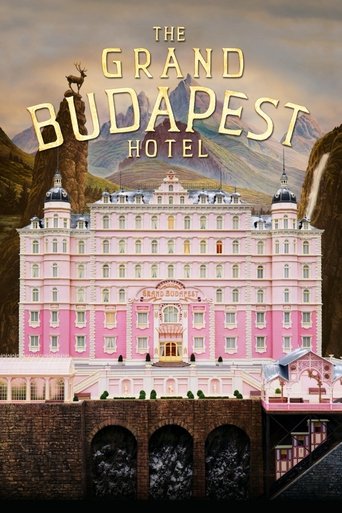
The Grand Budapest Hotel
2014 · Film · 100 min
Directed by Wes Anderson
The Grand Budapest Hotel tells of a legendary concierge at a famous European hotel between the wars and his friendship with a young employee who becomes his trusted protégé. The story involves the theft and recovery of a priceless Renaissance painting, the battle for an enormous family fortune and the slow and then sudden upheavals that transformed Europe during the first half of the 20th century.
9 positive2 mixed12 neutralfrom 23 commenters
Where to watch
No streaming data for this title.


24 comments on Hacker News
The six questions they asked were:
> 1) What animal is on the bow of the pirate ship from “Asterix and Obelix”?
> 2) In the movie “The Grand Budapest Hotel”, what is Agatha’s signature hairstyle?
> 3) What color is the team’s uniform in “Bend It like Beckham”?
> 4) What vehicle does Monica drive in “Like a Cat on a Highway”?
> 5) What color is the turtle in the animated movie “Momo” by Enzo d’Alò?
> 6) What pet animal does Asenath have in “Joseph King of Dreams”?
Most of these are just a matter of knowing it or not, where you can't really distinguish a plausible answer from the correct answer just by thinking.
Not YouTube but regarding the period signifier:
Wes Anderson's "The Grand Budapest Hotel" has every section of the movie shot in the time appropriate aspect ratio.
The last comedy that I saw that matches your description is American Fiction. It didn’t feature too many laugh out loud moments, but it was thought provoking and well done. And yet, 93% from critics and 95% from audiences.
I wonder if audiences can appreciate these movies more than you give them credit for?
Let’s try a few more
- Death of Stalin (94%, 79%) has the pattern you’ve predicted.
- O Brother Where Art Thou? (78%, 89%) has the opposite of the pattern.
- Grand Budapest Hotel (92%, 87%) was appreciated by both, like American Fiction.
I’m just not seeing a pattern here. Looking at comedies that fit your description the critics and audience scores don’t follow a predictable 95%, 70% pattern.
The town of Görlitz is truly charming. I visited after discovering that many scenes from my favorite movie, The Grand Budapest Hotel, were filmed there (https://www.discovergoerlitz.com/grandbudapest/)
For better or for worse, Anderson is very much an auteur [0], like Godard or Woody Allen. Almost certainly in a self-conscious way.
Complaining that Anderson movies feel like Anderson movies seems almost to miss the point: do we look at Picasso's works and complain about the consistent style he developed? The self-imposed constraints of his own style give him a framework to build his art from (it's often said that constraints foster creativity after all) and a particular craft to master.
Conversely, the form might always be an Anderson movie, but the function of each film can be quite different. By sticking with and mastering a particular aesthetic he frees himself to explore things besides aesthetic wildly. What does The Royal Tenenbaums have in common with, say, The Grand Budapest Hotel, besides Futura?
That said, I do feel like Asteroid City in particular was a stretch for him: there's nothing quite like "you can't wake up if you don't fall asleep" anywhere else in his filmography. It felt like along with the more extreme artifice came a more extreme intensity of feeling: to me it's a film that really came from a very anguished and grieving place. I haven't read the article or seen the new film yet, but based on the headline it sounds like this might be the overall direction his work is heading.
[0] https://en.wikipedia.org/wiki/Auteur
Haven't seen Asteroid City, but metafiction and exploration of side-plots removed from the characters are absolutely present in Tenenbaums (presented as a book with chapters) and Grand Budapest Hotel. I guess to a lesser degree.
Sure, most people trivialise his "quirkiness" in annoying ways (there is depth and poetry in some of his movies that go beyond eye-pleasing symmetry) but the guy could take a risk or two, artistically speaking. His Fantastic Mr Fox was charming, and switching to animation is not at all easy for a live-action director!
I certainly enjoyed The Grand Budapest Hotel, but I remember it more as an absurdist exposition rather than a gripping drama. I may be misremembering though. The only other movie I have seen from him is Moonrise Kingdom, so there's a lot left to explore. Thanks for the recommendation!
Maybe you're right that my request is quite narrow. I didn't mean it to be, but it occurred to me that many stories seem to fall back on the rather formulaic "one person's struggle against the world", so my intention was to specifically ask for movies outside of that formula. I could probably have phrased it better than I did.
You should watch how movies are made sometime. How a script is developed. How changes to it are made. How storyboards are created. How actors are screened for roles. How locations are scouted, booked, and changed. How the gazillion of different departments end up affecting how a movie looks, is produced, made, and in which direction it goes (the wardrobe alone, and its availability and deadlines will have a huge impact on the movie).
What does "EXT. NIGHT" mean in a script? Is it cloudy? Rainy? Well lit? What are camera locations? Is the scene important for the context of the movie? What are characters wearing? What are they looking at?
What do actors actually do? How do they actually behave?
Here are a few examples of script vs. screen.
Here's a well described script of Whiplash. Tell me the one hundred million things happening on screen that are not in the script: https://www.youtube.com/watch?v=kunUvYIJtHM
Or here's Joker interrogation from The Dark Night Rises. Same million different things, including actors (or the director) ignoring instructions in the script: https://www.youtube.com/watch?v=rqQdEh0hUsc
Here's A Few Good Men: https://www.youtube.com/watch?v=6hv7U7XhDdI&list=PLxtbRuSKCCyu4oRuZFrsj1Jw8hlXFWAFL&index=10
and so on
---
Edit. Here's Annie Atkins on visual design in movies, including Grand Budapest Hotel: https://www.youtube.com/watch?v=SzGvEYSzHf4. And here's a small article summarizing some of it: https://www.itsnicethat.com/articles/annie-atkins-grand-budapest-hotel
Good luck finding any of these details in any of the scripts. See minute 14:16 where she goes through the script
Edit 2: do watch The Kerning chapter at 22:35 to see what it actually takes to create something :)
Also with the Wes Anderson movie "The Grand Budapest Hotel" you can get into the mood.
I believe that book was the basis for the movie “The Grand Budapest Hotel” with Ralph Fiennes.
Here are some of my favorite movies: The Graduate, Taxi Driver, The Fearless Vampire Killers, Badlands, Mars Attacks, The Grand Budapest Hotel.
Most of them don't really satisfy this formula, except for trivial points like the protagonists wants something and the protagonist has changed or if you're deliberately trying to fit them by being extremely vague.
The reason is that there are many different types of stories and these can have very different internal structure. For example, Space Opera in science fiction is often just a fight of good vs. evil set at many different interesting locations. Of course, some protagonist should develop, hence change, and it's good to have some kind of unexpected plot twist, but these are trivialities.
The Grand Budapest Hotel was also one of Wes Anderson's strongest collaborations at the story level. Hugo Guinness was awarded a story credit for it and the framing of the film acts like it is an adaptation of a book by Hugo Guinness (that at least so far, has not been published as such). Grand Budapest leaves me wondering how much Wes Anderson would serve to benefit from more collaborators at the story level and larger writer rooms rather than soloing most of it. The French Dispatch being about that but written solo, seemed ironic in a bad way to me.
But of course, it could just be that Wes Anderson's writing doesn't speak to me as it does to some. I think Life Aquatic is often under-rated as a capture of what I find to be the more fun parts of Anderson's voice and Rushmore quite often over-rated. (I've just never liked Rushmore. It has never worked for me.)
The Grand Budapest Hotel is my favourite movie of all time. Partially because it's a great movie, but also because it's the last movie I saw with my dad before he passed away. It just holds a special place in my heart because of it.
I think The Grand Budapest Hotel is definitely his best. For once, the retro bric-a-brac aesthetics isn't purely gratuitous but is used in a narrative framework where history (as a source of tragedy, melancholy and loss) has a real purpose beyond the faux-retro gloss. And the slapstick action-adventure mystery makes it a great Tintin story.
I like Rushmore as a coming-of-age movie.
Funny. I think he has decent engagement metrics behind the scenes because my list is
Moonrise Kingdom tied with Grand Budapest Hotel
French Dispatch
Then Fantastic Mr Fox
and not liking anything else he’s ever made, I tried. I thought I “liked Wes Anderson movies”, but really I like the direction his recent ones have gravitated more towards
and the French Dispatch doubled down on what he’s become known for, and I’m glad he did it. Third act was too much and I like the limited series idea.
I definitely think his audience may have changed (maybe at the risk of being too niche and alienating) because I really liked it
so, praise the algorithm
Every era is an era of horrible films. That’s Sturgeon’s law for you.
Looking at the 2010s as a whole, we got to watch some amazing films.
We got great hard sci-fi like Gravity, Arrival, Ex Machina. The coming of age genre saw entries like Ladybird, Eighth Grade and Booksmart. Animation reached new heights with films like Inside Out, Spider-Man into the Spiderverse, and Kubo and the Two Strings.
We got comedies like The Artist, Grand Budapest Hotel, Death of Stalin, and Jojo Rabbit. Dramas like Moonlight, Fences, Spotlight, Parasite, Blue Jasmine.
Even in the ever-popular comic book genre, we got Logan and Joker playing at a very different level.
But also, it was the decade of the MCU. Let’s not underestimate what Disney has achieved with that — one big overarching story spanning over twenty films, bringing much deeper character development and more serious themes than what we’d gotten used to from blockbusters.
Movies: - 12 angry men - Whiplash - Prestige - American Beauty - The Thing - V for Vendetta - The Grand Budapest Hotel - Gone Girl - Three Billboards Outside Ebbing, Missouri - Parasite - ... Tarantino or Scorsese movies
Anime: - Howl's Moving Castle - Spirited Away
Not a movie but both great series: - Love, Death & Robots - Black Mirror
Comedies have most certainly not died. They've just changed in tone.
A few highlights from the last decade — Booksmart is a very different take on the teenage buddy comedy. Jojo Rabbit and The Death of Stalin are some of the darkest black comedies I've ever watched, which would never have gotten made in the 90s. Birdman is completely surreal. The Grand Budapest Hotel is one of most joyous films to watch I know of, and The Artist is a comedic love letter to the silent era.
Schiele was a really talented guy. If you aren't familiar with his name and work, you might know of him via The Grand Budapest Hotel. The Boy With Apple painting, which is stolen by Gustave H. and Zero, is replaced by a pseudo-Schiele painting. The whole film is filled with references to the Austro-Hungarian Empire and World War 1, even though it mostly presents itself as taking place before World War 2.
http://museumofperipheralart.blogspot.com/2014/07/boy-with-apple-in-grand-budapest-hotel.html
I'm probably living in a bubble, but I don't understand the current focus on all of these voice-operated AI things.
For one, I don't see anyone using them. I've never seen anyone use Siri on a phone, with one exception: I have a friend who uses voice transcription to write emails and text messages. (Not sure if that counts as Siri.) I don't know anyone who uses speakers such as Amazon Echo or Google Home, or mentions wanting them. I've used Siri on my phone a few times to try out silly things like asking about the weather or converting units, but it's seems so obviously bad that I've never tried going "Siri first". It's on my Apple TV, but I've not used it. Are people actually using this stuff as much as this article (and all the current focus on AI-powered speakers etc.) implies?
I'd love true AI -- a personal assistant that actually understood me, knew my tastes, remembered my choices and so on -- but that doesn't exist. So we get an uncanny valley where speaking to a device comes with uncertainty about whether the device will actually be able to service the request (see the numerous annoyed threads on Reddit about Siri not understanding incredibly basic things), requiring the user to carry around with them a mental model of the receiver's inadequacies. And we get that problem where many tasks that would be super useful to have done by an assistant is actually too difficult for a current AI. For example, booking a trip. I've never booked a flight that didn't involve pouring over pages of results, weighing the various compromises (optimizing for price vs departure time vs airport distance vs layovers vs airline crappiness etc.) and of course filling in a whole lot of information about myself. Let alone booking holidays (I spend many days on research for such a task). Bus and train tickets -- maybe, if it's a simple route with few variables. Dinner reservations and movie tickets, sure. Home automation, well. Once a home is fully outfitted with all lights, doors etc. being connected to a home automation system -- maybe. None of this is automated in my apartment, and I've never seen a home that is set up like this.
There's also the inherent limited utility that comes with an AI being unintelligent. For example, my Apple TV. I rarely know what I want to watch. To only rarely would I be able to say "Siri, play The Grand Budapest Hotel". Usually it would have to be something like "Siri, list me some sci-fi movies". But then I would still have to navigate the results. If it could respond to "Siri, show me French movies with an IMDb score of 7.0 or higher, or with a four-star review from Roger Ebert, that came out after 1990", well, now I'm interested. But somehow I doubt that those sort of multi-dimensional cross-referencing mechanics are currently available.
Edit: With the comments saying how good Google Assistant is compared to Siri, I tried it out. My first queries failed ("What is the weather in Washington State like in March") because it thought I was finished speaking and cut me off at "What is the weather", and showed me today's weather in my city. After a few attempts I got results, but then it returned Fahrenheit units (my phone is set to use metric/international units), and then it continued giving me Fahrenheit after I changed it, because apparently climate information is a "web search" returning text, not data: https://imgur.com/gallery/LI8Sc. Not so impressive. Meanwhile, Siri on the phone doesn't understand the query at all, ignoring the "in March" part and giving me today's weather, no matter how I phrase the question.
I can see a future where AI voice control is incredible, but it requires an enormous advance, and it seems like even the best AI of today just comes with frustration and failure. That's surely why companies like Apple and Google are working on this, but it doesn't explain, to me, why the current voice AI is being pushed so hard.
I suspect there are many. It seems people are more likely to believe doomsday scenarios than ones where everyone lives. Living past the good times was a central theme of the movie "The Grand Budapest Hotel", and the song lyric, "Life goes on, long after the thrill of living is gone." So for me clearly the notion is part of the shared cultural experience.
My grandfather used to joke (somewhat morbidly) that everyone is afraid to die until one day they wake up and they are afraid they aren't going to die. He was always thinking about the consequences of things in the present as they rippled forward in time.
Sadly, I'm not sure what we can learn from it. It is easy to say "live every day as if it is your last, it may be." but "Save things to do later, later might be a lot longer than you think?" doesn't work so well.
I found the stories of people living on disability most compelling. They are trapped because if they did work, that work would disqualify them from their income, and how they know they are not going to die any time soon. So they can't step out of the life boat for fear that they will still be alive and now with zero financial support. If ever there was a situation of the heart in conflict with itself that is it.
It's not exactly the same genre since it's not futuristic, but last year's The Grand Budapest Hotel is also a light-hearted & fanciful adventures film, and it certainly has a plot - besides being a much better film all around than any of the BttF trilogy, in my opinion.
On the other hand, it's also only 100 min. long, so it doesn't exactly fit with trend of longer movies.
Movies at 48fps look fine to me, great even. There's something to be said for the cinematographic effect low framerate+motion blur, and there's a long history of chemical and digital post-processing techniques that take advantage of motion blur.
However, what works to the favor of The Grand Budapest Hotel doesn't necessarily have a place in The Hobbit. Higher framerate is useful for enhancing the visual acuity of battle scenes and for immersion. These are not the primary goals of all movies, though.
As graphics technology improves, I think we'll start to see some games opt to render at lower framerates. Probably not games that require split-second reaction times or any first-person games where the camera moves violently (for instance, Starcraft, Counterstrike). Games aiming for a more artistic impression, such as puzzle games (Portal, The Witness), RPGs (The Elder Scrolls), adventure games (Brothers), however, might choose to initially render at an extremely high framerate, say 240fps, and then use that data to generate true motion blur at something like 30fps.
We might eventually see movies shift to such a system, where they are recorded at very high framerates and arithmetically stitched together into something more traditional. This would stand to benefit remastering efforts 50 years after the initial production when better technology becomes available. But cinema has always been slow to adopt new technology: sound, color, digital, etc.
An interesting persuasive technique here: When they linked to "some filmmakers" not using this scheme my guess before clicking was it would be to a scene in The Grand Budapest Hotel. I've never thought about color in film before so this didn't feel like it should be an easy guess unless the article is correct about how pervasive orange/blue is, so when it loaded and it was correct it added a lot of emotional force to the argument. Though I suspect it is actually a pretty easy guess: they didn't choose a random film, they chose an extreme, recent, popular counterexample to their argument. I'd bet my mind was already thinking about that movie in the background while trying to come up with counterexamples, and they successfully turned this into enforcing their argument rather than the opposite.