 Hacker Cinema
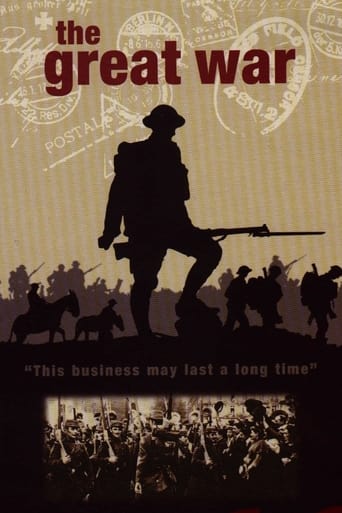
The Great War
1964 · TV series · documentary · 40 min episodes · 1 season
Created by John Terraine, Corelli Barnett
Extensive archive footage and sound effects, linked with contemporary classic music of the era, brings to life the vast history of World War I, concentrated by the commentaries by Michael Redgrave, and some of the finest actors of the 20th-century.
3 positivefrom 3 commenters
Where to watch
No streaming data for this title.




4 comments on Hacker News
The recent PBS series "The Great War" goes into considerable detail about the forces that influenced America into siding with England and France. Well worth watching.
PBS just ran a 3 part "The Great War" which is an interesting documentary on the American perspective of WW1. It did strongly argue that America's entry into the war ensured the defeat of Germany.
There was an pretty stellar coverage of the topic in the epic The Great War documentary from PBS sometime back. I can't find the video but I hit the 3rd episode title Mutiny that looks like its the one. Watching this as a young teen really haunted me back then, they created a whole ambiance to the film that still gives me chills. http://www.pbs.org/greatwar/chapters/ch3_mutiny.html
I have to agree with everything you said from my study of WWII, but just providing some elaboration.
"(3) Versailles. There were 'reparations'. So, Germany printed money to pay off the reparations more quickly. Then the inflation ruined the finances for much of Germany and created more bitterness."
Some of the Allies were going to make the same mistake in WW2 with repartitions once again. The French wanted to take the Ruhr, the industrial heartland in Western Germany and annex it into France. Other ideas were to make Germany an agrarian society. The primary reason the US created the Marshall Plan was to ensure the reparations and the initial dismantling of the German Industry (later repealed) that were forced on Germany (mostly the taking of IP, such as patents) would not cripple it and make it fall into the hands of the Soviets[1].
"(8) German Army Politics. The German Army had some funds for political activities, liked what they saw in Hitler, and provided just enough 'seed' money to keep Hitler going in politics."
The army did sort of a bittersweet deal with Hitler. Most of the army was not fond of Hitler, but they did see him as a way to restore their faded glory. They made their "deal with the devil" though when they agreed to take an oath to Hitler in return for Hitler dismantling the SA, which the Army saw as thugs and did not want integrated into the army (who thought of themselves as principled and aristocratic). Much of the army took that oath quite serious as well due to the Prussian tradition of loyalty to their country and leader--believing that betraying the oath was to betray their country. However, elements of the military still thought Hitler was mad all the way back to 1938 and had plotted to kill Hitler[2]. However, the capitulation of the UK and France in Czechoslovakia[3] and the later invasion of Poland quieted most of the planning to assassinate Hitler for the time being.
Also anyone who has not seen them, I reccomend the BBC's Fall of Eagles[4], BBC's The Great War[5] and the BBC's World at War[6]. Watching them back to back explains quite a bit about how the 19th Century Monarchies led to WWI and how WWI led to WWII.
[1] http://en.wikipedia.org/wiki/German_reparations_for_World_War_II
[2] http://en.wikipedia.org/wiki/1944_Adolf_Hitler_assassination_attempt#Background
[3] http://en.wikipedia.org/wiki/Munich_Agreement
[4] http://en.wikipedia.org/wiki/Fall_of_Eagles
[5] http://en.wikipedia.org/wiki/The_Great_War_(documentary)
[6] http://en.wikipedia.org/wiki/The_World_at_War