 Hacker Cinema
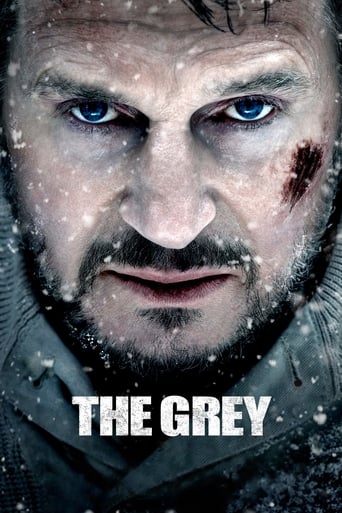
The Grey
2012 · Film · 117 min
Directed by Joe Carnahan
After their plane crashes in Alaska, six oil workers are led by a skilled huntsman to survival, but a pack of merciless wolves haunts their every step.
2 positive2 negative2 neutralfrom 6 commenters
Where to watch
No streaming data for this title.



6 comments on Hacker News
I'll take this thread to plug my totally subjective hare brain theory/bias.
I've noticed that I like movies that are shot with the blue filter (or atleast thats what I call it) - everything has a tinge of blue (the filters are almost closer to blue-grey; something like #374358). For some reason, I have noticed that, to me, they also turn out to good movies. Example would be Margin Call[0] (though in some scenes the blue is mixed with a golden hue which actually makes it look nicer); another one is The Grey[1].
[0]: https://www.imdb.com/title/tt1615147/
[1]: https://www.imdb.com/title/tt1601913/
There's a difference between ambiguity that's integrated into a story and ambiguity that's forced on the viewer. If the only thing that makes the movie ambiguous is that the final shot of the film isn't five minutes longer, then that is the type of film I hate. All Is Lost, The Grey, Save Yourselves, etc. If it's woven into the story from the beginning then I have no issue with it even if it may not be for me.
The sadest thing is that wolves are demonized world wide as a nuisance/danger. Movies like "The Grey" where Liam Neeson faces down grey wolves that are hunting him is a great example of this.
Wolves are loving family oriented creatures that only hunt for survival. They have a complex pack order and prioritize the pack over all.
Just like the war on drugs, time has twisted reality and now we have a fear and hatred for the wolf without a real explanation.
This topic makes me think of 2012 American adventure drama film co-written and directed by Joe Carnahan and starring Liam Neeson, Frank Grillo, and Dermot Mulroney "The Grey", which is based on the short story Ghost Walker by Ian MacKenzie Jeffers, who also co-wrote the screenplay with Carnahan.
http://en.wikipedia.org/wiki/The_Grey_(film)
These are some of the movies that I watched and liked in 2012:
The Grey
Prometheus
The Avengers
The Dark Knight Rises
Skyfall
The Hobbit
And these are some of the good ones I would like to watch:
Argo
Lincoln
Looper
Life of Pi
Zero Dark Thirty
It's a fun way to find sequential tokens (words) that have a high probability of being the names of people.
- Take a lexicon (list) of single words in a given language (English for example).
- Take a block of text and think of it as an ordered sequence of tokens, news articles work really well for this approach, books not as much.
Example (from http://www.cnn.com/2012/11/02/showbiz/movies/flight-review-charity/index.html?hpt=hp_bn9): With its spectacular plane crash -- I would rate it fractionally behind the air disasters director Robert Zemeckis staged in "Cast Away" and Joe Carnahan in "The Grey," but still more than gut-wrenching enough to make you think about taking the train, next time -- "Flight" immediately raises the stakes on your typical addiction drama. But that's essentially what it is -- with a courtroom finish for extra lift.
- Stream through the text, any word that is in your lexicon, throw away.
---- ---- ----------- ----- ----- -- - ----- ---- -- ------------ ------ --- --- --------- ------- Robert Zemeckis ------ -- "---- ----" --- Joe Carnahan -- "--- ----," --- ----- ---- ---- ------------- ------ -- ---- --- ----- ---- ----- --- -----, ---- ---- -- "------" ----------- ------ --- ------ -- ---- ------- --------- -----. --- ----'- ----------- ---- -- -- -- ---- - --------- ------ --- ----- ----.
- treat each group of remaining tokens as separate objects, in this case we have 2
- write these non-lexical (not in your original lexicon) sequences out:
Robert Zemeckis
Joe Carnahan
Boom, you just made an entity extractor that plucks names out of text without having to model the English Language too rigorously. And it generally works in most languages that have a low intersection between name-part tokens and lexicon tokens. And it can be brutally fast.
Where this gets interesting is in suppressing junk and tweaking the algorithm around things like parenthesis, apostrophese, and sentence boundaries. There's lots of little edge cases like this that you have to be mindful of - numbers in the text for example are never parts of names but aren't in your lexicon so you have to figure out what to do with those. And then you can use other heuristics to improve the results, suppose another sentence just had "Zemeckis" in it, that's a name, but then suppose another sentence had a token not in your lexicon like "Samoflange"...do you count that as a name? What about lexical tokens that are names like "Bush"? So you can try things like only counting sequences of tokens that have more than 2 tokens (like "Robert Zemeckis") and ignoring ones that have only 1.
And it goes on and on -- endless tweaks to improve the quality of the names you get and suppress non-name sequences.
To make the project more interesting, try storing your lexicon in a database or some kind of index so you can search it quickly, I like to use SQLite files with indexes on the lexicon table myself, but it's a fun assignment to try different things like in-memory TRIEs.
If you want to try threading, you can try playing around with searching the text at different start and end points (thread 1 searches the first 25% of the text, thread 2 the second 25%, etc.) or have different threads search different articles.
You can try all kinds of different things to keep it interesting and as you start abstracting the problem you can play with all kinds of different control and data structures to accomplish the task. Trying to make this as fast as possible (with all the heuristics turned on) can also be a fun challenge.