 Hacker Cinema
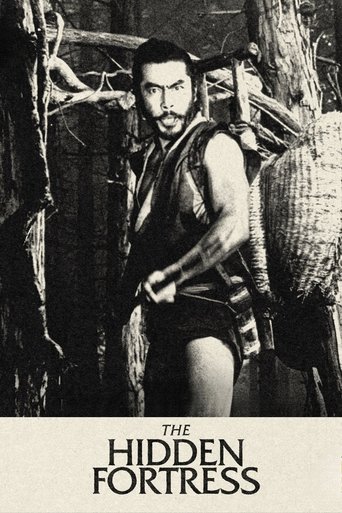
The Hidden Fortress
隠し砦の三悪人
1958 · Film · 139 min
Directed by Akira Kurosawa
In feudal Japan, during a bloody war between clans, two cowardly and greedy peasants, soldiers of a defeated army, stumble upon a mysterious man who guides them to a fortress hidden in the mountains.
4 positive15 neutralfrom 19 commenters
Where to watch
No streaming data for this title.

26 comments on Hacker News
Well George Lucas did borrow a lot of stuff from samurai films (The Hidden Fortress being the main one), so that is a return to its roots. Personally, I think that Firefly did the cowboys in space a lot better, but maybe that's due to better writing. I did enjoy the Mandalorian, but it's a bit too shallow.
> Evangelion is Japans star wars
Which is funny to say because Star Wars is actually the Western version of samurai movies (especially but not exclusively Akira Kurosawa's Hidden Fortress).
That's the movie that Lucas is pretty open about heavily drawing "inspiration" from (all the way down to specific characters and plot beats) but Hidden Fortress is itself part of a larger genre of similar stories.
Most "space opera" folks recognize, are just a close scene-by-scene copy of a classic foreign film title.
"The Hidden Fortress" (Akira Kurosawa, 1960)
https://archive.org/details/the-hidden-fortress
https://en.wikipedia.org/wiki/The_Hidden_Fortress
Luc Besson and Patrice Ledoux structured The Fifth Element plot very differently due to their culture. Perhaps one may also find something unique in the classics for your own enjoyment, or continue to choose to be upset with mundane facts. Goodbye =3
Andor succeeded despite the bureaucracy porn. Good stories are universal. You need to care about the protagonists.
The exposition is important, but doesn’t drive success. The best example of that is the original Star Wars. Contrast Star Wars to Kurosawa’s The Hidden Fortress — which inspired many aspects of Star Wars. Essentially the same story with different framing. Both are still excellent films.
Shitty sequels or in-universe works focus on the exposition. The Book of Boba Fett is probably the best example of this. Watching some dude slow walk through the desert to waste my time and engage in some inane plot that made no sense made me actively not give a fuck and turn it off. Cool universe. Bad TV.
The homage and direct copy of shots of Kurosawa's The Hidden Fortress nothwithstanding, George Lucas is on record saying the Alliance represents the Vietnamese, and The Empire is the United States of America and the films are partly commentary on the civil war in Vietnam.
I always heard that George Lucas was inspired by The Hidden Fortress by Akira Kurosawa. If you watch it (and it's a great film) the parallels are quite obvious.
https://en.m.wikipedia.org/wiki/The_Hidden_Fortress
Most science fiction is just lazy writing about current pop-culture trends, or stories gleaned from other areas of fiction. It is a difficult genre to navigate for quality...
George Lucas was considered a genius for "allegedly" copying this film scene-for-scene:
https://en.wikipedia.org/wiki/The_Hidden_Fortress
https://archive.org/details/the-hidden-fortress (1960*, Akira Kurosawa)
The original film was entertaining, and still worth a gander... unlike the poorly generated article =3
Yeah, actuaries look at statistics and determine relative financial risks and benefits of a particular course of action. In the example I gave, the course of action is "remake 'The Hidden Fortress' as a space sci-fi fantasy movie" and the actuaries plug in various values for copyright and intellectual property lawsuit risks and costs, potential revenue from the new movie and give predictions for what level of copying (or other risky behavior) is acceptable to reduce costs below the projected revenue without risking a costly lawsuit. Or maybe they just recommend buying the rights as cheaper than the potential cost.
When your movie is thin retelling of another movie (think Kurosawa's "The Hidden Fortress" v Lucas' "Star Wars"), actuaries can help make sure the retelling is just enough different from the original to avoid a lawsuit.
I've watched a bunch of the films said to influence Star Wars, and I'd say the main influence of Hidden Fortress was the R2-D2 and C-3PO characters. There are some plot similarities and of course Lucas has a character almost say the words "hidden fortress" but the only part that made me go "oh, wow, that's exactly where that came from" was the two sidekick buddy-characters.
> Why shouldn’t I have the right to take my work to my grave and never have someone else profit from it?
Because Mickey mouse is just a mouse and Frankenstein is "the modern Prometheus" and Star Wars is a western movie where "Lucas has said that the plot and characters in the 1958 Japanese film The Hidden Fortress, directed by Akira Kurosawa, was a major inspiration" (Star Wars came out only 19 years later, in 1977)
nothing we create is "ours" let alone forever...
There's an argument on incentives, if copyright ends after say 20 years, media companies could simply wait 20 years to use the content for free, it's possible, but I don't think it's probable.
I imagine a system where if the publisher makes a lot more money (with a lot to be defined) than the original author made before the creation went public domain, then they could be forced to compensate the original author.
It’s all about perspective.
Some people find original Star Wars to be a truly great movie. Those same people may find the movies that inspired Star Wars, like Kurosawa’s “Hidden Fortress” or Midway boring or solely on technical factors like color vs black and white. In a mass market product those technical factors make the work less approachable.
I spent several years walking through a pretty good collection of mid-20th century modern art. Most of it made no impression on me at all, but one installation’s aesthetic appealed to me for reasons that I cannot really describe. Part of it was the absurdity of what the facility did to that space — they literally dropped a random howitzer in the room. But if I nerded out and studied the artists and their art, I’d develop a more nuanced understanding and appreciation.
Is it? There was a lot of space opera and space adventure and space imperialism in the 1940s and 50s. Claiming to be the original is a big claim.
Mind you, Lucas cribbed from everything in sight; samurai movies (Hidden Fortress), Westerns, war films (the trench run is from 633 Squadron). Partly why it was so successful.
Babette's Feast is also Danish, one of the most well-known and highly regarded Danish films of all time. The other 2 are Dreyer films—I've only seen Ordet so far, and I thought it was just amazing. Johannes is an unforgettable character.
It's a pretty great list, far as I can tell. Dersu Uzala (1975, not 1978) must be in my all-time top 5.[0] I loved Bicycle Thieves—The Bicycle Thief is a bad translation. Yes, it's important to the story!—but much preferred Umberto D. Liked On the Waterfront but vastly preferred A Face in the Crowd.
[0] It's my pet theory that Yoda in Star Wars is based on Dersu. There are many similarities. Seems very obvious to me but I've never heard or read anyone else mention the connection. The plot of the original Star Wars was after all based on that of another Kurosawa movie, Hidden Fortress. See e.g. https://www.bbc.com/culture/article/20160104-the-film-star-wars-stole-from
You're wrong.
For me, Ikiru and Dersu Uzala are the best, but the usual ones mentioned are great too. Some I didn't see mentioned on this page yet that I also really like: One Wonderful Sunday (1947), Red Beard (1965), Dodesukaden (Clickety-Clack, 1970). First one I saw was The Hidden Fortress (1958), remade in the west as Star Wars – and Yoda, it seems to me, is Dersu Uzala.
I think his movies seem so good because everything about them is good. Screenplay, camera angles, editing, actors, music..etc.
So the original Star Wars, which has spawned so many copycat movies, is itself a copycat movie? Let's see. The formula seems to be: take two successful old movies, such as Battle of Midway and Hidden Fortress, and create a mashup set in a different genre to make it seem new. Has someone created a machine learning application that applies this mashup/genre switch on old movie scripts to make new ones?
George Lucas was influenced by Akira Kurosawa. Most closely by Hidden Fortress (although he puts it lowest on his list), but by other Kurosawa movies too. He talks about it some of his interviews.
https://youtu.be/E9V2T1ONA2I
To be fair, much of Episode 4 was inspired by Hidden Fortress.
George Lucas was inspired by samurai films. This film are called jidai seki (period films). From jidai --> jedi. Also C3PO and R2D2 are inspired by the couple of mongrels in Hidden Fortress.
After looking at pictures of a bunch of samurai helmets, I came to a realization that Darth Vader's helmet is more or less the shape of a samurai helmet. Maybe this should have been obvious to me (especially being a fan of the Hidden Fortress film), but it was a cool discovery for me.
There is nothing wrong with a space cowboy western, and in fact that's one of the reason people love the original trilogy: plenty of original (for the time) action, good guys on one side and BIG BAD guys on the other, so it is easy to takes sides, add some cheap mysticism (the "force" stuff) and the redemption of the baddest of the bad guys.
Not the most original of the plots [1], but good enough and simple enough that most people can enjoy it. That's not the issue with the current state of Star Wars in my opinion. Also for most people Star Wars is the movies so the issue about what is canon and whats is not is moot [2]: for them it is canon if it appears in one of the trilogies.
I have three other different issues with the current trilogy (and in general Disney's approach to Star Wars).
The first is that the current trilogy is just more of the same. The Force Awakens to me looks more like a reboot of the original movie than a sequel. The Last Jedi is a bit better but only because it looks a reboot of the whole original trilogy: I think that a better name would have been "The Empire strikes the return of the last jedi", and that would even describe the most relevant parts of the movie perfectly. In a way the prequel trilogy is better: while it is not up to par with the original trilogy, I like the contrast between a world where Jedis are available by the dozen (for example see when the jedis come to save the main characters in the arena) versus a world where there are two "bad" force users (Darth Vader and the Emperor) and two "good" force users (Luke and, for a while, Ben Kenobi).
The second issue is more general, and it is related to the fact that regardless of the quality of the content, the more movies you make about a topic or a "universe" the less value the single movie has. Even worse, after a given threshold I won't even watch any movie about the genre because I fear that if I don't see all of them I will miss something. I feel that way about the gazillion of Marvel/DC Comics movies, I feel the same about Star Trek (I only know about the original serie, but I don't have time to see _all_ the episode that I missed) and I fear one day I will feel the same about Star Wars.
[1] Also it seems Star Wars got many idea from other movies. My favorite is the one about getting inspiration for R2D2 and C3PO from the main characters of Kurosawa's "the hidden fortress", though after seeing the movies I would say the resemblance is only in "the character of the characters"
[2] I have to admit that I played to some of the games, and I think that KOTOR has a story that is much better that Star Wars original story. THAT is something I would love to see a movie about.
Sure. <Intrepidly goes off-topic> .. Into The Wild was just the guy being a spoiled ignorant delusional dick, I thought, really not impressive. Jungle was far better. You almost persuaded me the guy in 127 Hours ate his arm off the first time I read that haha. (Um he didn't, did he?!) Am writing this in case you didn't see Dersu Uzala (the Kurosawa version), one of my very favourite movies. The world before cities was a different world, like you say. <Totally off topic> Incidentally, it's my theory that Yoda is taken from Dersu. (As Star Wars is a remake of Hidden Fortress)
> It's a matter of if you think about it for a bit it makes no sense, it's logically impossible.
Let's take a look at a dictionary definition of culture: "the way of life, especially the general customs and beliefs, of a particular group of people at a particular time" (http://dictionary.cambridge.org/dictionary/british/culture)
Now, note the "particular group of people" part. A person can be a member of more than one group. Some groups are sub-groups of others; some overlap with others.
For example, I am an American, and as such I have been brought up in American culture, with many of the traditions and ideals that that entails; Thanksgiving, the 4th of July, a strong belief in civil liberties, and a love of strawberry rhubarb pie.
American culture is also a subset of Western European culture, with influences from Catholic and Protestant branches of Christianity, so while I am not myself Christian, I celebrate Christmas and Easter and have many Christian influences on my values and life.
However, I am also a member of other cultures. My most recent ancestors to travel to the US were Scottish; and so Scottish culture is also part of my culture, but not most other people in the US. I wear kilts to weddings, and have an uncle and cousin who play bagpipes at weddings and funerals. That's a part of my culture, but that is not a part of overall American culture.
I'm also a software engineer and computer geek, and involved in free software, advocacy for civil liberties online, advocate for strong encryption and privacy, and the like. This is a particular subculture that tends to promote strong protections for individual privacy and liberty, while openness and transparency on behalf of institutions such as corporations and governments. This is not part of mainstream American culture, but it is part of my culture; and this particular subculture spans multiple countries as well, so in many of these ways, I have more cultural values in common with a Brazilian or German who is also involved in these communities than I do with the average American.
There are many other subcultures I could describe myself as a member of. And the same goes for anyone you ask. "Culture" is not one big, monolithic thing with clear boundaries. Because it is a set of customs and beliefs shared with a group, that set can be larger or smaller, and stronger or weaker, depending on how big of a group you choose.
> And if "multiculturalism" whatever that is, is so great, you'd think someone would have come up with support for that notion by now beyond "Ethnic food!"
Food is a pretty fundamental part of any culture. As something that is necessary for sustaining life, it's something that everyone does. In almost every culture I've seen, meals are a large part of fostering community, of strengthening social bonds. You have meals with family, with friends, with coworkers. "Breaking bread" is a term rich with culture connotations of mutual trust, peace, welcoming, because sharing food with someone is so important; and the same holds in many other cultures, one of the most generous and welcoming things you can do is invite someone to your table and share your food with them.
So don't be so quick to dismiss "ethnic food" as an important part of multiculturalism. Food is in many ways the heart of of a culture, and exploring the food culture of another people can be a strong way to share something with them.
However, multiculturalism can extend far beyond that as well.
The musical heritage of America is quite strongly multicultural. Ragtime, blues, jazz, R&B, and hip-hop all have their roots in black culture in the US, but have had enormous influences in white culture as well. Of course a large amount of American musical traditions comes from Western European classical and pop traditions as well, and then there are a variety of folk traditions, such as Celtic, that have been integrated into the mainstream through bluegrass and country music.
But there's a lot more than just that. A large number of cultures have made substantial impact on film in America. Many of our "Western" genre is actually a product of Italy; but that in turn influence Akira Kurosawa in Japan, with Samurai westerns such as Yojimbo. His work has also influenced Western work, where The Magnificent Seven is a western remake of Kurosawa's Seven Samurai, and his The Hidden Fortress is one of the major influences on Star Wars.
Let's see, getting back to day to day life, Jewish culture has also had a fairly large impact; from Yiddish, we get words like "schmuck", "chutzpa" and "klutz". We also get bagels (oops, back to food again),
On the musical front again, some of the best American music like Gershwin's Rhapsody in Blue had roots in Western classical tradition, jazz, and klezmer, traditional Ashkenazi folk music.
I could go on, but man, detailing all of the positive effects of multiculturalism on American society could fill up hundreds of volumes of books, not just a single comment on HN.
> A murder seems to be ipso facto a hate crime.
That is not what is meant by the term "hate crime." Simply redefining a term that has a particular meaning to mean something else does not really add to the discussion.
I'll quote from Wikipedia:
> In both crime and law, hate crime (also known as bias-motivated crime) is a usually violent, prejudice motivated crime that occurs when a perpetrator targets a victim because of his or her perceived membership in a certain social group. Examples of such groups include but are not limited to: ethnicity, gender identity, disability, language, nationality, physical appearance, religion, or sexual orientation.
A "hate crime" is not simply any violent crime. It is a crime in which the attacker was motivated by their perception of the victim's membership of some other group.
There are several things that can motivate a criminal to commit a crime. Poverty, greed, hatred of a particular group, hatred of a particular person, sheer anti-social tendencies, and I'm sure many other motivating factors. Only one of these falls under the term "hate crime" as it is commonly defined; those crimes in which hatred of a particular group of people is a primary motivator.
If you look at the statistics I cited in a previous comment, while it is true that black on white murder happens more often than white on black, white on white murder far surpasses either (and likewise, black on black). No amount of arguing about the black on white vs. white on black levels of crime will make these intraracial crimes go away, and the levels of intraracial crime is a very strong signal that racial animus is not actually the motivation for the majority of crime that occurs.
The reason it is important to look at the motivation behind a crime, and not just the statistics about whether a crime happened, is that the motivations can help tell you the best way to reduce that type of crime in the future.
Hate crimes, in the sense of any crime committed on behalf of membership in some group, can be particularly dangerous because they can lead to either prolonged violence between those two groups, or ethnic cleansing or genocide. These types of crimes, when allowed to escalate, have escalated into some of the greatest atrocities of a last couple of centuries. Breaking the chain of hate-motivated violence by discouraging the use of rhetoric of hate, by changing laws that institutionalize disparities between these groups, and by applying harsher penalties to those crimes committed for these reasons, are some ways to deal with these types of crimes.
Crimes committed due to a hatred of a particular person, however, are fairly different. They are usually based on some aspect of those people's relationship; perhaps an abusive domestic relationship, a cheating spouse, or the like. Here, there isn't some group-based animus, but a dysfunctional personal relationship. Here, the better way to deal with the problems are to provide better outlets for change than violence; provide shelters for people to escape from abusive relationships, allow divorce, as it it preferable to violence or murder.
Crimes that are committed due to poverty, to people having as sense of hopelessness and no further opportunity but to turn to crime, are another kind of problem. Here providing better social services, better education, better access to affordable housing, and the like can all help take that pressure off that can push people over the edge.
In all of these cases, the actual perpetrators of actual crimes do need to be punished; there needs to be deterrence as well. However, on a societal level, there can be many things done to reduce the temptation and pressure to engage in criminal behavior. And even on the individual level, knowing someone's motivation for a crime can be important in rehabilitating them and reintroducing them back to society.
Star Wars didn't borrow ideas from Japan, it "borrowed" a Kurosawa samurai movie "the Hidden Fortress", added some aerial scenes inspired by "Midway" and did it in space.
Then again, that first Star Wars movie is mostly taken from Kurosawa's The Hidden Fortress (https://en.wikipedia.org/wiki/The_Hidden_Fortress), right down to the personalities of the robots... I gather The Dam Busters and perhaps other films of that sort (none of which I've seen) get a lot of credit for the end.
You need the watch the Akira Kurosawa movie "the hidden fortress". Basically, the parts of the first Star Wars that weren't borrowed from WW2 movies were lifted from this movie. Many story elements, C3-PO/R2 and parts of the musical score are very similar.