 Hacker Cinema
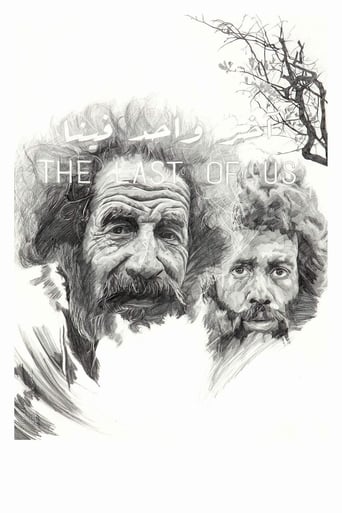
The Last of Us
آخر واحد فينا
2018 · Film · 94 min
Directed by Ala Eddine Slim
N is coming from the desert to reach the north of Africa and make an illegal crossing to Europe. Alone in Tunisia, he decides to cross the solitary sea. He steals a boat and begins his journey, but it soon sinks into the water. From that moment, N embarks in a special and unique voyage: he discovers different and infinite spaces, makes intense and fleeting encounters, and meets another altered image of himself.
3 positive3 neutralfrom 6 commenters
Where to watch
No streaming data for this title.


6 comments on Hacker News
Something I think about is how there have been outstanding games that the majority of people will never play. Just in recent years - Red Dead I and II, Horizon Zero Dawn, Last of Us, etc. These have quality/polish up with Breaking Bad or any acclaimed movie/TV, but no one else in my extended family would have played a second of any of them. How do you bring that experience to people?
This made me think on a tangent, on whether divulging spoilers for an interactive experience have a heavier "stigma" than for books or movies. Five or 10 years from now, or even a month from now, I can't imagine being offended if someone were to spoil who dies in "Avengers: Infinity War", or the 3rd season of GoT. Whereas a video game is much more inherently about the "journey" -- e.g. you have to do some work to get to the end. I think I'd be annoyed if people were just spoiling "The Last of Us" 10 years after its release (which is likely to be after its sequel is released).
That said, I don't think I'll ever find time to play the original Shenmue. But hearing more details about why it has cultivated such a fond following makes me very interested in playing its Kickstarted sequel.
I'd go back to GP's "why" question.
I thought that The Last of Us was an absolutely fantastic game. Honestly, its one of the few games I've managed to stay engaged with all the way to the end. It works as a game. It's wonderful within its medium. A movie can't give you moral choices (did you guys kill the doctors at the end??), nor the time required to really get aquainted with the characters.
The narrative works best in the medium it was designed around. As a movie, I Dunno, what would the medium bring to the table? I suspect it'd just be another throw away zombie movie
Games like "The Last of Us" and "Uncharted 4" definitely seem more like audience-participation movies. The fight scenes might be fun to play through, but a lot of the good stuff comes from the scenery, the story, and the acting - both voice and capture.
I watched Let's Plays of both because I wanted to see the story, and because the players were entertaining. I don't think I'd have enough time or patience to play through either game, but I definitely got value out of the game itself without having played it.
It does seem like a gray zone - I experienced content without paying for it, but I didn't experience it the way it was truly meant to be. Did I come by it unfairly?
I completely agree with your point. I'm more pessimistic about AAA in general, though. AAA always tries to maximize superficials, minimize the hard stuff, and pay more money for marketing than for development. It's the same in games, novels, music and movies. And your grandma could have said the same about the AAA products of her time (music, theatre), right? It's not a surprise.
There are lots of great games below AAA and even some AAA titles have good content by surprise (for example the interactive movie "The Last of Us" was great in my eyes, not as a game but as a movie, which you can enjoy for free on Youtube).
I think the overarching point is that "storytelling" simply can't work in the same manner as it does in books and movies.
If you tell a story in a cutscene, you then aren't playing a game at that point. Or if you plot out every possible interaction (kind of like The Walking Dead games) you have to limit the outcomes to a manageable level, which hamstrings the gameplay. So what's the solution? The article is arguing that you have to abandon narrative and focus on what you want the player to feel directly.
The problem is that "game literacy" is focused on all the wrong elements. A game like Doom has much better, tighter, more interesting gameplay than something like The Last of Us. (which I still really enjoyed!) And you can be moved by the story, characters etc. from The Last of Us, but it's a lot more like how you feel watching a movie. With Doom, people create their own narratives by interacting with the game, and those narratives have a different kind of power. People still tell stories about playing Doom for the first time 20 years ago with their friends. The objective, I think, is to make a game where those personal stories are directed to achieve a specific effect.
There's one example of this effect that I've read about before. There was a game in the 80s where you play a war game as either the U.S. or Russia. If you play as the U.S., you stockpile arms and try to win the war as you'd expect. But if you play as Russia, you have a whole different set of concerns - starvation, winters, limited resources, aggressive neighboring countries and other factors which lets you experience some of the desperation Russians must have felt during the Cold War. It's a pretty powerful story to tell through gameplay alone, and a story that was told through gameplay without narrative.