 Hacker Cinema
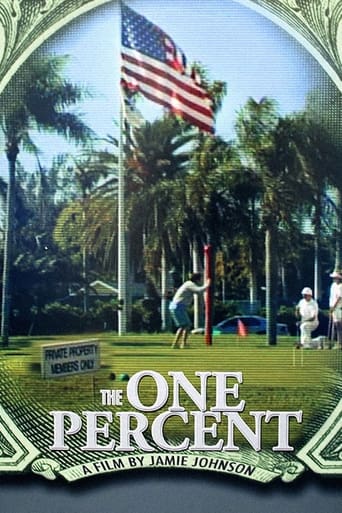
The One Percent
2006 · Film · documentary · 77 min
Directed by Jamie Johnson
Jamie Johnson takes the exploration of wealth that he began in Born Rich one step further. The One Percent, refers to the tiny percentage of Americans who control nearly half the wealth of the U.S. Johnson's thesis is that this wealth in the hands of so few people is a danger to our very way of life.
3 positive1 negativefrom 4 commenters
Where to watch
No streaming data for this title.





6 comments on Hacker News
To anyone interested in this, I'd highly recommend Born Rich.[1]
It's a documentary made by the heir to the Johnson & Johnson fortune, in which the film maker interviewed all his friends, who were also born in to incredibly wealthy families.
The director later filmed another documentary on the subject, The One Percent, but I didn't find it to be nearly as good.
[1] - https://www.youtube.com/watch?v=1sD3pG74Wv8
There's a fascinating documentary called Born Rich[1], which was made by the heir to the Johnson & Johnson fortune, where he interviewed his friends who were also born in to incredibly wealthy families. It was interesting to see how differently they all reacted to it, some embracing their wealth and partying like mad, others rejecting it and trying to live a normal life. Highly recommended.
The documentary's director and some of the participants in this film and its sequel, The One Percent[2] (which was not nearly as good), got in a lot of trouble for talking about their family's wealth, presumably because the ultra-rich families really don't want a lot of attention. The blowback included lawsuits, and, if I'm remembering correctly, an adopted daughter of Warren Buffett's got disowned by him after her own participation in The One Percent, where she talked about him and what it was like for her to be part of his family.
[1] - https://dvd.netflix.com/Movie/Born-Rich/70008257
[2] - https://dvd.netflix.com/Movie/The-One-Percent/70092779
1) Capitalism is creating commodities, like corn, and then shipping them. Picking one billion corn stalks is a lot more cost and effort than picking one corn stalk.
With software nowadays, you create the first product, and then with the push of a button, can duplicate and distribute it to billions, almost instantly, almost for free. What this means is you are not really making a commodity any more. Which means that in those parts of societies where this mode of production prevails, you're not even really working within a system of capitalism any more. The system of production outgrows the economic system it is in, just like town trade and manufacture outgrew feudalism centuries ago.
2/3) The helpful thing is to look at what is actually happening, as in a scientific experiment. The real world is not people sitting on top of piles of money, like a dragon in some fairy tale. Those who get the fruit of other's labor by rentier means - landlords, lenders and most importantly stockholders and owners, can only spend so much on luxury goods. They also need only so much as that aforementioned stacks of Credit Suisse gold bars stored somewhere for a rainy day. Most of the money is reinvested.
Where is the money invested? New construction projects, new companies, new loans - or further capital for existing projects. At companies owned, San Francisco apartments etc., more and more of wages go to profit and rent, as that is necessary for inequality. So the worker has less money to buy commodities. But more and more capital is being spent to build more and more commodities. The workers/consumers can not buy these increasing commodities made by the more enriched investors. Credit can kick the can down the road for a time, but if things don't go back to equilibrium, things get worse (see the 2008 taxpayer TARP bailout of banks, 2000 dot-bomb crash etc.)
There's a documentary called the One Percent, where a conversation between Bill Gates Sr., Warren Buffett and Chuck Collins (Oscar Meyer heir) is retold. He is talking about the inheritance tax (now corporate spinned to be called the death tax) and says if things are as unequal as they are now without an inheritance tax, what will happen when one does happen?
I myself don't think there's some liberal, social democratic solution. Idle class heirs have this self-destructive tendency to pull more and more power to themselves, to the point where they begin to undermine their own long-term power. At some point a very radical change comes. That has been the history of the past centuries. The US depression of the 1930s was so long ago, it's hard for Americans to fathom it, and I would guess most people think it could never happen again, but it could. It could even be worse.
I highly recommend a documentary called Born Rich[1] to anyone interested in this sort of thing. It was made by one of the heirs of the Johnson and Johnson fortune, who interviews and follows the lives of many of his friends who were also, as the title says, born in to ultra wealthy families.
It's pretty interesting to see how differently they react to their privileged position, some of them embracing and others rejecting it. It was also interesting to see how the parents of these kids reacted to the documentary itself. Many of them were strongly against revealing anything to the public about themselves or their wealth.
The director of this movie also went on to make a follow-up documentary called The One Percent[2], which was not nearly as good.
[1] - https://dvd.netflix.com/Movie/Born-Rich/70008257
[2] - https://dvd.netflix.com/Movie/The-One-Percent/70092779
The OP was judging a person by his job, and implying that the person in question couldn't be a genius because he worked at a menial job.
I simply provided some counterexamples.
Furthermore, white collar or not, I doubt that many would contend that Kafka or Einstein were some sorts of models of "success" if judged by their jobs, and few would judge them "geniuses" solely by looking at what they did for a living.
The fact that Wittgenstein gave away his inheritance is completely irrelevant. We were talking about jobs as marks of genius, not about inherited wealth.
However, I will grant that being born in to a wealthy family, being given a first-rate education, and being surrounded by highly accomplished individuals (as Wittgenstein was) does usually give the beneficiary a tremendous head start over most people.
I would certainly have bet on someone born in to Wittgenstein's highly privileged position making something of himself than on someone born in to poverty.
That said, plenty of people born in to tremendous wealth squander it and their lives. A couple of interesting, relatively recent documentaries on the subject are "Born Rich"[1] and "The One Percent"[2].
[1] - http://www.imdb.com/title/tt0342143/
[2] - http://www.imdb.com/title/tt0819791/
ianhawes below also recommended "The One Percent," which is a newer documentary by Jamie Johnson.