 Hacker Cinema
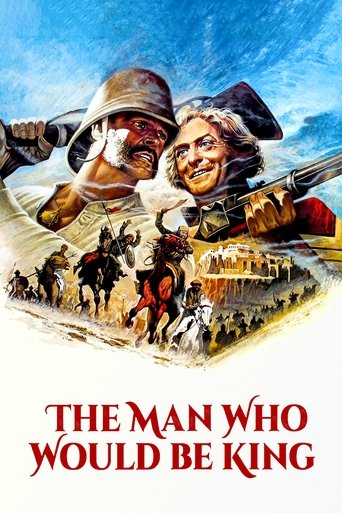
The Man Who Would Be King
1975 · Film · 129 min
Directed by John Huston
Tired of life as soldiers, Peachy Carnehan and Danny Dravot travel to the isolated land of Kafiristan, where they are ultimately embraced by the people and revered as rulers. After a series of misunderstandings, the natives come to believe that Dravot is a god, but he and Carnehan can't keep up their deception forever.
4 positive2 neutralfrom 6 commenters
Where to watch
No streaming data for this title.


6 comments on Hacker News
Masonry features prominently in the movie "The man who would be king" based on Kipling's short story
'The Man Who Would Be King' is a wonderful film. He was also in some stinkers ('Highlander' springs to mind).
In my mind, I was listing the Connery movies that I liked and I completely forgot The Man Who Would Be King. I love that movie! Along with Michael Caine and Saeed Jaffrey as Billy Fish, it really shows a fun side to him.
The Phantom Rickshaw and other Eerie Tales, Rudyard Kipling. This is the one that includes "The Man Who Would be King" that's a fairly well known film with Sean Connery and Michael Caine.
His other short story books, such as The Jungle Book and Just So Stories - so much better than the Disney.
The Time Machine and other Stories, H G Wells.
But the author didn't get it right though. His conclusion- "By highlighting its Greek heritage, Afghanistan could claim a share of the classical origins of Europe and the West", aspiring to "the 'civilizational norms' of the developed world"- is a tired formula of western Orientalism. The Seleucid Greek culture has had an enduring impact on the people and culture of Afghanistan, as anyone can see by the Buddhas there which matched the muscled aesthetic of Apollo statutes, as opposed to usual image of the sitting Buddhas in China. Greek culture wasn't some attempt to manufacture legitimacy for national boundaries in the '30s. Interestingly, it seems that the desire to inherit the legacy of Alexander the Great's feats is not limited to the people in his kingdom. After all, Sean Connery in the film "The Man who would be King" is one of the more famous depictions of Kipling's novella on wayward westerners trying to capture an Alexander glory from the locals, including Civilization V, Star Trek episodes, Jimmy Buffet songs, etc.
Also: Once the Taliban took over, I think everyone can agree that they represented the polar opposite of modernity and ties to Europe. Despite destroying the Buddhas, they did not destroy the Greek antiquities or scrub the Greek from their money.
mmorris answered this, but can I take this opportunity to add a couple of absolute gems, which I love, and which I have read and re-read so many times that I've gone through 3 copies each?
They are:
1. Dreadnought (by RKM) 2. Storm of Steel (by Earnst Junger) 3. (bonus) Josiah The Great: The True Story of The Man Who Would Be King
For my money, Dreadnought is the Best Overall History Book, and Storm of Steel is the best First-Person History Book.
They're topical, too -- SoS didn't have a quality English translation until 15 years ago, and Josiah The Great was based on the early-2000s discovery of a trove of documents that corroborated the amazing tales of the first American in Afghanistan, who became the inspiration for Kipling's short story (and John Houston's near-best-picture winner, and the movie Michael Caine says he wants to be remembered for), 'The Man Who Would Be King.'