 Hacker Cinema
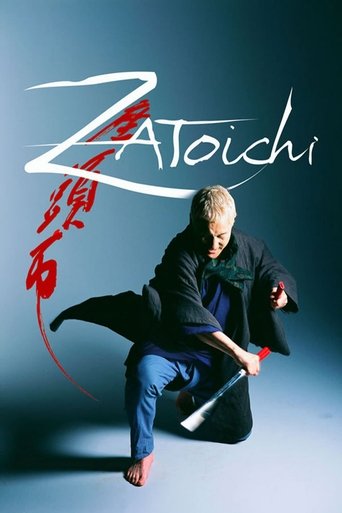
Zatoichi
座頭市
2003 · Film · 116 min
Directed by Takeshi Kitano
Blind traveler Zatoichi is a master swordsman and a masseur with a fondness for gambling on dice games. When he arrives in a village torn apart by warring gangs, he sets out to protect the townspeople.
3 positive4 neutralfrom 7 commenters
Where to watch
No streaming data for this title.



7 comments on Hacker News
The only service I pay for is Criterion, which has done a great job at keeping vintage films alive, stuff I can't find on torrents, streaming services or even youtube.
Buying the Zatoichi box set has been one of my proudest purchases.
In 2003 I was first unknowingly introduced to Takeshi Kitano on MXC on Spike. That fall in a Japanese film class I saw him in Sonatine which remains one of my favorite movies. Then in the spring of 2004 Zatoichi was released and I saw it in theaters. I had a year in my life where Takeshi Kitano was *everywhere*.
Book - The Terminal Man, Flatland
Music - Squarepusher, Autechre
Movie - Tetsuo The Ironman, Zatoichi series, Macgruber (def the first movie, not the show)
As you mention Blind Fury, do you know of the Zatoichi movie franchise [1], which is about a blind swordsman wandering Japan around the Edo to Meiji period? Really good films! (Blind Fury is a reimagining of the 17th movie in the series, Zatoichi Challenged.)
[1] https://tvtropes.org/pmwiki/pmwiki.php/Franchise/Zatoichi
What's interesting that you see this come up in places in cinematic period pieces like Takeshi Kitano's Zatoichi remake, Oliver Stone's Alexander, the shows _Rome_ and _Spartacus_ on HBO. We _should_ have seen this in Zack Snyder's _300_ as well (Spartans allowed for same-sex relations in older/younger male mentorships in their warrior-aristocracy training, much of the lifestyles of Spartan citizens would be prohibited from being depicted) but that movie chose to be a historically inaccurate Triump of the Will of the straightest of straight male masculinity.
No. Feudal means that the land was managed by the samurai and all the rice produced on it was owned by them. The farmer class worked the fields and were paid for their production, but owned nothing. This was one of the big changes that was instituted by the Meiji restoration -- the samurai class was outlawed and farmers were allowed to own land (and have a name).
https://en.wikipedia.org/wiki/Feudalism is a useful reference. Of course Japan was not technically feudal, but the parallels with feudal Europe run deep, so most things I've read on the topic use that term.
One of the reasons I started avoiding conversations on HN of late is due to questions like this. It's appears to be a very shallow dismissal of what I was saying. I really don't mind if people disagree with me -- especially when I'm saying something as extreme as I have in this thread. However, you seem to be saying that the upper classes treated the lower classes terribly badly and therefore nothing can be learned from that era.
Indeed, when I say that Japanese people admire Edo culture, they are not only, or even principally, speaking of the noble classes. Indeed, most are referring to craftspeople, farmers, etc. In fact, you will even see a considerable amount of respect and gratitude toward the Yakusa who generally protected normal people against the excesses of the powerful. There is a reason for the huge number of Zatoichi movies out there, as well as all the ronin (disgraced samurai whose daimyo is dead, but who didn't commit suicide) movies where the protagonist wanders around and protects the common people.
When the Meiji restoration came about, the government was keen to take on European culture and technology which it viewed as being more advanced compared to the seemingly backward analogies in Japan. So suits and neckties came into fashion. Brick and stone were used to build buildings, etc, etc. Much of the appropriate cultural technology that had evolved to suit the climate and nature of Japan was thrown out the window.
Things like the natural life cycle of cloth was changed for example. Originally a parent would buy a kimono. When it was worn, it was taken apart and a kimono was made for the children from it. When it was worn, it was taken apart and cleaning cloths were made from it. When it was worn, it was burned as fuel. There was a general ban on burning firewood in parts of the Edo period because of over logging, and so people were very clever about how they got fuel.
Even now, if you go to a traditional futon store and try to buy a new futon the first thing the craftsperson will ask you is if you have old cotton from a futon or zabuton. In fact, if you do not, they may heavily encourage you to go away and ask your family for old cushions and what-not as they are very loath to use new cotton if they can avoid it. Again, this comes from the Edo traditions and is something that many people cherish in Japanese culture. It's also something that is slowly disappearing as the country becomes more westernised.
I hope you found the above interesting. I probably shouldn't complain about the quality of responses I get from crazy postings I make, but it's something I'm starting to feel more acutely these days. If you found what I wrote interesting, I hope you will find a way to encourage others to write something similar rather that to write in a way that may dismiss what they are saying out of hand. I'm sure that wasn't your intention, otherwise I would not have wasted my time typing all of the above, but I still had that feeling from reading the words that you typed.
I have a theory that Japanese sense of humor is actually a lot more sophisticated than that of the west. In particular, I think movies like Zatoichi satirize westerners. It's a movie where the main character, who is a blind samurai, is shown to constantly know what people are doing and talk about it. It is supposed to show him as being ultra-perceptive to westerners, but in reality I think it was just a farce. Westerners always have to have things said explicitly, because we lack the ability to understand ishin-denshin.