 Hacker Cinema
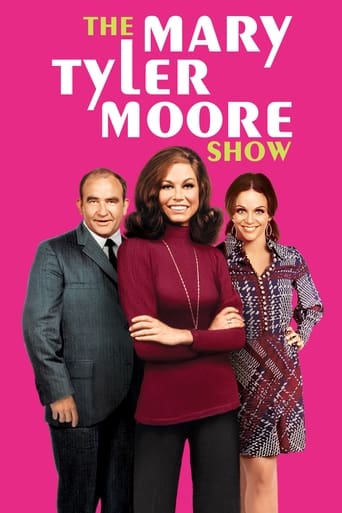
The Mary Tyler Moore Show
1970 · TV series · 25 min episodes · 7 seasons
Created by Allan Burns, James L. Brooks
30-year-old single Mary Richards moves to Minneapolis to start a new life after a romantic break-up. There she reacquaints with Phyllis who rents her a room, and meets her upstairs neighbor and new best friend Rhoda. Mary unexpectedly lands a job as associate producer at the TV station WJM, where she works alongside her bristly boss, Lou; the comical newswriter, Murray; and the newscast's often-incompetent anchor, Ted.
1 positive4 neutralfrom 5 commenters
Where to watch
No streaming data for this title.




5 comments on Hacker News
I recently started going through The Mary Tyler Moore show and was struck by the timeliness of this quote from the very first episode:
Lou Grant: What religion are you?
Mary: Uh, Mr. Grant, I don't quite know how to say this, but you're not allowed to ask that when someone's applying for a job. It's against the law.
Grant: Wanna call a cop?
> I believe that if you are moving to a new country, you are deciding to an extent leave your old country behind and start a new journey helping build your adoptive country.
The decisions of refugees is far less voluntary than yours. Your personal experience isn't a meaningful comparison.
> there is hatred towards some of the original values (communist/revolutionary Cuba)
I don't think you sufficiently understand the Cuban migration experience. The first wave in the late 1950s and 1960s were there because they rejected the new values of communist/revolutionary Cuba.
> and a strong embrace of the new world.
Many expected the revolution to end soon, and they would be able to return home to Cuba, and even get their land and houses back.
You can see strong counter-evidence to your position in the Wikipedia entry for the 1970s TV series ¿Qué Pasa, USA? at https://en.wikipedia.org/wiki/%C2%BFQu%C3%A9_Pasa,_USA%3F :
] The series focused on the identity crisis of the members of the family as they were pulled in one direction by their elders—who wanted to maintain Cuban values and traditions—and pulled in other directions by the pressures of living in a predominantly Anglo-American society. This caused many misadventures for the entire Peña family as they get pulled in all directions in their attempt to preserve their heritage.
That's very different than your characterization - no doubt partly because what you know about Cubans in Miami now is after 40-60 years of integration.
The recent refugees in Sweden have not had nearly so long.
> This is not the same for all other immigrant cultures
What's your issue with the Amish? That's an immigrant group which fits your description. It sounds like you want to force them to integrate with the Anglo-American society?
For the matter, Swedish immigrants to the US peaked around 1890, but it took generations before the Swedish descendants in Minnesota stopped using Swedish as their mother tongue.
We can even see this in the 1970s TV series The Mary Tyler Moore Show where her friend and landlady Phyllis Lindstrom occasional repeats Swedish phrases from her husband, or in "A Prairie Home Companion" where host Garrison Keillor would occasional say something in Swedish, and joke about "Norwegian bachelor farmers". That's nearly a century later.
I knew those already from being flooded for 40+ years with Hollywood films (all of them) and sitcoms, I know Cosby, Malcolm in the Middle, Beverly Hills 90210, Miami Vice, the Fall Guy, Seinfeld, Friends, Lou Grant, Mary Tyler Moore Show, Diff'rent Strokes, Cheers, Golden Girls, MAS*H (the best), Married... with Children, Three’s Company, King of Queens, Family Matters and on and on and on.
Basically I know the US better - or the image it projects - than my own country.
Funnily it was a huge letdown when I visited for the first time decades ago, as it felt just like a sitcom and there was nothing new really.
The author blames the modern sitcom's remoteness from working and lower-middle class concerns with their creators' immunity from the recent recession. In place of everyday situations, we have shows set in "soundstages and writers’ rooms," the haunts of the out-of-touch in New York and LA. So you wind up with a show with this sort of genesis:
Our creator was once a prominent writer and performer on a comedy sketch show, which aired live every Saturday night from an NBC studio in New York. It ran for 90 minutes. After their time on the show came to an end, our creator decided to pitch a sitcom based on their experiences there. The lead character is the head writer on a comedy show, similarly produced in New York. They must balance their work in the writers' room and their personal life, though this turns out to be difficult. A pilot is made, and our creator plays the lead.
Modern viewers may recognize this as 30 Rock, but it is in fact The Dick Van Dyke Show. It is based not on SNL but on a direct ancestor, Your Show of Shows. Carl Reiner's performance in the pilot may have dissuaded executives from casting him in the commissioned series (hence Dick Van Dyke), while Tina Fey remained the lead in her own version. But otherwise the parallel rings a sight near perfect.
The author stumbles over himself insisting, however, that while The Dick Van Dyke Show did not give vent to working and lower-middle class concerns, it did at least feature characters who "had careers" and were definitely of a class. As if the same were not true of shows like 30 Rock (which is at times obsessed with class difference), or of Parks and Recreation and The Office. These do not depict realistic workspaces, but why place that demand on a sitcom? And why not place the same demand on, yes, The Honeymooners, Taxi, The Mary Tyler Moore Show, I Love Lucy, The Beverly Hillbillies, Green Acres, The Andy Griffith Show, and on and on. In all cases the demands of the form—and in almost all cases the demands of overly long tenures—stretched the premises and the rare attempts at realism very thin.
I think you can make an argument that the most popular comedies available right now—whether on TV or at the movie theaters—are unflinchingly escapist. (Though, as the article notes in its discussion of an episode each of Horace and Pete and Girls, this has not gone unnoticed or unremarked by all of the shows' writers. Still, these two are not the most popular things around by any stretch.) Similarly, Fred Astaire and Ginger Rogers were seen to traipse across exclusive resorts, high-class stages, ballroom floors, and Venice, in elaborate dresses and a "top hat, white tie, and tails"—all during the Great Depression. Sometimes hard circumstances produce a public clamoring for comment; sometimes the public just wants a reprieve.
Plenty of shows taped in front of a live studio audience still sweeten it with a laugh track. But I have no idea if BBT does.
edit: wikipedia says yes. "Sweetening has been used in a number of television series, from older shows like Happy Days, Taxi, The Mary Tyler Moore Show, to newer sitcoms Two and a Half Men and The Big Bang Theory" http://en.wikipedia.org/wiki/Sweetening