 Hacker Cinema
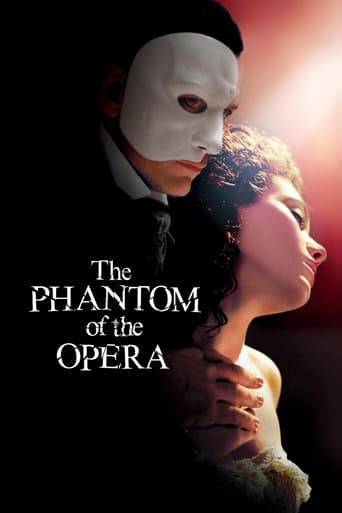
The Phantom of the Opera
2004 · Film · 141 min
Directed by Joel Schumacher
The deformed Phantom who haunts the Paris Opera House causes murder and mayhem in an attempt to make the woman he loves a star.
3 neutralfrom 3 commenters
Where to watch
No streaming data for this title.


3 comments on Hacker News
Wincott and Dance and are both British actors that began their careers on stage, so they have similar accents, cadences, and vocal mannerisms common to stage actors. For example, both of them speak like Patrick Stewart, another English who also began his career on stage. But otherwise they all clearly have very different voices: they have different timbres, vocal fry, and only one of them (Dance) can sing well and he has a surprisingly large vocal range (see his performance as the Phantom in Phantom of the Opera).
In this case, the actress selected for OpenAI was clearly selected for similarity to SJ. And that by itself would have been okay, because the actress is speaking in her natural voice, and SJ doesn't have a monopoly on voice acting...but OpenAI went further, and had the unknown[1] actress base her inflections, cadence, and mannerisms on SJ's performance in the movie Her. And Altman even tweeted the movie's name to advertise the connection.
The problem is that there is a well-settled case law stretching back over several decades that makes this a slam-dunk case for SJ, because it doesn't matter that OpenAI didn't "steal" her voice, they stole her likeness.[2] It wasn't just some unknown actress speaking in her own voice, it was an actress with a voice similar to SJ given lines and directing by OpenAI with the clear intent of mimicking SJ's voice performance in one of her more-famous roles.
[1] There is a very short list of a few actresses who both sound like SJ and do voice-over work circulating around Hollywood, so a lot of people have a pretty good idea of who it is, but nobody will identify the actress unless she identifies herself, out of solidarity.
[2] Likeness rights are quite strong in the U.S. They're even stronger in Europe.
I've only seen clips of the movie, but those don't look very promising IMO. I read that this had a $95 million production budget, I can't fathom what they spent it on when looking at the end result.
Beyond that I'm quite a bit sceptical of choosing Cats for a movie adaption at all. It's nowhere near 'Phantom of the Opera' in terms of popularity, and the last (2004) movie of that musical didn't do particularly well at the box office.
In the 20th century, classical music went a lot of interesting ways. A lot of the really innovative composers were focusing on dissonance and atonality — Bartók, Stostakovich, Varèse, Stravinsky. With that, there starts to be a challenge to find music that grasps you instantly. I tend to find that once I figure out something about a composer, his works start making sense to be, but before then it frequently sounds like noise.
When I think about modern composed music, my utterly-amateur mind goes in three directions — jazz, minimalism, and scores. There's a lot of interesting music being made for movies — do the scores of Jaws and Indiana Jones or Sweeney Todd and Phantom of the Opera count as classical music? Certainly musically there are certain things in common. Jazz, meanwhile, is an absolute paradise of talented musicians and musical experimentation. Charles Mingus comes to mind, as does John Zorn as a more modern composer.
The only movement I'm really aware of in modern classical music that has a distinct classical taste is that of minimalism. Philip Glass is an obvious first name, but then Steve Reich, Terry Riley, and La Monte Young were all composers whose music emphasized certain kinds of repetition. But when you begin listening to them, you realize how diverse each one is and how it's almost silly to group them together. Riley's music tends toward electronica and unpredictability, Glass eschews the term altogether, and Young's music tends towards categories like "drone", at which point you're talking a genre that includes a lot of rock music, also. Then you look at how Riley influenced bands like the Who (who named a song after him) and how La Monte Young worked with John Cale of the Velvet Underground, and it starts looking like that branch of classical music got submerged in avante garde rock.
But that's all the perspective of somebody who admittedly knows less than he wants to. If the classical music scene is different than that, it's done a damn good job of hiding it: I've found no other category of music that might help me understand what's going on today (and I'd appreciate the helping hand of any user who knows more).