 Hacker Cinema
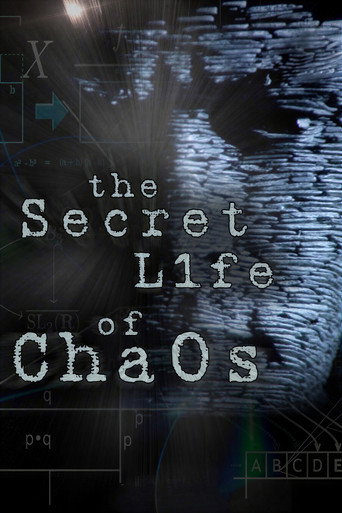
The Secret Life of Chaos
2010 · Film · documentary · 60 min
Directed by Nic Stacey
Chaos theory has a bad name, conjuring up images of unpredictable weather, economic crashes and science gone wrong. But there is a fascinating and hidden side to Chaos, one that scientists are only now beginning to understand. It turns out that chaos theory answers a question that mankind has asked for millennia - how did we get here?
5 positivefrom 5 commenters
Where to watch
No streaming data for this title.



6 comments on Hacker News
There's a good documentary called "The Secret Life of Chaos" that has a fairly cool overview of this concept.
Though it's just the beginning of a very deep rabbit hole, possibly unending.
Here is a link: https://www.dailymotion.com/video/xv1j0n
The notion that determinism leads to seeing the world in terms of simple predictable clockwork universe is obsolete. Look up "chaos theory". It describes how even very few deterministic rules applied to a vast number of elements can very quickly produce chaotic, unpredictable and non-deterministic results. Especially if those rules include feedback loops. BBC has a very good documentary on this called "The secret life of chaos".
To summarize, given all this new informatio: no, deterministic machines do not contradict free will. Because those machines are intelligent and have feedback loops and can (deterministically) make intelligent decisions based on the information.
'The Chemical Basis of Morphogenesis', Alan Turing.
The last paper written by Alan Turing, "The Chemical Basis of Morphogenesis," [0] attempted to answer the theoretical explanation of the biological process that defines the shape of an embryonic organism from creation. This process is called "Morphogenesis". This is an important problem because complex organisms appear to be created by some "random" process that organises what appear to be self similar cells.
A lot of recent work has been done to experiment Turings ideas on "reaction-diffusion" processes describing morphogenesis in biology and other natural systems to see if a) they can be reproduced in the lab and b) mathematically model them. [1]
There is a pretty good broad outline of Turing and Morphogenesis in a BBC documentary, "The Secret Life of Chaos" [2] by Professor Jim Al-Khalili on Youtube. [3]
[0] Alan Turing, "THE CHEMICAL BASIS OF MORPHOGENESIS, http://www.dna.caltech.edu/courses/cs191/paperscs191/turing.pdf
[1] Brandon Keim, Wired, "Alan Turing’s Patterns in Nature, and Beyond" http://www.wired.com/wiredscience/2011/02/turing-patterns/?pid=9...
[2] Jim Al-Khalili, "The Secret Life of Chaos" http://www.bbc.co.uk/programmes/b00pv1c3
[3] Jim Al-Khalili, "The Secret Life of Chaos" http://www.youtube.com/watch?v=uF7gdlTrCQY
BBC's "The Secret Life of Chaos" covers some of this from kind of a historical perspective. It's a nice pretty superficial documentary, I enjoyed it: http://topdocumentaryfilms.com/secret-life-chaos/
"... One key element to debate is randomness ..."
I'm not so sure randomness is the key. Randomness can be also be thought of as "absence of pattern". For me the key question to ask is to ask what role chance plays in formation of startups? Is it really chance or something process we can't yet fathom?
The last paper written by Alan Turing, "The Chemical Basis of Morphogenesis," [0] ~ http://www.dna.caltech.edu/courses/cs191/paperscs191/turing.pdf attempted to answer the theoretical explanation of the biological process that defines the shape of an embryonic organism from creation. This process is called "Morphogenesis" [1] This is an important problem because complex organisms appear to be created by some "random" process that organises what appear to be self similar cells.
A lot of recent work has been done to experiment Turings ideas on "reaction-diffusion" processes describing morphogenesis in biology and other natural systems to see if a) they can be reproduced in the lab and b) mathematically model them. [2] This begs the question, "what is the Morphogenesis of startups?" and can the same maths Turing used to describe the process be applied to startup formation?
There is a pretty good broad outline of Turing and Morphogenesis in a BBC documentary, "The Secret Life of Chaos" [3] by Professor Jim Al-Khalili on Youtube. [4]
[0] Alan Turing, "THE CHEMICAL BASIS OF MORPHOGENESIS", http://www.dna.caltech.edu/courses/cs191/paperscs191
[1] Morphogenesis, "the Greek morphe shape and genesis creation, literally, "beginning of the shape", is the biological process that causes an organism to develop its shape.", http://en.wikipedia.org/wiki/Morphogenesis
[2] Brandon Keim, Wired, "Alan Turing’s Patterns in Nature, and Beyond" http://www.wired.com/wiredscience/2011/02/turing-patterns/?pid=978&viewall=true
[3] Jim Al-Khalili, BBC, "The Secret Life of Chaos" http://www.bbc.co.uk/programmes/b00pv1c3
[4] Jim Al-Khalili, et,al, Yahoo, http://www.youtube.com/watch?v=uF7gdlTrCQY
Highly recommended BBC Documentary "The Secret Life of Chaos". It starts with Turing's work before he died.
http://www.youtube.com/watch?v=HACkykFlIus