 Hacker Cinema
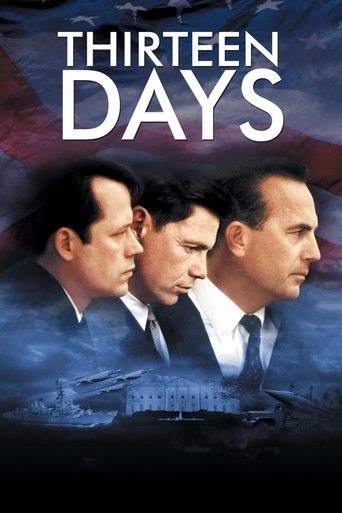
Thirteen Days
2000 · Film · 145 min
Directed by Roger Donaldson
The story of the Cuban Missile Crisis in 1962—the nuclear standoff with the USSR sparked by the discovery by the Americans of missile bases established on the Soviet-allied island of Cuba.
5 positive1 negative4 neutralfrom 10 commenters
Where to watch
No streaming data for this title.


10 comments on Hacker News
In the movie Thirteen Days, JFK mentions a book titled March of Folly by Barbara Tuchmann. I bought the book on that tip and it has an interesting chapter on Vietnam. I don't think adding a chapter on this "special operation" would even be worth it as it would just be repetitive.
That's going to sound luddite and backwards, but to be completely honest, I'm not 100% "frustrated" about being "left out" from "far west"-style AI image generation.
At this point, really, I can think of exactly two use cases:
* cheaply producing ads
* cheaply producing fake news
And it's terrifying, and the people jumping in the bandwagon are scaring me.
There is this quote in "13 days" [1] where people are discussing the Cuban missile crises, and, while everyone is gladly / obliviously preparing for the upcoming nuclear holocaust, one gray-haired diplomat raises his hand and says "One of us in the room should be a coward" before asking for a more prudent option.
Maybe it's the age old tension between the "new world" racing forward and the "old world" hitting the brakes. Not necessarily a bad dynamic in the long run. [2]
Feel free to call me, and the whole block I live in, "coward" on this front.
[1] https://en.wikipedia.org/wiki/Thirteen_Days_(film)
[2] https://en.wikisource.org/wiki/French_address_on_Iraq_at_the_UN_Security_Council
>It is implied the stakes are very, very high, but never is explained what exactly is at stake. Very puzzling.
Is it rude of me to ask if you were born after about 1972 (so less than about 17 at the time the wall came down and the Cold War ended)?
Le Carre's books, even the newer ones, are deeply embedded in a grand battle to the death between superpowers. He didn't bother to explain that in his books because at the time he was writing them his readers (and most of his original film audiences) took that context for granted. By about the age of 17, most people in those days had a very clear understanding of the stakes involved in conflict or war between super powers, including for example the Cuban Missile crisis when everyone in the world understood that tens of millions of people could be killed in the next 12 hours or so (if you're not personally familiar with the era, the movie Thirteen Days starring Kevin Costner is a powerful and engaging view into what was perhaps the height of the Cold War experience).
I agree on the recommendation for Dobbs' book.
"Thirteen Days" is an enjoyable movie, but it does overlook the recklessness of some of the Kennedy administration's actions. For a more critical view, see this article: https://www.theatlantic.com/magazine/archive/2013/01/the-real-cuban-missile-crisis/309190/
Another good one to illustrate the fragility of the world we live in: One Minute to Midnight: Kennedy, Khrushchev, and Castro on the Brink of Nuclear War by Michael Dobbs.
To me it was eye-opening to read about all the close shaves which could easily have ended in catastrophic misinterpretation by one side, and to wonder what might be going on along similar lines today.
The events described in this book were also dramatized in the movie "Thirteen Days".
Author namechecks Thirteen Days, the harrowing account of the Cuban Missile Crisis and a world on the brink of annihilation. There is also a terrific movie adaptation. In it, Secdef McNamara talks about how the positioning of submarines and aircraft carriers about the open seas is actually a coded language. And by making moves and counter-moves, what the US and USSR are actually doing is communicating intent.
Another classic is Ron Howard's Apollo 13. One of the few movies that depict the engineers as heroes. An inspiring watch for the whole team. And Damien Chazelle's upcoming Neil Armstrong biopic might make for a similar outing.
Crisis management, perhaps more so than innate technological superiority, can yield distinct competitive advantage. And this is where actually learning from precisely the type of case study found in the YC network makes sense. Knowing that you can stay calm, slow time, take deep breaths, and react rationally because others have dealt with far more on their plate than you ever will.
I'll share an anecdote. A small independent media outlet once got wind of a redesign I was working on and reported the story. The client was incensed as they were planning a full marketing rollout and had "lost the narrative". We were still months from launch. But rather than get into a blame game and lose more time. I suggested a soft, beta launch with media blitz immediately. After a week of jamming to polish our working prototypes for general availability, we were public facing, with laudatory feedback and the client appearing on CNBC ;)
Weeks later, as it turns out, it was revealed I was in fact the source of the leak. An unscrupulous reporter had called my office posing as a contract employee of the client and asked about a meeting time and place. In replying that it would be at my office that afternoon, they had confirmation that in fact the redesign was in progress!
It was a movie that I enjoyed when it came out, which is why I was troubled when I later learned the full extent of American responsibility for the crisis.
First, before Jupiter missiles were deployed to Turkey, the question was raised in Congress of what our response would be if the Soviets responded by placing nuclear weapons in Cuba. Deployment of the Jupiter missiles was particularly provocative, because they were incapable of surviving a counter-force attack, so their only logical purpose was a first-strike capacity against the Soviet Union.
Second, the declassified EXCOMM transcripts include all sorts of shocking moments. At one point, JFK commented that the Soviets were acting as if we had deployed missiles to Turkey... at which point someone had to remind him that we had done exactly that. It's possible that the drugs he was taking for his back injury seriously impaired his cognitive ability.
Within the White House, it was openly acknowledged that the missiles were of no military significance, and that the "crisis" was a matter of public perception. Yet RFK still advocated a full invasion of Cuba! Is that in Thirteen Days? (Honest question)
Third, the very fact that the movie left you with an impression of mutual arrogance demonstrates that it misled you. The Soviets' deployment of the missiles was a completely reasonable response to (1) the attempted invasion of Cuba at the Bay of Pigs and (2) American missiles in Turkey and Italy. And they offered to honor the principle of reciprocity, which America was striving to violate during the entirety of crisis, until finally succumbing to reason and cutting the original tit-for-tat deal that the Soviets wanted in the first place.
In a sense, the fact that Thirteen Days is a facially credible movie makes it that much more misleading than transparently jingoistic action flicks. Viewers are more likely to accept its version of history, no matter how slanted.
But if a well informed Russian watched Thirteen Days, I'm sure he would find it a laugh-inducing example of American nationalist indoctrination.
I didn't think Thirteen Days was that unbalanced. It didn't portray a unilateral victory for the steadfast Americans, but made it clear that both sides made compromises to end the crisis.
Thirteen Days left me with an overwhelming impression of extreme arrogance on both sides. Who are you people, and who gave you the power of life and death over an entire planet? It's a good movie IMHO, and you're doing it a disservice by lumping it in with the usual jingoistic propaganda flicks from Hollywood.
Not sure how accurate it is but I enjoyed Thirteen Days: http://www.imdb.com/title/tt0146309/
Fog of War also features the subject and is excellent: http://www.imdb.com/title/tt0317910/
EDIT: Falcon and the Snowman is also great and it's kind of related so it's worth a mention: http://www.imdb.com/title/tt0087231/
Some famous ones I enjoyed are 'Dr Strangelove', 'WarGames', and 'The Day After'.
I also enjoyed the lesser-known 'Miracle Mile' and 'Matinee (1993)'.
Haven't seen 'On the Beach', but it's an early (1959) well-reviewed film on the topic. Haven't seen 'Thirteen Days', but it covers the Cuban missile crisis -- perhaps the closest the world came to using nuclear weapons after Hiroshima and Nagasaki.