 Hacker Cinema
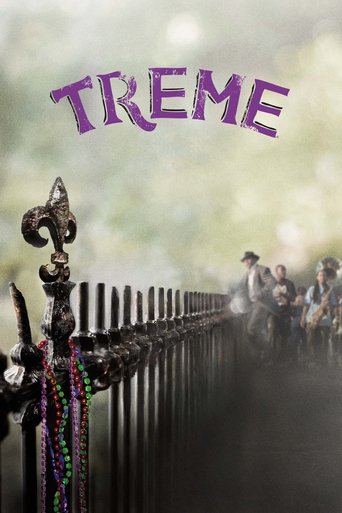
Treme
2010 · TV series · 60 min episodes · 4 seasons
Created by David Simon, Eric Overmyer
Tremé takes its name from a neighborhood of New Orleans and portrays life in the aftermath of the 2005 hurricane. Beginning three months after Hurricane Katrina, the residents of New Orleans, including musicians, chefs, Mardi Gras Indians, and other New Orleanians struggle to rebuild their lives, their homes and their unique culture.
3 positive5 neutralfrom 8 commenters
Where to watch
No streaming data for this title.


9 comments on Hacker News
He was also a consulting writer for season 2 of Treme on HBO. Presumably for the story threads centered on Kim Dicken’s chef character.
Almost no one in the cast, including the Americans, save for the 3 actors from the area (Robert Chew as Prop Joe, Felicia Pearson as Snoop, Anwan Glover as Slim Charles) even tried putting on a Baltimore accent. Wood Harris and Idris Elba were supposed to be dealers from the Baltimore projects, but Harris just spoke in his Chicago AAVE accent and Elba sounded like a guy from New York City (his accent even breaks pronouncing the word 'responsibilities'). Lance Reddick sounded like Lance Reddick. Robert Chew tried coaching the kids in season 4 in a Baltimore accent and dialect but the accent didn't seem to land.
I do wish David Simon had enforced accents as strongly as he did with Treme.
I don't watch stuff unless it has ended and is reccomended by someone who watches shows I generally enjoy. Here's my pitch for the golden age of TV, though most of these are from a few years back. Most on HBO.
The Wire
The Sopranos
Generation Kill
The Deuce
Treme
Show me a Hero
Luck
The Expanse
Sillicon Valley (not actually that funny but like a documentary of our field)
Mad Men
I think you have to read a lot of books to understand what they mean. And i don't think this woke crowd is right btw.
If you're writing fantasy or fiction in anothertime book, be my guest and write about any character (although if it is supposed to be based on history and you're completely off about the culture at the time, i don't want to read your junk, really). If you're writing about a character in modern time, either you do some really good research, or you'll be off, and if your book/movie is bad, the woke crowd will drop on you. I mean, even if "The Wire" or "Treme" was ran today, nobody would drop on it.
And i will take another example for people in the US. Books about the so-called "white trash"/"trailer trash" or who depict people in this population are mostly wrong. Sometime its hilarious, sometime you just stop reading because the book is so bad. For me it was books about Appalachians hillbillies. Since its the american crowd i know the most, i was quite exited to read about them. I've found on good book, one. The rest is complete trash. Honestly if my grandfather or any of his friends found those books, those would burn.
> Someone needs to do a study on government waiting lists. I
I'll spare you the time and money with my best guess of the conclusion of said study:
In conclusion, Government tasks outweigh the potential output of Government employee expectations, therefore we the researchers recommend ever greater budget allotments and grants to further study why the adage 'more money' doesn't translate into more 'productive' outcomes in the Public Sector.
The very essence of the State as a bureaucratic system ensures that things move as slow as possible, which often illicit the occasional Kill-dozer [0] event, even if you have someone motivated to 'change it from within' they inevitably get burned out due to the amount of red-tape and general sense of apathy. I highly recommend you watch the Wire and maybe even Treme (same producer) as it outlines anything I say way better than I could ever articulate in a 10,000 page essay on the matter.
We really need to move past the nation-state model and limit its scope to as little as possible as that could at least allow for more viable solutions. I just heard you can print car tags at kiosks in grocery stores in CA, which is an example of simple and elegant solutions that were only made possible because the pandemic shut down so many government offices and thus allowed for these services to allotted to more sensible methods--they were not going to let such a massive amount of tax money slip through their hands so they moved fast before people simply disregarded it just as they did lock-down or stay at home orders, and sadly even mask wearing in certain cases.
I waited nearly 5 months for my tags prior to this for my motorcycle in CA, only to see this outcome, which normally would have driven me up the wall but at least produced a reasonable over all solution. No one needs to be paid to hand out something you can automate, it makes no sense. Put those people to more sensible tasks like addressing liens or title transfers that are more nuanced and require actual Human intelligence (and I use the word loosely) or zoning approvals, or solar tie in approvals etc... to solve as there is a massive back log of those right now that can't move forward until some bureaucrat signs off on it.
0: https://allthatsinteresting.com/marvin-heemeyer-killdozer
> I strongly disagree. This article has given me more insight into the process by which a cop "becomes evil" than literally any other piece I can recall. I hope it's authentic but who knows.
Then its clear you have been the fortunate few who have never had to be subjected to the perverse legal system in the US, or spent any time in low income areas where those tactics are 'business as usual' in what is referred to as policing. This is the norm, shows like The Wire or even Treme (both made by the same director) are just as much documentaries and exposes as they are entertainment. The latter skewing into some sort of misery porn.
And to be honest, given this is Hacker News, that doesn't surprise me. I just wonder if it ever occurred to you what the plight of those immense amount of homeless people is, and what happens to them when they're no longer in sight?
> I feel like I read an entirely different piece than you did... the author is not a police officer. He's a former police officer who seems to have genuinely come to hate the profession as much as anybody.
Again, proving the point that this is not something that has only just occurred out of no-where, but is seemingly systemic in the very system we're discussing. Again, no one involved with any activism is surprised by what just occurred with Police, we've all seen it up close and been subject to it, its what you understand going into them.
What was remarkable was how surprised the rest of you were towards them, and how often people are still quick to rationalize their behaviour. This is what authoritarian regimes do, they bolster the police to enforce political decree, not Law. Look at Hong Kong, its way more pervasive than you think and it stems from the same thing.
I don't know if David Simon's (creator of "The Wire" and "Treme") defense of the Verizon phone records request ever made it onto HN's page:
Here it is, if you hadn't seen it: http://davidsimon.com/we-are-shocked-shocked/
Apparently it was so controversial that his site crashed from the traffic, and he had to tell everyone to chill out: http://davidsimon.com/nsa-and-fisa-commentary-calling-it/
Anyway, why I thought of that in relation to the OP was, that I think some defenders of the NSA and general government surveillance policies are just unaware of how technology can fundamentally change things...As Google leaders have been known to say, "Speed is a feature"...and so it's not the finding of information that makes the establishment of Google time in human civilization, but how fast Google allows us to do it.
So that said, Simon is one of the journalists I have the absolute highest regard for...I'll be one of the many who think "The Wire" is the best TV drama ever, both for its artistic take and for its illustration of how institutions -- the police, the schools, the drug trade -- corrupt even the best of individuals. "The Wire" is heavily based off of the year that Simon embedded himself in the Baltimore homicide department...the book (which spawned a network TV show) is the best book about the practice of journalism I've ever read. After a year following the detectives, you'd think Simon would be pretty much in cahoots with the police...but he followed up "Homicide" with "The Corner", in which he spent a year embedded with drug dealers and their customers...apparently most of the friendsships he made in the Baltimore Police department evaporated after he published a book bringing sympathy to Baltimore's downtrodden.
Anyway, I don't think Simon has a love for government or authority. But I do think he's a little naive when it comes to advances in technology and their consequences. When "The Wire" started, the police were focused mostly on tapping pay phones. By the time "The Wire" ended, the police were surprised at the advent of camera phones. So when Simon says he thinks the NSA and other law agencies won't abuse their wiretap authority, I believe him...because in much of his experience, the practical obstacles (such as, having to have an officer watch a payphone all day) made it basically impossible for blanket surveillance.
But technology is different...I think Simon's -- and others who I respect -- mistake is to think that the game is being played the same as it always is. It may be the case that the NSA is staffed with as people as good and conscientious as anywhere else...but it's naive to think (as was the primary lesson in "The Wire") that the power they have will lead them astray...and to those of us affected by it, it makes no difference if the violations were intentional or accidental.
Anyway, back to Paul Revere and the OP...I think it's a great example. But of course, what makes that educational scenario feasible is technology and the ability to record information (metadata or whatever you want to call it) in an organized way.
Frankly, I kind of thought anyone who read 1984 would understand how technology changes everything. But yeah, I do think there are some well-meaning people don't grasp the technology, and if they did, they'd have a different opinion about the dangers of unchecked surveillance.
* edit: misspelled conscientious as 'contentious'
* edit: as an example of how much Simon continues to challenge the police as a citizen, here's an essay he wrote after the success of the Wire, in which he tried, as a citizen, to get the basic details of a cop-involved shooting, something that has always been public record. He eventually succeeded, and the revelations about the officer involved ended up jeopardizing the prosecution: http://davidsimon.com/in-baltimore-no-one-left-to-press-the-police/
But as you can see if you read the piece, Simon is not to thrilled with how the Internet has displaced newspaper journalism
No, I don't think I'm forgetting that. Netflix is talking about doing five original scripted series per year. HBO does... seven or eight, maybe? (Off the top of my head from the last year, Game of Thrones, Girls, True Blood, Boardwalk Empire, Newsroom, and Treme; that list isn't complete). That content is all not only original but, at least initially, exclusive. Showtime is at about the same level of volume, so this isn't unique.
You're right that in terms of a fraction of hours of content per month, most of what they show is not first-run original content, but I don't watch TV 24 hours a day, so I don't care. Like I said, if I got that amount of original content from four or five different providers (let alone 10), that would be more television than I have time to watch. The fact that they mostly show movie reruns is immaterial.
I know there will be a lot of people feeling extremely vindicated in their suspicions that if HBO offered Game of Thrones for legal download they would rake the money in. Let's take a second to work through the counter-argument though.
Instead of asking why they don't cash in on the clear demand, why not ask yourself how HBO & Co would operate if they did sell shows by the episode and direct to consumers. If you're looking for a proxy, the outcome probably wouldn't be a million miles from the networks, where audience levels translate into ad revenue, which means shows live or die very quickly. Look at Fox's 2010 series Lone Star. Despite having the best-rated pilot of any of that season's debuts, it was cancelled after two low-rated episodes.
Have you ever asked yourself why HBO, Showtime and AMC have the track record they do in producing great TV of movie-rivalling production value and movie-topping narrative chops? The simple answer is that they run a subscription model and that gives you a lot of freedom. In the first instance, a significant part of HBO's subscriber base is there for boxing first and foremost: money in the bank for the programming arm. In the second instance, once you're paying for something monthly, you're actually quite unlikely to cancel it even if you don't extract the full value from your subscription (see cinema all-you-can-eat memberships). Above all, it allows you to operate from a stable base of yearly income and that completely flips the consideration of which programs stay and which programs go. It's simply a consideration of opportunity cost; is there a better series that could fill this slot?
The subscription model is precisely the reason that HBO is able to swing for the fences on things like Boardwalk Empire and Game of Thrones, which are both enormously expensive undertakings. It's entirely because the shows are able to prove themselves over seasons, and not episodes, that subscription-driven channels are able to make them. And even then the judgment of whether to continue is usually based on creative satisfaction and not cold, hard audience figures - both the Wire and Treme kept their places on the roster despite comparatively lousy viewing figures.
The problem with a subscription model is that it has to be all or nothing. If you start giving people a way not to subscribe, they won't. They'll just pay to watch episodes as they become available. That's not even to get into the practicalities of carrier relations and all the added considerations that throws into the mix.
tl;dr: Game of Thrones might be a no-brainer for selling legal downloads, but things like Game of Thrones don't get made by companies that use that business model for very good reasons.