 Hacker Cinema
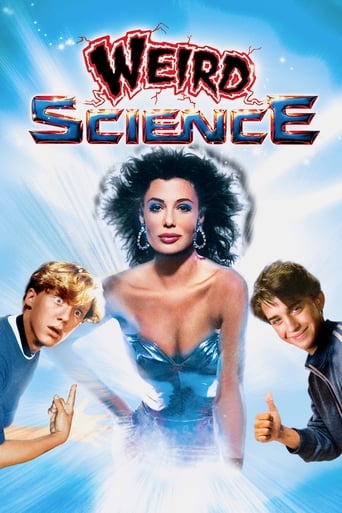
Weird Science
1985 · Film · 93 min
Directed by John Hughes
Two unpopular teenagers, Gary and Wyatt, fail at all attempts to be accepted by their peers. Their desperation to be liked leads them to "create" a woman via their computer. Their living and breathing creation is a gorgeous woman, Lisa, whose purpose is to boost their confidence level by putting them into situations which require Gary and Wyatt to act like men.
4 positive1 negative8 neutralfrom 13 commenters
Where to watch
No streaming data for this title.



13 comments on Hacker News
Oh it will be even better than humans some day. Not any time soon, and definitely not when the sort of people training these things range from incredibly awkward around people to downright psychotic in public. But the infinite patience and persistence of coding agents in the form of a teacher for other things than code would be pretty amazing, but we're nowhere close to that.
Case in point, I would love to know who thought deploying a figuratively "demilitarized" sexbot as a teacher in NY town in 2026 was a good idea. And I say that as someone who loved the movie Weird Science. And I'm evil enough to admit that Van Halen's Hot For Teacher was the first thing that slipped into my mind reading the article below. But really? Who?
https://www.npr.org/2026/07/29/g-s1-136072/ai-robot-teacher
Solid debunking.
This is just the same computer ‘magic’ that I’ve seen my whole life. From the dawn of home computing in the 80’s, to Hollywood films like Weird Science and War Games, through videos games of the 90’s and CGI… it tickles the imagination but never really pans out.
The idea of film fans pooling together and generating the films they really want to see, from Star Wars sequels that don’t suck, to TMNT films that look like the original, was exciting to me and many others, even if they were copyright infringement. Want a Joker sequel where he doesn’t get shanked in prison? We can do that!
I think that’s why they used Pitt vs Cruise in this demo. They’re selling a dream. Sad, really.
I'm honestly pretty tired of the 80s-movie-derived cultural memeplex of nerds getting oppressed by jocks with girlfriends in a high school context. This never accurately characterized any social environment I've been in, and I'm definitely a nerd by disposition. I'm not sure this ever really existed outside the imaginations of hollywood screenwriters. The Breakfast Club is mid, Weird Science is an actively terrible movie, and Ferris Bueller's Day Off is entertaining enough but looms way too large in the American pop culture imagination.
Tim Cook was the salutatorian of his Alabama public high school, majored in industrial engineering in college, and later got an MBA. He sold IBM computers for years and joined Apple in its late 90s doldrums because he was won over by Steve Jobs' charisma within several minutes of his first interview with Jobs. He's an openly-gay fitness nut - meaning he's had a lot of opportunity to have sex in his life (and being famously private, he's not talking about it one way or the other, as is his right).
I frankly don't think Tim Cook is much of a nerd. He's a smart, driven, ambitious business guy who's done a good job at making the gigantic electronics company he's the CEO of sell more products and navigate the political environment it operates in. He's not some underdog hero, and people who actually care about technology for its own sake or who care about computational sovereignty shouldn't attach their sense of identity to anything Apple does.
I pity those who missed out on those tech golden decades of the 80's and 90's. The very idea of email was revolutionary. Getting news on demand while others waited for newspaper deliveries or set time TV shows was thrilling.
This is probably why Weird Science is one of my favorite films, because it captures that period where imaginations ran wild. The simple video games were fine as we used our imagination to fill in the gaps.
Tech these days has long lost it's magic. The 'AI' boom tried to recreate the buzz with nonsensical claims that it has failed to deliver. It's all smoke and mirrors these days.
I think the last time I was truly wowed was when Shazam appeared. That was 23 years ago.
Neutrinos pass through the entire planet from space, so hopefully they will be able to see the background neutrinos as well as the neutrinos from their collisions.
If this was a brimstone and fire depiction for those with a religion vent, neutrinos would be likened to ash, the other particles would be various sizes of burning embers, some large but glowing gently (beta), others small and burning brightly (alpha).
Its all contained in a giant underground magnetic donut that would have Homer Simpson salivating which accelerates the particles, like a rail gun or steam catapult on an navy aircraft carrier or a catapult launcher for roller coasters, and it keeps accelerating these particles, like a child with ADHD on sodium benzoate can accelerate a fidget spinner, until the particles collide, like the crescendo of a fantastic firework display at a country's official New Years eve display watched through computer screens that's somewhat reminiscent of the 1979 Atari Inc Asteroids computer game when an asteroid explodes.
The electrical demand for the magnets is great but short term like the Death Star blowing up Alderaan, so whilst its CO2 footprint could be likened to a large Cruise Liner over the year, it generates this footprint over extremely small periods of time when running these experiments like something out of Weird Science when Kelly LeBrock comes to life!
So the electrical infrastructure is highly capable.
The electrical companies need advance knowledge to make sure they have ordered in enough coal and gas, and topped up the hydroelectric dams, when they run their experiments, otherwise the neighbourhood experiences something of blackout like in the movie Batteries Not Included.
https://en.wikipedia.org/wiki/Neutrino
SuperK (not the raving form of Ketamine being consumed down the Dog and Duck pub on weekdays) https://en.wikipedia.org/wiki/Super-Kamiokande#Description
No so broad a notion of 'culture', mainly cultural 'content'. This can be, and it is tweaked (worldwide), as needed. Cinema/TV in US has always been a leading indicator of societal change, rarely a lagging indicator. So it has always been, in a sense, understood and used as a pedagogical platform.
They actually tried this in US starting in late 80s and 90s, when we got a slate of 'geeks who get babes, and social acceptance' movies - War Games, Real Genius, Revenge of the Nerds, Weird Science, Hackers, etc.
[p.s. didn't finish that thought! /g]
But imho this was the wrong set of adjustments. The inducements - sex, money, and social acceptance -- are certainly attractive, but any kid with half a brain can note that there are far easier and certainly more exciting ways than learning -- culturally celebrated ways, yo -- to get that very same set of inducements. It did however get us to the geek hero celebrity stage, with Jobs and now Musk.
[edits]
Too many facets to this question...
to adolescent me: https://en.wikipedia.org/wiki/Weird_Science_(film)
to middle aged me: https://en.wikipedia.org/wiki/Office_Space
But, in relation to HN? Perhaps https://en.wikipedia.org/wiki/Catch-22 mixed with https://en.wikipedia.org/wiki/Schizopolis
> I believe we should be motivating girls who show interest, but is there harm if no interest is shown?
The question then becomes why interest isn't shown in the first place.
You could argue, as the "manifesto" writer did, that there's some kind of innate biological explanation. To me, that's a pretty extraordinary claim and requires extraordinary proof. It's true that there are some differences between the sexes. Women do a bit better on some mental tests than men and vice versa. But how much of that is biology and how much is upbringing? For instance, from an early age, studies show parents make girls say "please" more than they do for boys, and emphasize sharing. So do women fair better on some emotional tests because of some innate biology or because we've emphasized that kind of thing literally since they could talk? It's really really hard to tease these things apart. And it's so hard because those differences are tiny. If we assumed those differences really are 100% biological (again, a big assumption), it might explain why Computer Science would be 55% men, and 45% women. It wouldn't explain the huge disparity we see today.
So if the reason women don't show interest isn't biological, what is it? A further complicating factor to the whole discussion is we're talking about why women aren't in computer science now. It hasn't always been this way. Historically, the field of computing had lots of women. A lot of women went from "human computers" who did math by hand to programming the early mainframes (the movie Hidden Figures shows a time at NASA when this was happening). While a gender gap has always existed, it used to be a lot smaller. Women made up about 1/3 of people with CS degrees in the late 70s and early 80s. But as the STEM gender gap has been closing everywhere else, it's actually gotten wider in CS, and only CS. Why? The "it's biology and girl brains are different" argument can't account for that. Biology didn't change.
What did change was society. Movies like Weird Science and War Games (my favorite) came out. The "cool hacker" entered Pop culture, and the stereotype they settled on was a boy. Girls were a lot less likely to have computers in the home as well. This is an interesting article (http://www.npr.org/sections/money/2014/10/21/357629765/when-women-stopped-coding) that talks about how early home computers were marketed as a toy to buy for boys.
It's like we as a society decided that computers fell into the "boy stuff" category with GI Joe and baseball, not the "girl stuff" category like Barbie and softball.
I think it all adds up to a pretty convincing argument that biology has nothing (or very, very little) to do with it.
I wouldn't read too much into that movie as an accurate portrayal of anything. The script is basically an early 80s college frat movie with all the bros in one frat replaced by stereotyped "nerds" to try and change up the formula a bit.
For contrast try: "Real Genius" or "Weird Science" or even "My Science Project" all from around that time period.
While I was working on the original version of The Sims 1, there was some crazy talk about a movie. I dearly hoped that nothing would ever come of it, since it couldn't possibly be anything but terrible. Fortunately it seems to have been canceled!
http://sims.wikia.com/wiki/The_Sims_%28film%29
http://www.imdb.com/title/tt1482462/
https://en.wikipedia.org/wiki/The_Sims#Other_media
>Producer John Davis revealed on an interview that he is taking inspiration from John Hughes's 1985 film Weird Science for the movie adaptation.
>"What they realize is that they can scan their world in, because this is the most lifelike, real Sims game ever. As they are playing this, they are all of a sudden realising [that] what they are playing on the game is having an effect on the real world. So in effect, through the game, they are able to control their world. It's wish fulfillment, and obviously it turns against them."
How could that possibly not bomb in the worst possible way?
I imagine they would have had to bury the DVDs in the same hole as the ET cartridges.
> Movies like Weird Science, Revenge of the Nerds, and War Games all came out in the '80s. And the plot summaries are almost interchangeable: awkward geek boy genius uses tech savvy to triumph over adversity and win the girl.
Movies like Revenge of the Nerds are not about nerds triumphing over adversity and getting the girls because they are nerds... it's about triumphing over adversity and getting the girls in spite of being nerds. Or, if the key to their success was really their brains, they used it to overcome an adversity that was caused by being nerds. If they weren't being nerdy and brainy, there would be no adversial story to begin with.
To implicitly suggest that movies like that are supposed to inspire people to become and continue to be nerds is asinine. It's a role reversal concept; not something that people believe happens in real life. The whole point is them being unlikely heroes and winners.
> Ordóñez got through the class but earned the first C in her life.
I guess this is supposed to evoke some "hitting a low" sentiment? The sheer horror of getting a grade that is technically right in the middle? Long live grade inflation, I give it an A+++.
It is comparable. In the way that blackface allowed African Americans to work in venues and productions that they were otherwise prohibited, BBT allows nerds to be the subject of a mainstream sitcom.
BBT is not at all empowering the way that "Weird Science," for example, was, and highly-mainstream TV executive Chuck Lorre is of exactly a more powerful class who has allowed nerds to enter into a world where they were previously excluded. That BBT is only slighly less-awful than how nerds were previously portrayed is not a badge of honor.
How often does the show demonstrate dignified interactions between its main characters and the outside world?
ooh, just found an old hacker post on movies - favorite answer: weird science