 Hacker Cinema
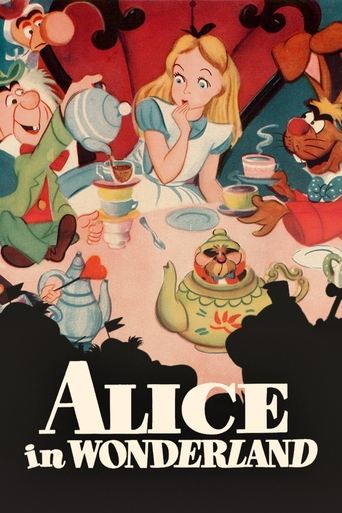
Alice in Wonderland
1951 · Film · 75 min
Directed by Clyde Geronimi, Wilfred Jackson, Hamilton Luske
AnimationFamilyFantasyAdventure
On a golden afternoon, wildly curious young Alice tumbles into the burrow and enters the merry, madcap world of Wonderland full of whimsical escapades.
2 negative12 neutralfrom 14 commenters
Where to watch
No streaming data for this title.


15 comments on Hacker News
>What work of Disney (company, not the man per se...) is more influential on the modern American Psyche (today, in 2026) than Ironman, X-Men or Spiderman?
All of them. None of those MCU movies really did anything to the "american psyche", forgettable entertainment.
And even if they had done, the question was "in terms of how Americans see themselves and how people around the world sees us". Nobody sees Americans in in 2026 the way Stan Lee or MCU saw them. Not even themselves. How they have been seen in general wasn't determined in 2026 or 2020 or 2000, but in the 20th century. And even how they're seen and see themselves in 2026 is not defined by the MCU either.
Concerning the general view on US, Disney movies (especially including Pixar) have had much more influence. But I mentioned other even more important things: Hollywood in general (pre-MCU, from early film to John Ford, and to Copolla and Scorsese), the western and the idea of the west/'frontier', rock n' roll...
>Sleeping Beauty? That's French. Beauty and the Beast? Also French. Great Mouse Detective? British. Alice in Wonderland? British. Pinocchio? Italian.
In their Disney treatment they're 100% American.
It's not like this is a new thing at Disneyland or anywhere. When they opened, they sold your tickets in tiers, and that's when we coined the expression "E-ticket Ride" because they'd deem the most desirable, most exciting attractions as top-tier premium packages, and families on a budget would settle for less.
It was the abolition of these distinctions and the flattening of the price of admission that took a step forward. Since Disneyland's reputation had been established, they were more willing to let the patrons and fans decide which rides were the best and coolest, and inform future iterations of Imagineering.
By the way, to speak to the article itself, I've been reviewing "classic" Disney films and found significant occultism, a lot of "magick" and such ("Sorceror's Apprentice", "Pinocchio"); everyone knows the fairies and supernatural elements; some say that Disney has changed and Disney has lost moral character and is no longer suitable for children, but I suggest that Walt Disney's morality hasn't altered course since its foundation, when "Alice in Wonderland" was a drug-fueled sex romp written by an ephebophile; when Steamboat Willie was an arrogant bigot who violently pounded other animals into submission...
Alice in Wonderland (the book) is in the public domain. The old Disney movie is still in copyright, and the cover image does look very much like it's from the movie, but that character design is from John Tenniel's illustrations which are also in the public domain.
I don't understand. According to Wikipedia, Disney bought the rights to Alice in Wonderland and the illustrations from the publisher in 1938, 13 years before the movie came out.
It's incredibly ironic that under the copyright terms Disney has helped get enacted, several earlier films in particular Alice in Wonderland would have been infringement. Crossing a rope bridge and cutting it down behind you.
and owns so much cultural IP
No. That's not cultural IP, that's Disney IP. Disney made a habit of taking stuff that was in the public domain, changing a few things around (even the whole story line) and copyrighted that.
Next time you have the inclination, compare a Disney movie/story/comic that purports to be the same as one of the public domain tales with the original tale. You'll find that the "Disney Creation (c)" is nothing at all like the original.
As an example, compare the original 'Star Wars' franchise from the 1970s with the later Disney knock-offs and see for yourself. As further examples, compare Disney's 'Cinderella' with the original book version, or maybe Disney's 'Alice in Wonderland' that is a weird hodge-podge of TWO of Lewis Carroll's books, 'Alice in Wonderland' and 'Alice Through the Looking-Glass'.
Licensing isn't the thing that prevents big budget productions from happening. If they wanted to make a bunch of big budget Marvel movies in 1992, nothing was stopping them. They'd have just paid for the rights back then, the same as they do now.
What copyright expiration would get you that you don't have now is tons and tons and tons of fan fiction and small budget productions. A few of which would have been good and most of which would have been both terrible and ignored. Like every school play being Shakespeare, but now it's Spider Man.
And heretical crossovers. Deadpool vs. the Joker and things like that.
But Tangled, Frozen, Little Mermaid, Alice in Wonderland, Beauty and the Beast, all the Peter Pan movies, they're based on public domain stories and they're still making major films out of them on a regular basis. The Snow Queen is one public domain fairy tale, Frozen is three movies.
Incorrect: Mickey Mouse was created in the 20s, Disney's Alice in Wonderland was released in 1951. You're right that the book would still have been copyrighted.
Oswald the Rabbit was also created by Walt Disney, in 1927, and sold to Universal. He then created Mickey Mouse as a replacement character for his own movie.
Alice in Wonderland was based on a book that was 86 years old when Disney's film was released. It was public domain. But Disney fought hard to prevent Mickey Mouse from going into the public domain, and got Congress to extend the copyright term to 95 years. Under such a rule Disney couldn't have made Alice in Wonderland without permission from the heirs of Charles Dodgson (aka Lewis Carroll).
You seem concerned about two issues: fair use and copyright term. Fair use is complicated and open to a lot of disagreement. Copyright term is more straightforward. I'll consider both in light of your examples.
Fair use is complicated because there's no hard and fast rule, just a set of factors that a court would consider and a few important court decisions to compare your facts to. Let's Plays are further complicated because some are probably fair use, but others probably aren't. An entertaining live commentary of part of a game would probably be fair use because it's like an excerpt included in a scholarly critique or literary review that is traditionally considered fair use. However, where the entire story of the game is included with all the dialogue and cutscenes, basically eliminating the need for someone to actually play the game, it starts to look more like an unlicensed copy of a movie, which isn't considered fair use.
Copyright term has a simple rule, it is finite. Alice's Adventures in Wonderland was published in 1865. When Disney released its animated film in 1951, 86 years later and 53 years after Lewis Carroll's death, the copyright term was over and Disney could make its movie without paying his estate anything. Today, the term in the U.S. is usually the life of the author plus 70 years, which wouldn't increase the term for Alice by very much. Also, Disney isn't special. The same freedom is extended to all of us. Any of us can make an Alice in Wonderland movie. We can use everything that came from Lewis Carroll in 1865, we just can't take what Disney added in 1951.
> Makers would prefer that and so would consumers
Unfortunately makers aren't the ones controlling the content. You forgot about the Studio Oligarchy that wishes to control exactly how and when you consume their content. They can negotiate higher royalties out of the likes of Netflix and Amazon through exclusivity.
Another tactic employed by studios is artificial scarcity. Disney is a pioneer in this technique and routinely locks movies in the vault until demand peaks then releases them at $25 a pop which is a premium over all but new releases. When was the last time you saw Alice In Wonderland for $9 at Best Buy? Never.
The studios are even starting to roll their own streaming services to compete with Netflix and Amazon. This is why Netflix, Amazon, Hulu, and now even Apple are becoming their own studios. Because the streaming business itself is dying and you either need to be the content provider or the service provider to survive.
Eventually studios and ISPs are going to start merging into one proprietary pipe.
There is absolutely nothing stopping you or anyone else making a film, animated or otherwise, of Alice in Wonderland. Disney categorically do not own copyright to the original work. There have been over 30 non-Disney adaptations of Alice in Wonderland since the 1951 Disney version, as well as 2 more works by Disney.
Since Lewis Carroll's original work had gone into the public domain, it is a misnomer to say that Disney "ripped it off". Anyone can take a public domain work and monetise it. That derivative work may be copyrighted, much like the performance of a Beethoven symphony (are the orchestra ripping off Beethoven?) or the performance of a Shakespeare play (again, are the actors, producers and directors ripping off Shakespeare?).
You seem to find the money side distasteful, which is a different argument. The issue here is that the Walt Disney Company, who ultimately own the copyright to the derivative work, maintain their copyright. Yes, copyright laws need re-examining in a world where corporations own copyright, but it's far more nuanced than you are making out.
I'm sorry I didn't read all the comments, but couldn't it be that the artist was inspired by Alice in Wonderland (1951) movie? The silhouette resembles to that of Alice: http://images4.wikia.nocookie.net/__cb20110816104841/disney/images/a/ae/Alice_KHREC.png
...just saying.
Perhaps slightly OT, but I think its easy for us as adults to thing we'll 'know' what our children will find scary or disturbing. The two film scenes from me being 5-6 that I remember always scaring me were things that most adults wouldn't probably find that scary. They were Bruce Banner turning into the Incredible Hulk and the Jabberwocky scene from Alice in Wonderland.
Children are complex, and I think rarely can we assume to know what they'll think. Its why we laugh so much when they say funny things- we can't predict them.
>I know that Disney stops people from taking Walt's original concepts. But is that a bad thing? What concepts did Disney steal? None: he made his own. Other people can do that too.
This is completely wrong. Nearly every famous early work of Disney's was "stolen" from others. Among the more famous are Snow White (1937), Fantasia (1940), Pinocchio (1940), Dumbo (1941), Bambi (1942), /Song of the South (1946), Cinderella (1950), Alice in Wonderland (1951), /Robin Hood (1952), Peter Pan (1953), Lady and the Tramp (1955), Mulan (1998), Sleeping Beauty (1959), 101 Dalmatians (1961), The Sword in the Stone (1963), and The Jungle Book (1967).
The first iteration of Mickey Mouse, called "Steamboat Willie", was copied directly from Buster Keaton's "Steamboat Bill."
This is an excerpt from one of Lawrence Lessig's speeches about the topic: "It was a parody, a take-off; it was built upon Steamboat Bill. Steamboat Bill was produced in 1928, no [waiting] 14 years--just take it, rip, mix, and burn, as he did [laughter] to produce the Disney empire. This was his character. Walt always parroted feature-length mainstream films to produce the Disney empire, and we see the product of this. This is the Disney Corporation: taking works in the public domain, and not even in the public domain, and turning them into vastly greater, new creativity. They took the works of this guy, these guys, the Brothers Grimm, who you think are probably great authors on their own. They produce these horrible stories, these fairy tales, which anybody should keep their children far from because they're utterly bloody and moralistic stories, and are not the sort of thing that children should see, but they were retold for us by the Disney Corporation. Now the Disney Corporation could do this because that culture lived in a commons, an intellectual commons, a cultural commons, where people could freely take and build. It was a lawyer-free zone."
To address your second point, "the idea of capitalism" does not necessarily require giving anyone permanent, state-enforced monopolies of anything, no matter how well written it is. Any justification for copyright has to stem from a benefit to society. Strong arguments can be made for giving creators temporary monopolies of a limited scope, but permanent monopolies are bad for both innovation and the public.