 Hacker Cinema
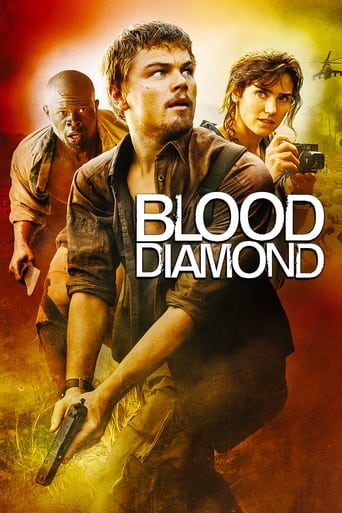
Blood Diamond
2006 · Film · 143 min
Directed by Edward Zwick
An ex-mercenary turned smuggler. A Mende fisherman. Amid the explosive civil war overtaking 1999 Sierra Leone, these men join for two desperate missions: recovering a rare pink diamond of immense value and rescuing the fisherman's son, conscripted as a child soldier into the brutal rebel forces ripping a swath of torture and bloodshed countrywide.
4 positive1 negative16 neutralfrom 21 commenters
Where to watch
No streaming data for this title.
Videos commenters linked
From YouTube links in the comments below. Most are clips and trailers; “Full” means the uploader says so.



21 comments on Hacker News
> When the issue became big, the Blood Diamond movie, sales of lab grown did not markedly increase
Other people would still assume you might have bought a blood diamond, so instead of buying a lab diamond, I would expect these people to have bought another gem if they bought a gemstone at all.
> What I find most interesting is the weight put on the ethical side. I think it’s overstated. When the issue became big, the Blood Diamond movie, sales of lab grown did not markedly increase.
It was not a switch that was pushed the moment the movie went out. In the grand scheme of things, the movie was not even that popular. But there definitely was a realisation that diamond prices were completely artificially inflated by an oligopoly, and that there were many issues with how they were sourced.
Just because demand did not follow a step function when the file was released does not imply that ethics are not relevant.
My wife is in the retail side of this market and I’ve had a lot of second hand familiarity with the transition to lab grown.
What I find most interesting is the weight put on the ethical side. I think it’s overstated. When the issue became big, the Blood Diamond movie, sales of lab grown did not markedly increase. It took another decade or so to become more prevalent. What changed over that time is the price, IIRC the price was comparable to natural at the time the movie came out. Ethics were not compelling enough for most people at that price. When prices got about 50% of natural, it became much more compelling. Now that it’s around 10%, it’s practically so compelling that buying natural isn’t even a real consideration for many people.
Anyways, I think people use the Blood Diamond talking point as a socially acceptable reason- it’s what they tell their parents and grandparents who might judge them- but in reality it’s almost completely a financial decision. If the tables were turned and natural diamonds became 1/10th the cost of lab grown, the market would completely flip back practically overnight.
Back in my law school days I was part of our school’s Immigration and Human Rights Clinic that won a $22M judgment under the Alien Tort Statute Act on behalf of Liberian torture victims against “Chuckie” Taylor, son of Liberian President Charles Taylor.[1]
The background is the stuff of movies, Charles Taylor was a high ranking official in Liberia that fled to the US after being accused of embezzlement (principally from US contracts), he was arrested in the US and “escaped” from Federal prison, fled back to Africa where he was armed and funded by Gaddafi, and became President of Liberia after a coup. His campaign slogan was "He killed my ma, he killed my pa, but I will vote for him.”
In fact both Charles and Chuckie are depicted in the Movie Lord of War, where Chuckie was the one who asks Nicolas Cage for the Rambo’s golden gun. Their brutality was also depicted in Blood Diamond, in neighboring Sierra Leon where they were behind Revolutionary United Front (RUF) and would cut people’s arms off (long sleeve/short sleeves for above/below the elbow) when they voted in elections, because voters hands/thumbs were inked as evidence of voting.
Chuckie interestingly was actually a born in the US and a private school kid. Then went to Liberia after Charles became President and became head of his anti-terrorists unit called the “demon forces”, the rest is the stuff of nightmares they leave out of the movies.
If you can read between the lines, this stuff goes to the highest levels of government and intelligence which is another reason the ATS Act is under attack.
[1] https://lawprofessors.typepad.com/immigration/2010/02/fiu-immigration-law-clinic-wins-millions-on-behalf-of-liberian-torture-victims-.html#google_vignette
This sort of problem has existed for some time.
Here’s a 2006 movie about diamonds in Africa.
https://en.m.wikipedia.org/wiki/Blood_Diamond
Didn't spot this till now, so you may have gone.
Largely based on articles I read after watching the film Blood Diamond, actually.
Your comment shows your understanding of the diamond industry comes from a few articles you read on the internet, like an anti-vaxx person crying foul about vaccines. The facts, about 50% of the diamonds in the world come from Western countries like Australia, Canada and Russia. Another very large percentage come from stable African countries like Botswana and South Africa. There's no child labor in any of these countries, no terrorists, not thousands of dead people, not the terrible working conditions you read 1 article about a few years ago by a writer in the Congo or the Blood Diamond movie with Leo.
Botswana has used the opportunity of being so diamond-rich to require that diamonds be cut/polished in the country, enabling hundreds of their citizens to learn a new high-paying trade. Many countries require the sale of their stones happen inside the country rather than having all the stones immediately shipped off to European trading floors.
The real hypocrisy is people complaining about an industry they really know nothing about.
A great movie that relates to this is Blood Diamond (2006)
https://www.youtube.com/watch?v=hz6kAEQl9mw
On same note, Blood Diamond is good movie about the topic.
https://www.imdb.com/title/tt0450259/
Not that it makes blood diamonds ok, but I would be curious to know how many people sneering at people buying real diamonds made their comment using hardware produced in a sweatshop, that was produced using minerals acquired using practices that are just as bad as those to acquire diamonds?
Obviously the diamond trade is terrible and is built on the backs of suffering, but a lot of the people I know IRL who literally used the movie blood diamond (or material talking about the benefits of artificial diamonds) to convince their fiance to go for an artificial diamond. But when trying to discuss the ethics of electronic production they literally just do not give a shit. Maybe it's just a classic case of people can only care about so many things, and these people just made the diamond trade their thing to care about, but to me, it came off like they only acted like they gave a shit about the diamond trade to save a few thousand on a ring without pissing off their fiance.
Both me and my fiance (now wife) are millennials as well. I hate the ring culture and all the wedding rituals (spending so much money to please others) surrounding it. In fact, I don't even believe in marriage in traditional sense (like going to courtroom to sign on a government issued certificate, which only applies to legal realms)
My fiance, whom I believe is fairly reasonable and frugal in all aspects considered, also learned (thanks to the movie, Blood Diamond) that diamonds are not worth the price and unethical. But she still wanted me to spend some amount on rings. So I had to buy decently priced wedding bands (cost about $1700 each). Otherwise, I am sure my fiance wouldn't be too happy (thinking that I married her for cheap). I really was surprised when I first heard my fiance complaining about me not planning to buy rings for our wedding. The marketing and brainwashing of women about rings and wedding culture really work.
My wife is as well. When we were married we were too poor to buy a diamond, but she always held out the desire for one. Coincidentally, about the time the movie "Blood Diamond" came out (2006) was about the time we were able to afford a decent diamond for her. The movie had a huge impact on her and she spent weeks slipping in between diamond shopping and learning about blood diamonds.
While she knew that diamonds are more or less worthless logically, the marketing and social drivers kept it in her head that she needed one - the emotional need was very very high. But the more she read about the human cost the more in conflict the social worth of the things became.
Ultimately she decided that the moral cost aligned with her logical mind and that's what finally overrode her emotional desire to get one. She still wanted a sparkly thing and after spending some time looking in to lab grown diamonds, she coudn't get over the basic worthlessness of having an expensive sparkly thing and ended up just getting a modest lab grown moissanite ring -- on sale and with a discount coupon.
My sense is most of such poaching is organized crime. The foot soldiers, poachers, are one end of a supply chain. My guess is they make a few hundred bucks, not 35K. Beyond poachers are transporters, a dozen checkpoints who are paid off, a marketer/dealmaker and an eventual buyer who would have paid 35K.
At least that's how it works in India (Sandalwood, ivory etc.,) so I'm guessing this is standard modus operandi across the world.
The point I'm trying to make is, ivory poachers are indeed poor people. However, the amount of money they make from killing one animal is good enough for a week or month's worth of living. Nowhere near 20 years salary. So they are driven by hunger.
The bigger players, politicians, corporations are the ones driven by greed. The movie Blood Diamond is quite accurate IMO.
That is absolutely true. I guess my incredulousness stems from that I would consider myself rather uninformed about diamonds and other gemstones, and still I have found the future of the diamond business very questionable. Basically since I saw some movie about how they are kept in stockpiles, and also the movie Blood Diamond. I would have thought it to be rather mainstream knowledge.
(I kinda went offtopic but I think it is worth telling)
That article seems to be overreaching about what's 'killing' industries a little bit. The industry that's really in trouble is the diamond industry. That industry wasn't mentioned anywhere except a tweet which was dismissed[1]
There are downsides (apart from being expensive of course) like forced labor in Botswana, etc. Even if they are specifically advertised as not Blood Diamonds, people just want to get away from that industry. Mossanite is an alternative that is getting popular.
This might seem like a very small thing to care about, but I'll say it has wide ranging ripple effects. Millions of people depend on the unreasonable margin that diamonds provide, ranging from specialists to the stores that litter every single town because of course, people had to have a diamond shop. That was more important, than say, a blood bank. On first look, it might not seem economically feasible, but just the absurd lengths people go through to pay for that one diamond keeps the industry alive -- and thriving. Culture is the only thing to blame (or thank)
On the flip side of the unemployment that will be caused in developed countries, you have to consider the sheer amount of labor that is put (or forced) in Africa. Because of the value of diamonds, many were forced into labor and that will hopefully go down.
[1]:https://twitter.com/UweBollocks/status/748679268599758848 - this tweet was embedded in the article. Shame that it wasn't talked about in detail
PS: I'd recommend the movie Blood Diamond
http://www.imdb.com/title/tt0450259/
I had a similar beliefs about diamonds and wasn't really sure how to talk about this to my (then) girlfriend. She's very progressive and would not interpret what I was saying as being a cheapskate (I'm the spendy one), but it seemed like the whole 'actual' value / marketing / cartel / theoretical human rights angles were all very rationally convincing, but pale in comparison to the cultural significance and century of visceral marketing. To compete on an emotional level it would mean watching blood diamond movies and/or being exposed to diamond industry scumbags for long periods of time. Not really how I wanted to start discussing a 'symbol of our love', and I didn't really want to be that guy.
So I just stated that I wanted any future theoretical ring to have real significance, not just a purchase. I preferred there to be some history behind it. This opened a door to rework a family heirloom (with a great story) into an engagement ring. It happened to be a diamond, but this process was so much better than diamond shopping that I'm pretty sure if it had been a sapphire it would have done the trick.
> Although the KPCS had noble intentions it also was a means of controlling the market.
De Beers used the film Blood Diamond with DiCaprio as a positive marketing tool (they bought advertising with it -- 'De Beers presents...'). It popularized the notion of 'conflict diamonds' and then they calm the fears of their customers with the certification mechanism. More importantly, it creates legal opening for countries to ban the trade in non-certified diamonds.
When I was buying an engagement ring, the idea of "conflict-free" diamonds was starting to gain popularity. But now, after reading OP's article, I wonder--was this mainly marketing to persuade me to buy from a mine that was cooperating with the cartel? Did movies like Blood Diamond appear because paying for Leonardo DiCaprio's salary was the easiest way to get people to buy diamonds they could control?
Wow, absolutely brilliant. I can't believe this article popped up on HN's front page tonight. I just got back from looking at engagement rings with my girlfriend.
I've known about this monopoly for a while, and so has she. Heck, one of the first movies we watched together when we first started dating 7 years ago was Blood Diamond. Here's the conversation we had while in the jewellery store tonight.
Me: "Sweety, I really don't want to buy you a diamond. I really would rather buy you something that at least has some more value associated with it, like a sapphire."
Her: "Well, I've always pictured a diamond ring. That's what everyone gets."
Me: "Well, what do you like about the diamond that the sapphire doesn't give you?"
Her: "I like the sparkle."
Me: "Ok, that's fair. What about moissanite? (Link: http://en.wikipedia.org/wiki/Moissanite) It's supposedly even more sparkly and brilliant than diamonds."
Her: "What's it made of?"
Me: "You know how diamond is just carbon? Moissanite is silicon and carbon in the same type of crystal structure."
Her: "And it's natural?"
Me: "Well, it can occur naturally, but it's extremely rare. So the ones you buy are usually created in a lab, but are more brilliant than a diamond, but actually cost less. I can apparently get a 1.5 carat stone for $800."
Her: (annoyed) "I don't want something fake!"
Me: "Oh, so it's not about the sparkle then?"
I swear, De Beers has probably pulled off the greatest marketing stunt in the history of humanity. The fact that it's so ingrained in our minds, to the point where a smart, educated, and informed person like my girlfriend still wants a diamond even after knowing all the issues with them, is fascinating.
Honestly, as a community of people in the startup ecosystem, we could stand to learn a thing or two here.
By fallenapple ( from showdead):
Ha, they quickly stuck a date in the title. ;) I was going to comment this is a "pre-internet" story. The film Blood Diamond came to mind as I was reading this, and the "Diamond District" in New York City. Lots going on behind the scenes in the "diamond industry". This is a superb lesson in 1. artificial scarcity and 2. how consumers can be conditioned to accept new symbols (a diamond is just a rock; but what does a diamond "mean"?). Both are principles that, for better or worse, apply to how business is done on the web.
Just like to add that once I watched the movie "Blood Diamond", I am all the more reluctant to buy Diamonds. Never know what you end up sponsoring.
http://en.wikipedia.org/wiki/Blood_Diamond