 Hacker Cinema
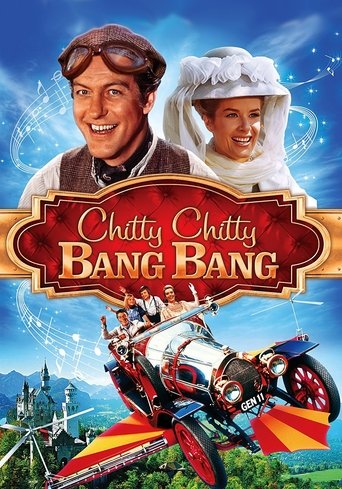
Chitty Chitty Bang Bang
1968 · Film · 144 min
Directed by Ken Hughes
A hapless inventor finally finds success with a flying car, which a dictator from a foreign government sets out to take for himself.
3 positive6 neutralfrom 9 commenters
Where to watch
No streaming data for this title.
Videos commenters linked
From YouTube links in the comments below. Most are clips and trailers; “Full” means the uploader says so.



9 comments on Hacker News
He sang probably the greatest song in musical film — Hushabye Mountain in Chitty Chitty Bang Bang:
https://www.youtube.com/watch?v=YfdRr7MWax4
https://www.youtube.com/watch?v=eeCBVerpYj8
If you have never seen this film, I don't care how old you are, you should watch it. It is overshadowed by Mary Poppins but it is a work of art — a funny, charming, astonishing visual feast of a film and he is magnificent in it. His performance as the jack-in-a-box alone is worth an Oscar:
https://www.youtube.com/watch?v=L_l2ii_25tc
A nice tribute at https://www.theguardian.com/film/2025/dec/13/dick-van-dyke-centenarian-100-mary-poppins-chitty-chitty-bang-bang
> When a participant imagined the password ‘Chitty-Chitty-Bang-Bang’ (the name of an English-language children’s novel) the BCI recognized it with an accuracy of more than 98%.
I wonder how difficult having a conversation about that novel (or film) would be. I imagine you would accidentally start saying your thoughts out loud.
And then there are the similarities, both video and song, between Can’t Get You Out Of My Head and Doll on a Music Box/Truly Scrumptious from the UK musical/movie Chitty Chitty Bang Bang… There was a mashup floating around somewhere, years ago. Probably lost.
Do G-Rated Films Even Make Sense Anymore?
Yes. Plenty of people want to have films that are family friendly, child friendly. The kids get plenty of trauma in school, some city neighborhoods and online. Movies are for an escape from those hellholes.
Movie screenwriters just need to step up their game and get as good as their predecessors. Example: Bewitched, a 60's sitcom murdered a couple miscreants in an episode but only the adults really knew what happened. They did not need blood, guts and gore to get the point across.
Another example? Take the time to watch Chitty Chitty Bang Bang a late 60's movie but this time with a critical eye, especially around and within Castle Vulgaria. There is a lot going on in there that would not be allowed in movies today but it's just subtle enough to not break any rules as you would have to be a detective to get the gist. That was good screen writing.
In summary, while the rating system is gamed the real problem is the lack of good screen writers and proper enforcement of the existing rating system. Movies are just being churned out as fast as they can be made and the artistic aspects of movie production are dying out and people are being bribed to look the other way.
Not only that, but the film of Chitty Chitty Bang Bang had Gert Frobe, who played Goldfinger, as Baron Bomburst of Vulgaria.
while a lot of attention is focused on Bond, i think it is notable that basically the same themes/style/etc. can be found in the [pretty good] children movie based on the Fleming's book and directed by Broccoli
https://en.wikipedia.org/wiki/Chitty_Chitty_Bang_Bang
> Nnnnnnnnnope, not letting a robot anywhere near my head with sharp stuff.
I'm probably not alone in being wary of this idea because of the movie Chitty Chitty Bang Bang
Genuine scientific progress is usually collaborative even if the nature of fame, and fiction, is to single out individuals, writes Quentin Cooper.
It is sixty years since Elizabeth Alexandra Mary Windsor became Her Royal Highness Queen Elizabeth the Second. Sixty years in which the planet has changed beyond recognition. As part of the Diamond Jubilee festivities the BBC asked the public to help select the sixty “New Elizabethans” – living or dead, British or not – who have had the most impact on life during her (or possibly Her) reign. Which in effect means fifty-nine since HRH herself is pretty much a shoe-in. Given all the myriad ways science and technology have left their mark on the last 60 years, it’s a list which you might expect scientists and inventors to dominate. And I’ve no problem thinking of worthy contenders. Indisputable geniuses like Sidney Stratton, Ned and Philip Brainard, Robert Campbell and Alexander Hartdegen. Don’t know them? More familiar may be Emmett Brown, Caractacus Potts or Eldon Tyrell.
Each is responsible for one or more world-changing inventions and breakthroughs. Unfortunately, as you will have no doubt figured out, each is also fictional.
Stratton, played by Alec Guinness, devises an indestructible fabric in wonderful Ealing comedy The Man In the White Suit; Brainard with a change of first name invents gravity-defying flying rubber in both The Absent Minded Professor and the Robin Williams remake Flubber; Campbell is Medicine Man Sean Connery curing cancer; and although in HG Wells’ novel and the first film version he has no name, in the most recent remake it’s Alexander Hartdegen who builds The Time Machine.
The time travel – by flying DeLorean – is rather more stylish from Doc Emmett Brown in the Back To The Future trilogy; Caractacus Potts also gets a car to fly and creates whistling confectionery in Chitty Chitty Bang Bang; and Eldon Tyrell gives life, and death, to Bladerunner’s replicants.
‘Nutty professor’
This may seem a long and very male list of characters who have come up with things that, if real, would be ranked among the greatest advances of all time. That’s because it is. Well, apart from the “toot sweets” in Chitty Chitty Bang Bang. Now try to do the same for the individuals behind genuine inventions and breakthroughs. It’s almost impossible.
You might say Watson or Crick for the structure of DNA – but while both did key work they also needed Rosalind Franklin and a host of other supporting characters. There is also far more to DNA than its structure. Or what about Tim Berners Lee who “invented” the World Wide Web? Undoubtedly “TimBL” was vital to its development but what about his less well lauded partner – Robert Callieau - or the many thousands of others who have left their mark on what it has become? And Ian Wilmut – the man who brought Dolly the Sheep to the world’s attention? Sure enough,the paper that describes just how the world’s first cloned mammal was “created” shows the names of at least four other scientists involved in the research.
It is a problem that can only get worse. Think of the growing number of “big science” projects, from the Human Genome to the Large Hadron Collider (LHC). All involve thousands of people working in myriad disciplines. Naming an individual who is single-handedly responsible for the project – and its findings - is an impossible task. The Nobel Prizes – perhaps the organisation that has done the most to promote the idea of individual triumph – is already under pressure to change its ways. Last year’s prize for dark energy came under fire from the Astronomer Royal – the Queen’s own astronomer - for not accurately reflecting the true number of people who carried out the work. I don’t envy the Nobel Committee faced with plucking out three individuals if - and when - the Higgs Boson is discovered at the LHC.
That is because genuine scientific progress is usually collaborative and collective even if the nature of fame, and fiction, is to single out individuals and hand them all the credit. We like to make heroes, and a century ago stories about dashing, dynamic inventors saving the day, and the world, through their indefatigable ingenuity were so popular they even had their own name – Edisonades, inspired by the famously sweaty Thomas Edison. Such tales peaked in popularity long before EAM Windsor became QE2. Now even in fantasies in which a scientist makes some amazing advance, they are usually portrayed as nutty, absent-minded, eccentric or plain weird.
So it will be interesting to see which scientists, if any, end up being allotted a place among the New Elizabethans. For all their incalculable influence on life as we now live it, few have changed anything single-handedly, while many who have made a significant difference have achieved little or no public recognition. Unlike their fictional counterparts, the scientists who have transformed our world seldom get starring roles, just an uncredited cameo as part of the crowd.