 Hacker Cinema
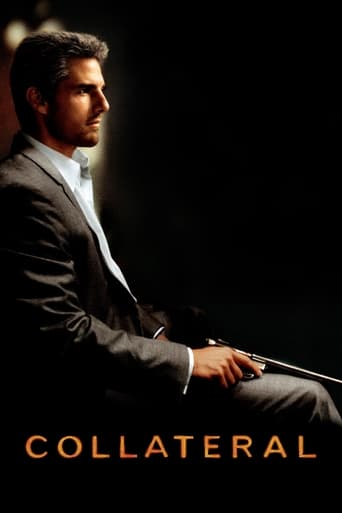
Collateral
2004 · Film · 120 min
Directed by Michael Mann
Cab driver Max picks up a man who offers him $600 to drive him around. But the promise of easy money sours when Max realizes his fare is an assassin.
7 positive1 negative1 mixed14 neutralfrom 23 commenters
Where to watch
No streaming data for this title.

28 comments on Hacker News
Michael Mann movies tend to get this right, Heat and collateral have really decent gun sounds. Turns out they are very loud.
Edit: just noticed you mentioned heat already, I need more coffee…
It's a similar thing to watching movies from before the mid-2000 (I place the inflection point around Collateral in 2004) where after that you get overly dark scenes where you can't make out anything, while anything earlier you get these night scenes where you can clearly make out the setting, and the focused actors/props are clearly visible.
Watch An American Werewolf in London, Strange Days, True Lies, Blade Runner, or any other movie from the film era all up to the start of digital, and you can see that the sets are incredibly well lit. On film they couldn't afford to reshoot and didn't have immediate view of what everything in the frame resulted on, so they had to be conservative. They didn't have per-pixel brightness manipulation (feathering and burning were film techniques that could technically have been applied per frame, but good luck with doing that at any reasonable expense or amount of time). They didn't have hyper-fast color film-stock they could use (ISO 800 was about the fastest you could get), and it was a clear downgrade from anything slower.
The advent of digital film-making when sensors reached ISO 1600/3200 with reasonable image quality is when the allure of time/cost savings of not lighting heavily for every scene showed its ugly head, and by the 2020's you get the "Netflix look" from studios optimizing for "the cheapest possible thing we can get out the door" (the most expensive thing in any production is filming in location, a producer will want to squeeze every minute of that away, with the smallest crew they could get away with).
"But you are right that Collateral did do something very new/unusual at the time, and that was shooting scenes in higher frame-rates than 24, and mixing multiple frame rates in a film. (This might not sound like much, but until this time, pretty much every film was 24fps for the previous eighty years and it had a very specific look that everyone's eyes/brains were conditioned for, unbeknownst to them.)"
Why was certain scenes in Collateral filmed in other frame rates than 24 fps (unless you are doing slow motion of course)? AFAIK it was never projected/shown in anything else than 24 fps.
Collateral was not the first fully digitally shot feature film. In fact, Collateral was not even fully digital. (The first major, all-digital, HD feature film was Attack of the Clones, but there were other fully-digital feature films before that, just not as major, and/or not always HD. Robert Rodriguez' Once Upon a Time in Mexico (2001) was fully digital.)
But you are right that Collateral did do something very new/unusual at the time, and that was shooting scenes in higher frame-rates than 24, and mixing multiple frame rates in a film. (This might not sound like much, but until this time, pretty much every film was 24fps for the previous eighty years and it had a very specific look that everyone's eyes/brains were conditioned for, unbeknownst to them.)
And the other thing that was very interesting thing about it (though not something very visible to a viewer) was that it was shot on the Thomson Viper FilmStream camera[1], which was the first major attempt at shooting not just digital, but very close to "raw". It was also a huge pain in the ass. The camera itself was massive, but due to the bandwidth, it recorded to an external storage array that had to be pushed alongside it at all times, and that was itself about the size of a shopping cart. (This device was hilariously referred to as the "Director's Friend.")
In 2002, my friend and I, both cinema nerds in high school, drove an hour away to the nearest theater showing a film called Russian Ark[2]. Why were journeying to to see a strange little Russian film where a never-named character walks the viewer through Russian history? Because just like each episode of the recently-released Netflix show Adolescence, this entire film was a single, very long, very complicated, unbroken shot. One shot. No trickery, no cuts that were just hidden to the audience, one shot, through streets, buildings, snow, ballrooms with a couple hundred choreographed actors, it was crazy. This is easy now compared to how it was back then.
As we've now established with Collateral (and this film predates it by 2 years), digital cinematography existed, but the storage was a real problem, the power was a real problem. Since this film was one shot, it needed almost 100 minutes of both, unbroken. And since it was a very complex moving shot, it had to be operated handheld. So essentially they had an incredibly ripped director of photography who operated the camera on a steadicam the whole time while a giant array of daisychained batteries and hard drives were lugged behind him. And they did it something like 100 times until they had a few takes where there were no mistakes.
None of this really means anything to anyone anymore, but at the time, to cinematography nerds at least, this stuff was all absolutely insane!
[1] https://web.archive.org/web/20040103133953/http://www.thomsongrassvalley.com/products/cameras/viper/pdf/viper_ds.pdf
[2]: https://en.wikipedia.org/wiki/Russian_Ark
I was reading about the cinematography of _Collateral_, possibly the first large budget feature film to be shot digitally, and one of the issues back in 2004 when it was made was the amount of storage required for digital video and the risk of not being able to retrieve the images from the data stores:
> “We did massive testing with the hard drives, and everything was great, and then we had an experience where we shot, and when we sent in the material, they couldn’t get the information off the hard drive,” said Cameron. “So the studio went ballistic and was like, ‘There’s just no way we can we can let you guys do this.’”
> The compromise was the production would record to hard drives as well as SRW tape. And unlike today, verifying the digital footage was equally cumbersome and tension-filled.
> “We recorded everything two or three times on decks that we carried with us,” said Beebe. “So we were backing up, two or three times.”
https://www.indiewire.com/features/interviews/michael-mann-collateral-miami-vice-interview-cinematography-1235035511/
"Even things that can't go wrong, do" - Troubleshooting Analog Circuits, Robert Allen Pease.
Your perfect plans are drawn around a set of hypotheses and premises, chained unfortunately, some of which I'm not uncertain would be proven wrong the moment you'd try and execute.
I am reminded of this: https://www.youtube.com/watch?v=uDJEjT2kKqY . Trey Parker and Matt Stone, of South Park, on story structure. This is what mostly happens.
I'm also reminded of that scene from the Collateral movie, where the Jamie Foxx character talks about his business plan, the one he's been refining for ten years.
Don't sell the pelt before shooting the bear.
Most movies in 2005 were film. So the style in 2005 was the film look. Collateral (2004) was the first major movie shot on video and it's got a very different look and the tech was so new, Tom Cruise had to wear a certain shade of gray suite so as to not blow the highlights in some of the scenes.
I felt the same way about Tom Cruise until I saw Collateral, which quickly become my favorite movie of his and possibly one of my favorite movies of all time.
That's is why I called it two separate axes and not two ends in a single axis. You need a base level of technical competency to understand what the limitations of your equipment are to leverage it to the fullest extent and avoid doing things that will just plain not work, and the technical features are needed to accomplish specific things, but artistry is till required. Feature films have been captured on iPhone (you can say that is little more than a stunt, but it still exists).
Not everyone is filming Barry Lyndon with f/.95 aperture in candle-lit scenes. Watching older films where both the glass and the film were subpar compared to what's available today, where the grain was high, the focus puller wasn't at the top of their game leaving characters somewhat out of focus (when looking closely, maybe not noticeable at 480p or 720p), but the films are still enjoyable. Parts of The Batman were filmed on a Helios 40-2, an objectively terrible lens when it comes to it's optical characteristics, but it can evoke a look that you can't otherwise get which helps with the mood the cinematographer was trying to capture. You won't be able to capture the vast expanses of night time scenes of Nope (filmed as day for night with infrared cameras) with subpar equipment. You need full sharpness for easier rotoscoping when dealing with VFX. You want the best cameras available to capture miniatures of spaceships like in 2001 or Interstellar to make people believe these are real spaceships. You can leverage a new technology in a new way, like 28 Days Later used new at the time digital cameras (that would nowadays be considered subpar) for easier application of effects like undercranking and lower production costs, or how they used 360 shutters in Collateral. But you can also make a film like The Man From Earth that was shot in a single room, with a bunch of actors and an camera that was average at the time, or Saving Private Ryan simply undercranking and using really short shutterns to ensure that the beach landing scene was crisp through and through. Everything Everywhere All At Once didn't have Marvel-budget level gear, but they still made one of the best movies of the past few years.
I don't fully disagree with what you're saying: better tools expand the envelope of what you can accomplish. But technology is in service of the art, not the other way around (unless you're producing marketing material for the manufacturer, I guess ^_^).
I love combing over features, and learn about the mechanics of these amazing machines, and the theory of the physics of light (even knowing how it works, it is still feels like magic that you can take a full picture of an object that is partially obstructed as long as you can make that foreground element blurred enough). I'm a shit artist, but I trust one with a point and shoot to make something better than I can with my DSLRs. I can't wait to see what new story telling tricks people will come up with new tech, like Nope did.
>I know it’s referred to as film grain, but digital cameras also have grain, and the amount of grain will vary from shot to shot depending on lighting, shutter speed etc.
2004 Collateral and 2009 Public Enemies were early all digital movies full of digital noise, it looks BAD.
Here's at least one book on him: The Mastermind: Drugs. Empire. Murder. Betrayal. by Evan Ratliff.
Another is: Hunting LeRoux: The Inside Story of the DEA Takedown of a Criminal Genius and His Empire by Elaine Shannon.
Michael Mann has the rights to turn Hunting LeRoux into a film. He did Heat, Ali and Collateral (probably one of my favorite movies). Unfortunately, he also did Blackhat.
Mann likes to savor the cultural and visual environments his movies take place in. That makes them (later ones like Collateral, and especially Miami Vice and Blackhat) too slow for a mass audience.
There was an essay I can't find about how non-US, European audiences appreciate that kind of thing much more.
Mann's movies don't have endless thrills and they end on a slightly positive to neutral note, not like romances or action movies where the end is supremely positive. Instead, some problem has been averted, but nobody's saved the world. Any positive elements (couple living happily ever after, wounded cop surviving) are tempered by a strong sense of malaise that nothing's keeping the same thing from happening again tomorrow.
Oh, I don't know. My respect for Cruise has gone up quite a bit. The MI series is formulaic but he does put a lot of effort and soul into his work. Top Gun was a slap in the face to formula films. Some of his smaller projects (like Jack Reacher) were fun to watch too. Collateral is an underrated classic though.
I don't know if there's a market anymore for movies like this that won't "become a unicorn". One that comes to mind is collateral.
what about Prisoners, In the bedroom, The guilty (2018), Good time, Oldboy (original, not from Hollywood though), Collateral, End of watch, Training day, Drive, etc. - all these were released after and they are better movies (most of them more thrillers than action though, but some straight up action), I can't really recommend exactly same alternative since I don't watch stupid action flicks like Fugitive, now that I have much more options than in 90s
Eyes Wide Shut? Collateral? Magnolia? He can certainly play characters outside the big action hero. He just gets paid a shitload of money to keep making shit big budget action movies and he's a high level cult leader who has an ego the size of a planet.
He could do well in a little indie movie that pushes his range but his life and personality prevents that way more than his range as an actor.
this should be top comment
though honestly I was more influenced by movies than books, I guess strongest influence on hour I vote the world around me had Fight Club, Falling Down and American Beauty plus the car speech in Se7en and Collateral as well, Taxi Driver as well
I strongly agree. One of the most striking aspects of Collateral is how the camera captures the city at night. The entire movie feels like a liminal experience - otherworldly.
> The reason for that choice is simple: This is one of the first big-budget movies ever shot primarily on a digital camera, and the digital cameras of the time worked great in low-light environments but also tended to flatten the entire image in a way that more or less tugged the entire picture toward the darkest pixels within it.
I am not certain that the discussion of "Collateral" is accurate. The writer is considering the movie through the presupposition that Michael Mann was attempting to match a color grading style that could only be achieved years in the future, when Mann is more on record saying that he chose digital cameras specifically for the look that was realized in the movie. I think a case would be better made that a new style was then turned to an extreme. I also think that the colors of the costumes seem more in line with what the characters were supposed to represent in the film than with a supposed style of color grading that was being attempted.
https://filmschoolrejects.com/michael-mann-collateral-commentary/ > 28. He points out several shots in Collateral that wouldn’t have been possible on 35mm film including the one at 1:38:37 — a closeup of Vincent in the office that shifts focus to reveal Max on the parking garage rooftop across the street. “Max would either be not exposed at all, and/or he would not be able to carry the focus.”
https://uproxx.com/hitfix/on-the-digital-legacy-of-michael-manns-collateral-nearly-10-years-later/ > “We have seen an emergence of what I think is a digital aesthetic. It's a beautiful aesthetic, and it plays to the strength of that medium, which is the very open bottom of the curve. It can look into shadows; it's got an amazing range. Digital gives us the ability to work from a base of ambient light, essentially. Because of that, you tend to light in a very different way. And I do think 'Collateral' helped launch that because it played to the strengths of the format. We never set out to replicate a film look, but rather to discover a digital one…Film has a unique texture and tone, and digital has its own unique texture and tone. It would be a sad day if we lost the ability to choose between them.”
I don't see the same flatness in Collateral as I do in Marvel.
"You killed him."
"No, I shot him. The bullets and the fall killed him."
- Collateral (2004 film)
So apparently there's a film on Le Roux in the making by Michael Mann ("Miami Vice", "Collateral", "Black Hat"), which is not based on the Evan Ratliff reporting (Atavist Magazine and later the book "The Mastermind", cf. the original HN discussion from 2016), but a different book from NY Times author Elaine Shannon.
Nothing matters; keep moving forward.
Or as the movie Collateral framed it:
> Now we gotta make the best of it, improvise, adapt to the environment, Darwin, shit happens, I Ching, whatever man, we gotta roll with it.
it depends on your age, I don't think you can really change your world view based on movie if you are in 30s or older, but you can be definitely influenced if you are teenager and into 20s
taking this into consideration I would recommend these parts of the movies, you can find them all on YouTube without watching whole movie:
Se7en - final John Doe monologue about innocence of his victims in back seat
Collateral - Vincent monologue on back seat about not doing anything with your life
Fight club - pretty much all movie, very influential, should be mandatory for teenagers
American beauty - less extreme version of fight club for older men that you can rebuild your life even in higher age
the big Lebowski - if you care about your clothing maybe it can help you to watch Lebowski
the beach - encouraged me to travel more, although wanted already before
They're owned by Daimer and BMW, so the cost of the cars isn't as big a factor.
Also, for long-running services, the initial costs aren't that important anyway if the cars are more durable. In Germany, almost all cabs used to be Mercedes. (I remember the whole cinema laughing in Collateral when the Jamie Foxx character presented his business outline for his luxury cab service)
Latest and greatest is severely overrated - that's something you throw money at if you already have a hot project and need additional hype. Sometimes it works out, sometimes not (eg Collateral was a very successful ad for the Viper camera's relatively good low-light performance; Public Enemy not so much for a different model).
I've been following this project for a few years and while it's got a slow development/adoption curve it's on the right track both economically and technologically; eventually it'll become the Linux of cameras. The thing is, we're already in an era of technological abundance where digital photography is concerned; commodity solutions are already good Enough for pretty much all commercial purposes. You can shoot an indie feature on an iPhone; even huge budget films like the Avengers franchise use Blackmagic pocket cameras as crash cams (cheapish cameras that you set up to run automatically stunt cars to provide a second or two of dramatic first-person footage).
There will of course always be more highly engineered offerings out there, that will be important for highly specialized tasks like astronomy and scientific work. And ultradense sensors might be deployed to allow photography at multiple focal depths - but even that is likely to find its way into consumer gear before lone. At this point the industry focus is no longer on which camera has the best specifications as on workflow and support. Blackmagic ave done incredibly well for themselves with a (relatively) technologically inferior sensor/package but by being more open than Red and thus building a larger and stronger community at a somewhat lower price point, for example. It's a good example of the tortoise beating the hare over the length of the race.
Indeed it does, and I'm not in the lowest tier. The quality of video is very fine indeed when watching with, say, a Netflix app on a Sony TV, but I prefer to watch stuff on my desktop in a comfy chair, and for that, Netflix leaves wanting with video bitrate not always even above 1000 kbps.
(Right now, for the movie “Collateral”, the highest bitrate offered is 870 kbps when watching in a browser. I'm almost certain it is way above that on more restricted devices, as that has been the case with other titles in the past.)
We didn't. Digital movies have been around longer than you think (eg Collateral was shot on a Viper > 10 years ago), and film is stil the only viable choice if you are shooting 70mm or for Imax delivery.
However I'm being pernickety because film is my industry (and because I'm middle of checking off a list of deliverables for a feature right now, which requires me to be extra-pedantic). It has been a rapid and near-total shift. To shoot on film nowadays you need to be working with a very large budget (where your unfashionable preference will not have a substantial impact on production costs).
Given the exponentially lower amount of data handled by still cameras, it was much easier for them to eclipse 35mm film in terms of quality. Keep in mind that even 'burst mode' on a high-end DSLR only runs at 3-5 frames per second (not 30), and still requires a few seconds between bursts to process and write to disk.
Film not only shoots at 24 frames per second (or more), but the final picture has to play on a screen that is literally two stories high. The scale is unforgiving. Things that would fly on television get suddenly ugly - especially if you're only starting with 1080 lines of resolution. And that's before your picture has gone through layers and layers of heavy post production - every one of which constitutes a round of transcoding, and thus, a source of degradation and artifacting.
In other words, not only are you shooting far more frames in far less time (and needing hardware that can do sustained encoding for each one in real time) but, you're doing so at exceptionally high bit-rates, oversampling like hell so that you'll still have a clean picture even after running it through the wringer of post-production. Encoding for broadcast, DVD and the web (which is par for the course with any professional shoot) only adds an extra layer of abuse. When Michael Mann was shooting Collateral (which made heavy use of HD), there were a number of scenes where they had to shoot film, just because the HD rigs capable of supporting adequate bitrates came with umbilical cords that were simply too cumbersome for handheld setups where agility was essential.
There's also been an optical issue, in that sensors for digital motion cameras have typically been much smaller than those used for digital still or motion film cameras. Even if the resolution is commensurate (which is hasn't been), the fact that the same number of scan lines are packed into a smaller area has consequences in terms of the optical effects that the camera can achieve. Specifically, a larger imagine surface allows for a shallower depth of field. Given that really good cinematographers can make masterful use of DOF, it's understandable that they don't like the constricted range that comes with smaller, digital sensors. For guys like Lucas, Fincher, and Jackson - who all do a huge amount of pre-visualization and heavy CG in post - this isn't such a big deal. They can plan around it, or deal with it after the fact. But in a more traditional setting - and for filmmakers who don't have the same hardcore ILM/WETA ethos and skill - the trade-off isn't so favorable.
All that said, my sense is that this RED camera marks a tipping point, where a lot of the advantages that film has held will start to erode in earnest. The thing that's really going to drive this is the exceptionally high dynamic range (that is to say, the range of light levels the camera can handle before the picture either drops into black, or blows out in a haze of pure white). Higher performance in this area really was the trump card for film. But now that RED is not just meeting, but exceeding the long-established benchmarks, a lot of people who have stuck with film are going to ditch it in favor of a much higher ceiling. I mean, wow, 18 stops - that's hot.