 Hacker Cinema
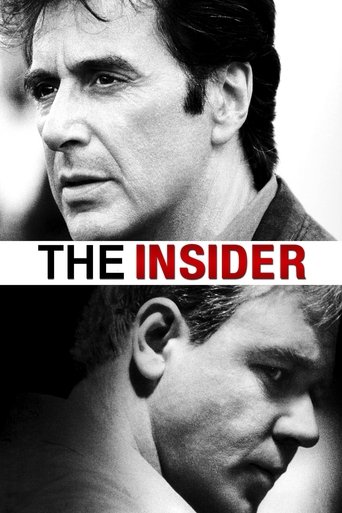
The Insider
1999 · Film · 158 min
Directed by Michael Mann
A research chemist comes under personal and professional attack when he decides to appear in a 60 Minutes exposé on Big Tobacco.
7 positive1 negative8 neutralfrom 16 commenters
Where to watch
No streaming data for this title.
Videos commenters linked
From YouTube links in the comments below. Most are clips and trailers; “Full” means the uploader says so.


22 comments on Hacker News
I don’t know if it would help anyone else, but personally, watching the movie The Insider kind of permanently put me off from smoking. Jeffrey Wigand is/was an incredibly inspiring figure and I think of him every time I see cigarettes.
https://youtu.be/MGOb29aePyc?is=CKyo1UM-dkiRHdWa
https://en.wikipedia.org/wiki/Jeffrey_Wigand
To me the key element is the addiction aspect. It’s one thing to ingest a substance which has good short term results but bad long term ones, but entirely another when the machinery of corporations is used to maximize that usage and make it as addictive as possible.
As a side note, the movie The Insider by Michael Mann with Al Pacino and Russell Crowe is the single most effective anti-smoking thing I’ve come across. It shows how evil those corporations are and what they did to a whistleblower.
>I never realized such a lawsuit was even possible; are TV shows not allowed to edit what they show?
This isn't 60 Minutes' first rodeo with this kind of thing. An earlier experience was so harrowing that it was turned into a film starring Al Pacino and Russell Crowe:
https://en.wikipedia.org/wiki/The_Insider_(film)
An excellent one, at that.
---
Since I can't post another comment owing to this submission first disappearing off the main page prior to being flagged for no apparent reason:
Corporate parent Paramount and its controlling owner, Shari Redstone, are seeking the approval of federal regulators to sell it to the son of Oracle founder Larry Ellison.
Joy. The censorship regime on HN lately has become grotesque. People should be ashamed.
I think the movie The Insider expressed it well: "The press is free, for anyone that owns one."
Apparently that comes from an older expression dating back at least to a 1960 quote in The New Yorker: "Freedom of the press is guaranteed only to those who own one."
Very topical for me, I was just watching the movie The Insider.
Granted, a movie, but something that portrays this well is The Insider (about big tobacco).
Choice quotes:
> Mike Wallace: Who are these people?
> Lowell Bergman: Ordinary people under extraordinary pressure, Mike. What the hell do you expect? Grace and consistency?
And:
> Lowell Bergman: I fought for you and I still fight for you!
> Jeffrey Wigand: You fought for me? You manipulated me! Into where I am now - staring at the Brown & Williamson building, it's all dark except for the tenth floor. That's the legal department, that's where they fuck with my life!
> Lowell Bergman: Jeffrey, where are you going with this? Where are you going? (Pause) You are important to a lot of people, Jeffrey. You think about that, and you think about them.
Subject of the amazing movie The Insider (1999), I might add for interested people.
I encourage anyone interested in the consequences of whistleblowing to watch The Insider. A truly excellent film about a whistleblower at a tobacco company and the terrible things they did to try and stop him. Russell Crowe, Al Pacino, Bruce McGill, Christopher Plummer, many others.
https://en.wikipedia.org/wiki/Jeffrey_Wigand
Trailer: https://youtu.be/MGOb29aePyc
The best scene: https://youtu.be/gNKmmA6_oTQ
This is quite the far cry from what the cigarette industry threatened to do to the Doctor who acted as a whistleblower to their deliberate negligence (as featured in the movie Insider starring Russell Crowe and Al Pacino)
Not directly related to tech, but I really recommend the movie The Insider for a look at how whistleblowing goes. It’s about the tobacco industry but can likely be generalized to any situation.
https://en.m.wikipedia.org/wiki/Jeffrey_Wigand
You might be thinking of The Insider (1999), though that film was mostly faithful to the real life story behind the 60 Minutes investigation.[0]
What you were probably thinking of can be found at 2:00 in the video below. Seven tobacco industry CEOs testifying at once, affectionately referred to as the "seven dwarfs".
The Insider is in my opinion excellent, and highly recommended.
https://www.youtube.com/watch?v=1_-Vu8LrUDk
>First, how could something this horrible happen at such a high level at such a prominent company? I mean, eBay is not some rinky-dinky business run by fly-by-night operators in a shady part of town.
How could something like this happen? Very easily. Also very often.
And this is one of the lightest cases. Huge multinationals have people defamed, killed, politicians bribed and exhorted, and everything in between...
Usually it happens with several layers, where the CEO or some exec gives a message like "Do what you have to do", and several layers of increasingly thuggish associates get the message.
Remember the movie Insider, how the whistleblower got death threats? In real life many people get worse, including actual beatings and deaths.
Especially in huge companies with subsidies, and factories in the developing world, this is par for the course... from Coca Cola to United Fruit Company to the Nike's of this world...
And god forbid someone stands to hurt some multi-billion deal...
If you haven't seen it, The Insider (1999) is well worth watching. It's based on a true story about a whistleblower in the tobacco industry. In the film the CEO knows nicotine is addictive and perjures himself.
https://en.wikipedia.org/wiki/The_Insider_(film)
> But Hollywood have always done this - recycling old ideas in new wrapping. And Hollywood have always been criticized for being vapid entertainment, empty spectacle etc.
Not to this degree. The last good year for movies was 1999. This is the list of major releases that year:
The Matrix
Fight Club
The Sixth Sense
Toy Story 2
The Green Mile
American Beauty
Being John Malkovic
Office Space
The Iron Giant
Magnolia
Austin Powers
American Pie
The Talented Mr. Ripley
Eyes Wide Shut
Dogma
Galaxy Quest
The Insider
Notting Hill
Man on the Moon
Analyze This
Detroit Rock City
Mystery Men
Bicentennial Man
This is not even the entire list, just the ones I enjoyed and I'm bothering to type.
You can't look at that list and honestly say nothing has changed, because it's just not true. The energy and creativity has clearly moved somewhere else, to TV and streaming services.
This year alone there's two FANTASTIC shows, Chernobyl and Stranger Things S3 that definitely deserve praise.
In the movie,The Insider (1999) a Big Tobacco CEO says "We are in the nicotine delivery business", substituting nicotine to dopamine and you have your Tencent and Facebook. They now are increasingly targeting women for social media gaming. [0]https://www.bloomberg.com/news/articles/2017-07-31/fueled-by-wechat-female-gamers-power-tencent-s-3-billion-hit
From one of my favorite movies, The Insider (http://www.imdb.com/title/tt0140352) about Big Tobacco and Dr Jeffrey Wigand:
"I know what you're facing, Jeff. And, I think I know how you're feeling. In the Navy I flew A-6's off carriers. In combat, events have a duration of seconds, sometimes minutes. But what you're going through goes on day in and day out. Whether you're ready for it or not, week in, week out. Month after month after month. Whether you're up or whether you're down. You're assaulted psychologically. You're assaulted financially, which is its own special kind of violence because it's directed at your kids. What school can you afford? How will that affect their lives? You're asking yourself, "Will that limit what they may become?" You feel your whole family's future's compromised, held hostage. I do know how it is."
Not to mention:
"You fought for me? You manipulated me! Into where I am now - staring at the Brown & Williamson building, it's all dark except for the tenth floor. That's the legal department, that's where they fuck with my life!"
If anyone is interested in why something like this is important, you might enjoy "The Insider", a movie made about Jeffery Wigand, the VP of Research and Development at Brown and Williamson. (Then the third biggest tobacco company.)
One of the main themes of the movie is how information can be known by everyone, but legally suppressed to the point that it's not actionable.
Wigand had tried to give the information to journalists, but then that information could be suppressed because of Wigand's confidentiality agreements.
A tool like SecureDrop or WikiLeaks allows a new method of releasing information to the public, because it obscures the source while turning it into public information. CBS attempted to do effect the same change (private information into public) by having Wigand deliver his information while under subpoena, but it turns out a prior confidentiality agreement can override your responsibility to tell the whole truth during a subpoena. So a tool like this is basically legal innovation that fills a need that can clearly benefit the world.
I'm not going to discuss TV movies.
But let's look at the other ones, shall we:
2004's Kinsey. Kinsey's a hero to the social justice movement, also: https://en.wikipedia.org/wiki/Alfred_Kinsey#Personal_habits
2009's Creation. Opened on 7 screens in the US. Hardly a cultural phenomenon.
2004's Aviator. Close, big surprise Hollywood chooses to mythologize a legendary director's early life.
Tim's Vermeer. "Inventor Tim Jenison seeks to understand the painting techniques used by Dutch Master Johannes Vermeer." Are you intentionally wasting my time?
2011's A Dangerous Method. Look who got first billing and is on the center of the cover. http://www.imdb.com/title/tt1571222/?ref_=fn_al_tt_1
2015's Experimenter. Do you not know who Milgram is? From the IMDB page the focus of the movie is his inhumane experiments. Whose case does "look at the horrible things this white guy did to people" help more?
1999's Insider. It's a stretch because it's a movie about a whistleblower who happens to be a scientist, but at least it was a big film with real actors.
2008's The Strangest Dream. A Canadian documentary that nobody's ever heard of. Doesn't even have a cover picture on IMDB or even one vote on Rotten Tomatoes. It's about the one guy who left the Manhattan Project. What are the odds that this is a vehicle to pass judgement on all the other guys who didn't leave the Manhattan Project?
> You for some reason switched to fictional scientists with Gravity (2013) and Interstellar (2014). Why is that? For that matter, you restricted me to scientists and mathematicians, while the protagonists of Gravity are engineers and astronauts - it's poor form to change your metric part-way through.
I hoped you would connect the dots that I was talking about large-scale, big-budget movies.
> If I expand the list to include engineers, astronauts, and similar occupations, then "Captain Phillips" (2013) concerns the captain of the MV Maersk Alabama, which was hijacked by pirates, "The Wind Rises" (2013) about Jiro Horikoshi, the man who designed Japanese fighter planes during World War II ... oops ! Sory, not a white man, though he would have been an "honorary white" in apartheid South Africa, " Zvorykin-Muromets" (2010) about the Russian inventor of television, "Flash of Genius" (2008) about the Robert Kearns and his invention of the intermittent windshield wiper,
At this point it appears you're intentionally wasting my time for effect, like maybe you're hoping somebody who glances over your post will assume it's well-researched and well-thought.
Naoki Mori? I was hoping you would notice from context I was referencing male scientists who were publicly disgraced as people, not as fraudulent scientists.
I'm sure you'll understand that I don't have enough time to fact-check your ridiculous list of movies and sift through all of your loaded questions, so I've left them unanswered.
> How do you define 'mythologizing' in such a way that it's at least roughly repeatable?....If you can't do that, then you don't really have a good metric.
http://www.merriam-webster.com/dictionary/mythologize
At least you closed with Deep Web which might be an actual counterpoint.
That list was incomplete. I added a recent Indian film about Ramanujan and a Soviet film about Sofia Kovalevskaya from the 1980s. FWIW, there's also an upcoming film "Dau" (in post-production) about the Russian mathematical physicist Lev Landau.
One difficulty is that the Wikipedia list does not include made for TV movies and documentaries, like 'Dangerous Knowledge' (2007) on Georg Cantor, Ludwig Boltzmann, Kurt Gödel and Alan Turing, or the BBC documentary 'Isaac Newton: The Last Magician' (2013), or the PBS documentary 'Newton's Dark Secrets' (2005), or "Breaking the Code" (1996), another biography of Turing, or "Freedom Man" (1989) about the black American mathematician Benjamin Banneker, or the 1973 Italian TV movie "Non ho tempo" about Galois, or Simon Singh's 1996 documentary "Fermat's Last Theorem", focusing on Andrew Wiles but including other mathematicians.
Or the BBC documentary "The Birth Of Calculus" (1986) on Leibniz, the four-part BBC series "The Story of Maths" (2008), the 2008 "Julia Robinson and Hilbert's Tenth Problem", or ... I think you get the picture that there are many TV movies about mathematicians, and most of them are white males. BTW, none of them are "average".
When "Moneyball" was turned into a movie, people asked how a book that dealt with statistics could be turned into a movie, since statistics alone isn't that interesting. What big screen movie is there to make out of Dirichlet's life? Of Riemann's? Of Wiles'?
So, of "regular white guy scientists or mathematicians we've mythologized in the past 20 years", where I'll define "mythologized" to mean "made a movie about them", and I'll limit it to feature length films based on lives of actual scientists:
"Kinsey" (2004) on Kinsey, "Copenhagen" (2002, TV) on a meeting between Bohr and Heisenberg, "Creation" (2009) on Darwin, "Something the Lord Made" (2004) about heart surgeons (one of which was a white male), "Tim's Vermeer" (2013) though that's more an amateur scientist, "The Aviator" (2004) about Howard Hughes (aerospace engineer and inventor), "A Dangerous Method" (2011) concerning Jung, Freud, and Sabina Spielrein (the first two being white males), this fall the film "Experimenter" about Stanley Milgram will be released, "The Insider" (1999) is a drama based on the research scientist Jeffrey Wigand, and "The Strangest Dream" (2008) about the physicist Joseph Rotblat.
Those are movies about 10+ real scientists, all male, straight, and not disabled, plus a couple of others. (There were a few movies with other than white, male, straight characters, but certainly not this many.)
You for some reason switched to fictional scientists with Gravity (2013) and Interstellar (2014). Why is that? For that matter, you restricted me to scientists and mathematicians, while the protagonists of Gravity are engineers and astronauts - it's poor form to change your metric part-way through.
If I expand the list to include engineers, astronauts, and similar occupations, then "Captain Phillips" (2013) concerns the captain of the MV Maersk Alabama, which was hijacked by pirates, "The Wind Rises" (2013) about Jiro Horikoshi, the man who designed Japanese fighter planes during World War II ... oops ! Sory, not a white man, though he would have been an "honorary white" in apartheid South Africa, " Zvorykin-Muromets" (2010) about the Russian inventor of television, "Flash of Genius" (2008) about the Robert Kearns and his invention of the intermittent windshield wiper,
A problem with your list is it's easily interpreted as cherry picking. Jodie Foster was the protagonist of "Contact" (1997), a big budget sci-fi film. How does your choice now of "Gravity" indicate a changed pattern from nearly 20 years ago?
Another problem is that you haven't established what the baseline should be. Given the 12.2% of the US population is "Non-Hispanic Black or African American", what percentage of films with 'hero scientists' should have a "Non-Hispanic Black or African American" in that role? Given that 51% of the adult population in the US are women, how many hero scientist movies should have a women in that role? Perhaps it's more that these roles were previously underrepresented?
Is the pattern you see simply explained by the secular trend that people other than straight white males are becoming more frequent in science?
You ended by picking two items from a different context - postings to HN in the last month and 'male scientists who have been publicly disgraced in the past year', I think to establish a pattern. But you again lack the evidence needed to tell if your observations are really a pattern instead of cherry picking. What is the expected baseline?
If the ratio of men to women in science is 4:1, then we would expect a female scientist to be publicly disgraced with about the same ratio. (It's hard to give a good ratio since I think it's more likely that a senior researcher will be found out and reported in the international news. I believe there are more males in higher level positions than females. Also, "Japanese women account for only 10% of the researchers in Japan" and "only 12 percent of the science and engineering workforce in India was female in 2010", so the international ratio is probably more like 8:1.
Checking now, I searched "Retraction Watch" for all people described by the writers as being "disgraced". The complete list of male scientists in the last few years are: Naoki Mori, James H. Hunton, Dipak Das, Don Poldermans, Yoshitaka Fujii, Joachim Boldt, Diederik Stapel, and Woo-Suk Hwang.
The only disgraced female scientist mentioned is Bengu Sezen.
This 8:1 ratio is about what I expect from the percentage of women doing science in the world stage, and within the error bars for something with so few numbers.
What method did you use to count disgraced male and female scientists? I see you missed Haruko Obokata as another disgraced female scientist, so it doesn't seem like you've done a systematic search.
(A double-check search against sciencemag.org finds Jens Förster and Marc Hauser as additional 'disgraced' male researchers and no additional female researchers. Note that Science does not use the term 'disgraced' in articles about Haruko Obokata.)
Also, what do you use as the ratio for males in science vs. females in science? If it's 4:1 or higher then with 3 male disgraces you would expect less than a 50% chance of hearing about a female in the same situation, no?
Otherwise, if you're just making connections based on the latest hot gossip, then you'll be suffering from some serious bias error. You're not going to hear about Naoki Mori on HN.
Regarding postings to HN, what is your criteria? For example, "Alain Badiou Is Making a Movie About Plato with Brad Pitt and Sean Connery" from 7 days ago is a movie about a guy. Is it mythologizing a male? What about "Deep Web (2015 Documentary) – The Story of the Silk Road" from a month ago - does it mythologize Ross William Ulbricht? How do you define 'mythologizing' in such a way that it's at least roughly repeatable?
If you can't do that, then you don't really have a good metric.
ADM's lysine fixing in the 1990s. The savings and loan debacle of the 1980s and 1990s. Hunt&Hunt's silver manipulation in the 1970s. The Towers Financial Corporation Ponzi scheme of the 1990s. Robert Emmet Brennan's First Jersey Securities pump-and-dump fraud in the mid-1990s.
Political white collar crimes from the 1970s include Watergate and Koreagate.
And as for movies: "Trading Places" was a 1980s movie ending with a foiled white collar crime attempt. "Wall Street" is a 1987 film where Gordon Gecko is convicted of multiple securities violations. "The Insider" is a 1999 film based on a 60 Minutes segment about a tobacco industry whistle blower. John Braithwaite wrote "Corporate Crime in the Pharmaceutical Industry" in 1984.
That you don't know about them doesn't mean they didn't exist or that people didn't know about it.
It is particularly interesting to note that blogger Felix Salmon got credited for bringing attention to this. My guess is that we are going to see more cases of bloggers breaking stories like this since they are often more free of conflicts of interest.
Before, you mostly had to worry about political bias in newspapers, but here we are seeing selectivity being employed when reporting plain old business news.
I don't have many memories of this happening in the recent past, a poignant example would be when CBS refused to air a story on 60 Minutes about how Tobacco executives perjured themselves about their awareness of nicotine’s addictiveness. CBS killed the story because it could have jeopardized their acquisition by Laurence Tisch (who at the time owned Lorillard). Michael Mann's wonderful film, The Insider, centers around that debacle:
http://en.wikipedia.org/wiki/The_Insider_(film)
They definitely were, once upon a time. 60 Minutes has lost its edge over time; I'd say they never really recovered from the episode with Brown and Williamson (dramatized in the movie "The Insider"). I don't know when 20/20 disintegrated, but when I see it now, I can barely distinguish it from Dateline NBC, which is little more than a new cartoon for children.