 Hacker Cinema
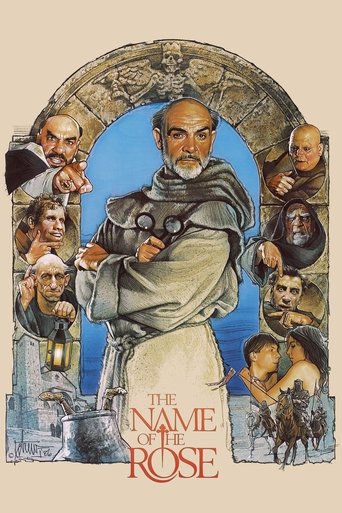
The Name of the Rose
1986 · Film · 130 min
Directed by Jean-Jacques Annaud
14th-century Franciscan monk William of Baskerville and his young novice arrive at a conference to find that several monks have been murdered under mysterious circumstances. To solve the crimes, William must rise up against the Church's authority and fight the shadowy conspiracy of monastery monks using only his intelligence; which is considerable.
11 positive3 negative6 neutralfrom 20 commenters
Where to watch
No streaming data for this title.
Videos commenters linked
From YouTube links in the comments below. Most are clips and trailers; “Full” means the uploader says so.


20 comments on Hacker News
Is is from a movie and a novel which the movie was based on. Both go by the title "The Name of the Rose". The author of the novel is Umberto Eco.
Interesting how this work received an homage in The Name of the Rose, up to the name of the librarian, Jorge de Burgos. (I hated the way they pronounced the name in the movie, /'iorge/ instead of the correct Spanish way /'xorxe/)
I saw the film adaptation of Umberto Eco's Name of the Rose, https://en.wikipedia.org/wiki/The_Name_of_the_Rose_(film)
That led me to read Foucault's Pendulum.
So reading Dan Brown's Da Vinci Code and watching Ron Howard's film version of Brown's book gave me a sense of deja vu.
Humour is one of the few things I take seriously. I must have been too young to understand it at the time, as Name of the Rose I both read and saw the movie, and I couldn't summarize the plot of it like this article did for the life of me. The question of the role of laughter is something I think about a lot, because I believe sincerely that it prevails. One of my favourite observations I heard was Rogan stating that laughter is an involuntary response, but moreso, it's one of our very few honest responses. Fake laughter is almost universally detectable. A joke that is funny enough to provoke it is an honest signal of underlying sentiments. It's easy to set up the church as a sanctimonionus buzzkill the way Eco did in Name of the Rose, but as the article mentions, Hobbes examined humour as well, because if you are in the business of orchestrating a state or empire, undeniable, involuntary truth is the most powerful factor you need to manage. An old friend of mine did standup, and graduated from being a standup comedian to a standup philosopher.
More than a few comedians have made the transition from clown, to philosopher, to statesman. In very recent memory, Italy's Beppe Grillo, Ukraine's Zelynsky, Minnesota's Al Franken are examples that come to mind. Arguably, you could include examples of journalists in office as well, but we tend not to notice their progress in that path because they skip the philosopher stage.
Our relationship to humour hasn't really changed much since Hobbes or Aristotle either, as the entire culture war and censorship regimes at platform companies are about suppressing humour under the auspieces of hate and misinformation. That's what censors do. They don't care about the disgusting or stupid, but the funny remains dangerous because there are more than a few regimes in place today who are only just a good one liner away from cascading into collapse.
Reminded me of the book/movie Name of the rose (awesome in both formats). The Macguffin is the single remaining copy, long thought lost, of Aristoteles book on comedy, thought to be a forbidden thing by some of the monks.
Was The Name of the Rose a better book or movie though, not sure.
Heart of Darkness was a way better book, I mean it was published 120 years ago and people still talk about it, the only thing I think people really remember from Apocalypse Now was loving the smell of napalm in the morning.
The movie is in the running for greatest American movie made; so much of it is so very good, and so many things went exactly right. The book, as others have said, is a pulp potboiler; no serious critic would place it on a list of 1,000 best novels.
Funnily enough, Die Hard is similar. It’s a great action movie, legendary and timeless. The book on which it’s based is awful.
It’s so rare that this happens, when usually it’s the reverse — a great book is made into a bad or mediocre movie. The true exceptions — great books made into great movies — seem vanishingly rare to me. Off the top of my head I can only think of a few: Lawrence of Arabia (from The Seven Pillars of Wisdom), The English Patient, The Name of the Rose. Apocalypse Now from Heart of Darkness, perhaps?
This reminds me of the movie The Name of the Rose, which I love. One of the characters was named "Jorge", and he was from Spain, so it was really baffling to hear everyone calling him "Yorgeh"... I guess they didn't have anyone on board who knew any better. Still love it.
It was also used as a pigment. They made it for paint.
I believe when I learned about Paris Green, in some documentary, it was mentioned that it was also briefly used for consumer goods. My association of Paris Green is a picture of a rich green notebook cover and the narrator saying that scholars have to wear gloves to read its contents. Name of the Rose vibe going on there, but the theory is that it was used to keep rodents from chewing on the books.
Also if you're collecting old books, be careful of the green ones. It seems they started with Paris Green in the 1600's but continued using arsenic for green colors all the way into the 20th century: https://daily.jstor.org/some-books-can-kill/
The Name of the Rose is pretty terrible. The book is incredible, though. It's the movie I instantly think of when someone asks "what is the worst movie adaptation of a book you've seen?"
RIP
Also loved his performances in The Name Of The Rose, and 70's weirdo films Robin And Marian and Zardoz.
Not a fan of newer Bond films after Roger Moore's which I thought took it too seriously and lacked comedy.
These appear to be available at dvd.netflix.com:
The Name of the Rose (2019 series): https://dvd.netflix.com/Movie/The-Name-of-the-Rose/81093444
The Name of the Rose (1986 movie): https://dvd.netflix.com/Movie/The-Name-of-the-Rose/70000552
The Draughtsman's Contract: https://dvd.netflix.com/Movie/The-Draughtsman-s-Contract/459613
Your spelling of "Draught[s]man" might have misled you for that one. It's a little sad that Netflix's search returned no results for such a close spelling. I'm not sure why you didn't see Name of the Rose.
(although maybe from your example link you are in Australia and thus don't have access to Netflix DVD?)
Two films that I can't get on streaming or DVD are
* The Name of the Rose * The Draughtmans Contract
I spose I'll have to find them at an old fashioned DVD store, eg. https://filmclub.com.au/
<3 The Name of the Rose, but I expected this generator to include the most terrifying of all sounds from the film, the bells heard at the beginning of this track: https://www.youtube.com/watch?v=5wmwzK0Orjo
Name of the Rose: Entertaining book and movie...
Loved Foucault's Pendulum, but I think Name of the Rose is a better novel. The characters are more convincing, the narrative momentum more propulsive, and the intellectual pyrotechnics just as satisfying. The film, with Sean Connery, is pretty good too...
I liked the book, The Name of the Rose. Got me hooked on historical fiction books after such as Sarum among others.
Not a bad film too with Sean Connery and Christian Slater.
Sadly this post isn't really about teaching students (from university) anything on literature. If it were so, they would have to look at very different theories/schools of study of literature.
There are quite a lot of schools/theories that could greatly benefit from a technical supported empirical method.
For example inter-textuality[1], the school that practically says every text has links to other texts, quotes, parts that are plagiarism, different stances on the shared topics or are just in the same genre.
So yeah, Detecting hidden "links" between texts could give you interesting insights, or might tell you, that there could be "hidden" texts, still unknown to us, as they were lost.
Reading (and writing my final thesis on on of his books) a lot from Umberto Eco showed me, what it means, that literary works are nodes in a network. Reading "The Name of the Rose" (and not just watching the movie) really drove home this point.
Especially, if you know a little bit about history or the basic structure of the genre "detective stories" ;-)
[1]: https://en.wikipedia.org/wiki/Palimpsests:_Literature_in_the_Second_Degree (the German version is much more elaborate)
The Name of the Rose is a movie about the crusade to eliminate humour and leave us with dour religiousness, and the inhumanity that ensues. Check it out.
I liked Foucault's Pendulum too, but didn't see it as anything more than an elaborate metaphor for kabbalism as intellectual cancer, although he was clearly having fun with the Holy Blood, Holy Grail stuff.
In contrast, Name of the Rose is brilliant on so many different levels, not the least being the way he pulls off the actual mystery. We can read it as a straight detective story, as a parable about faith versus reason, or on books-speaking-of-books (I remember him comparing the burning library to the burning bush as one point).
That said, have you read this essay of his on Casablanca? I've seen Passage to Marseille (the unofficial sequel to the film) and think this is one of the most fun things he has written. Not sure if it has been anthologized elsewhere:
http://andrewswebsite.net/books/eco_casablanca.html