 Hacker Cinema
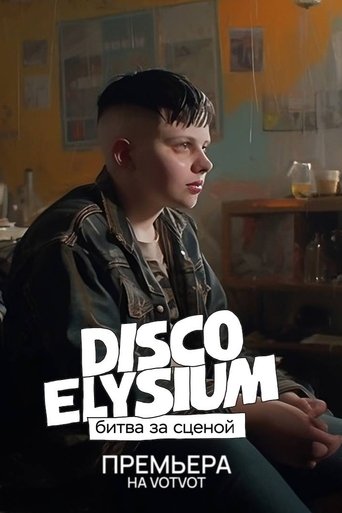
Disco Elysium: Battle Behind the Stage
Disco Elysium: Битва за сценой
2023 · Film · documentary · 46 min
Directed by Victoria Kaskova
The video game Disco Elysium was released in 2019. Great sales, prestigious awards — it was a resounding success. The main character of the documentary "Disco Elysium: the battle behind the scene", a gamer, wants to meet with the creators of the game. However, gradually an unexpected truth about his favorite game opens up to him…
1 positive4 neutralfrom 5 commenters
Where to watch
No streaming data for this title.




5 comments on Hacker News
Have you tried getting meta about sports and video games? I don't care about sports, but I'll be interested if you talk to me about the business of sports clubs or the technicalities of stadiums. Video games have a lot going on around them: The lawsuits and general weirdness around how Disco Elysium was made is the stuff of several documentaries, for example.
Anecdotally, I'd say women are worse when it comes to interests. It's incredibly common that they just don't have any, which isn't the end of the world, oddly enough. There might be little to discuss, but drinking some wine, going to the movies or a gallery while having a pleasant conversation - these can be fine activities. Hard to turn it into a club, but on the other hand it's basically universal.
I'd say it's fairly explicit that it was written by people with leftist sympathies and I assume that's what they meant. I don't get how anyone could find their portrayal of leftists very flattering; unless your notion of "leftist" is Biden/Macron/Starmer, I guess.
Not sure how someone could create a world like the one in Disco Elysium without having some kind of political ideology or why anyone would want them to be fixated on moderating themselves to the point of killing any sense of individuality in the work. It'd be like checking out the new Mel Gibson film and being annoyed that it comes across as having a conservative Catholic ideology.
Some video games have shown you can have incredible writing and narrative in the format (recent ones that stuck with me: Disco Elysium and Outer Wilds).
The vast majority of video games, though, and probably the most commercially-successful, are written really badly and show no particular regard to narration. The cliches are so bad, the writing either childish or more or less intentionally B-movie style.
I think games can still get a lot better on this front. In other areas, the medium has developed and experimented a lot. But, aside from indie games and a few noteworthy exceptions, I don't feel videogames focus a lot on telling good stories. At least, they don't do this as much as other media, such as literature or cinema or songwriting, have done in their history.
Video games are an art form unique from literature and film because you can interact with the world. Disco Elysium, Planescape: Torment, the original The Walking Dead Telltale game, and even indie browser games like One Chance on Newgrounds [0] created unique experiences.
For example, Disco Elysium (depending on your choices) talks about genuine change and the fact that other people who've known you for a while might not accept it upon seeing you again. Other games help place you in scenarios where you can make moral choices and experience the consequences (besides the original Telltale games, I'm also thinking of entries from Choice of Games LLC, assuming interactive fiction counts as video games). There are also works of genuine art like Myst or the indie game The Little Red Lie.
Outside of enabling a unique approach to storytelling, certain games can also help grasp specific concepts (e.g. Kerbal Space Program, flight simulators), though typically it's better to study a subject directly than consider video games as work.
There are a number of scenes in the television series Halt and Catch Fire where video games are presented as an art form. Interestingly, a character who treats game development as an art form initially doesn't like Doom because it looks like mindless shooting at first (but I think she warms up with it, as gameplay with a friend lets her open up about a problem on her mind [1]), and she also later enjoys Mario (also primarily gameplay-driven). In real life, trying out a couple of single-player video games recommended by different people I've met have deepened my friendship with them, surprisingly more than what I thought.
[0] https://en.wikipedia.org/wiki/One_Chance_(video_game)
[1] (Spoilers) https://www.youtube.com/watch?v=3HIfq3xH0Mk
> When people say a video game has a good story, they mean that it has a story.
The standard is so low is not necessarily a bad thing. Most of the games are bad, but people will try random things to improve storytelling, and we'll see games with great stories like Planescape: Torment or Disco Elysium in the future, or even better.
Movies, on the other hand, where there are so many established patterns - people tend to abuse them because 1) they don't want to take the risk to make something subpar 2) it's easier. They were so many terrible movies in the last centuries, but there are so many great movies as well. The golden era of movies has passed, but for games, it's yet to come.
There are in fact patterns that could be found in great games, but not as widespread as Hollywood cliches, for example:
1. Planescape: Torment, Witcher 1/2: Amnesia. It allows no assumption of prior knowledge of the protagonist, making the player discover the world, the past, and even the protagonist himself/herself incrementally with himself/herself. Witcher 3 on the contrary, makes me feel less connected because the protagonist knows many characters that I don't know like Dijkstra even though I played through the first two games.
2. Baldur's Gate 2, Pillar of Eternity: Meet the villain in EVERY chapter, and make it feel like watching Steve Jobs at Apple launch events. This gives the player a clear goal, and a villain that can keep all the game plots together instead of being too random and sloppy.
3. Original Sin 2, Baldur's Gate 3: Lock the protagonist with a magical shackle, put a parasite in the protagonist's head, this also gives the player a clear goal, but without spoiling who the villain is (DoS2 is THAT surprising, I bet it might be the same in BG3).
Actually, good games can be established on these patterns, until everyone started to abuse them.