 Hacker Cinema
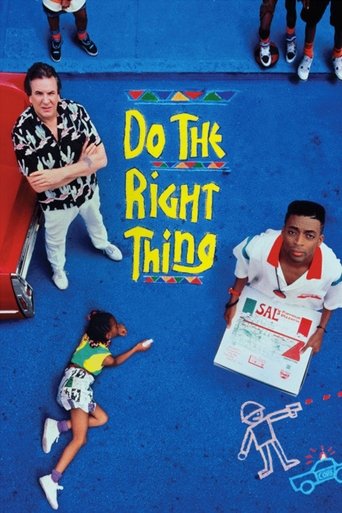
Do the Right Thing
1989 · Film · 120 min
Directed by Spike Lee
Sal is the Italian owner of a pizzeria in Brooklyn. A neighborhood local, Buggin' Out, becomes upset when he sees that the pizzeria's Wall of Fame exhibits only Italian actors. Buggin' Out believes a pizzeria in a black neighborhood should showcase black actors, but Sal disagrees. The wall becomes a symbol of racism and hate to Buggin' Out and to other people in the neighborhood, and tensions rise.
7 positive6 neutralfrom 13 commenters
Where to watch
No streaming data for this title.
Videos commenters linked
From YouTube links in the comments below. Most are clips and trailers; “Full” means the uploader says so.




15 comments on Hacker News
> Thanks again for continuing this conversation! I'm enjoying it. Also, can you recommend me a book or two to read on this subject? Thanks in advance.
Hey sorry for my late reply, I really didn't mean to waste your time, I just got super busy and spun a bit responding. Honestly I haven't read as much as I'd like to after discovering the internet around 1995, so this is mostly what I've picked up online.
To me, wokeism is fundamentally about stuff we can't unsee. It's like being friends with someone in an abusive relationship, where the other partner takes us aside and tells us that if we knew what they knew about our friend's behavior, we might not want to be friends with them anymore. The more we learn, the more that America's origin story becomes a twisted fable of revisionist history, written by the winners to cover centuries of oppression and violence. These stand out to me:
https://en.wikipedia.org/wiki/Tulsa_race_massacre
https://en.wikipedia.org/wiki/Thomas_Jefferson_and_slavery
https://en.wikipedia.org/wiki/Brooks_(1781_ship)#/media/File:Slaveshipposter.jpg
I went to South Carolina a few years ago and stood on a small plantation cotton field they keep preserved for tours. It was suffocatingly hot, felt like 100% humidity under intense sun, and not even the hottest time of the year. I just imagined people forced to pick cotton all day, every day, their entire lives. It was soul-crushing.
Then the tour guide called the Civil War the Northern War of Aggression and my eyebrows raised. Reality shifted and I suddenly saw the feelings from that time still running strong today.
Maybe I can relate my experience better through pop culture references..
I grew up on movies like To Kill a Mockingbird, The Color Purple, Do the Right Thing, Glory, Schindler's List and Amistad, to name a few. I never read Black Like Me and never saw Soul Man. I think I may start with these, regardless of if they aged well, to get an impression of where my head is at now vs then.
This search brought back a memory, that in Short Circuit (one of my all-time favorite movies), I didn't know that Fisher Stevens wore brownface to play Indian engineer Ben Jabituya until maybe the 2000s:
https://ew.com/movies/short-circuit-fisher-stevens-regrets-playing-indian-role/
This just goes to show how ignorant people were (including myself) as recently as a couple of decades ago. I think that the makeup in Soul Man is forgiveable because it's explicit and the subject of the film, much like Dustin Hoffman dressing as a woman in Tootsie. Whereas Short Circuit did it for convenience, without considering that it might be offensive.
I also grew up playing with the toy car with the rebel flag on it from the Dukes of Hazzard, completely oblivious to any racist connotations.
And sexual harrassment was so prevelant that we had never even heard of it until Anita Hill vs Clarance Thomas in 1991 before he was appointed to the Supreme Court. I remember that we were really appalled by that, because it was so obvious that he was guilty of the harrassment, even if that didn't bar him from being appointed. This was just after the Rodney King beating and LA riots, but a few years before the OJ Simpson case if I remember right. Racial tensions were running high, but also there was a feeling that minorities were being kept from positions of power, so there was a lot of cognitive dissonance. There was no Me Too movement and we didn't have a words like cancel culture yet. I didn't feel at the time that he should have been appointed, because he gave me creepster vibes. I think his decisions in the time since have shown that he is very, let's just say tempted by financial favors.
> This is sort of like the concept of "original sin", isn't it? The notion that certain people have a debt that is so big that it is impossible to ever be paid back, and so they must forever remain burdened with the guilt of the sin that their ancestors committed. The scale can never be zeroed. The guilt can never go away. The transgression can never be forgiven, because the effects linger down to our day.
Ya that's a good point, I hadn't considered that. It reminds me of how young people in post-WWI Germany felt that it was impossible to pay back the war debt that their elders faced when they lost the war. So they felt oppressed by who they viewed as Jewish elites in banking, eventually using them as scapegoats and starting WWII against the countries whose loans they were defaulting on.
Which has eerie similarities with the dissilusioned feelings of young men in America today, who due to wealth inequality can't earn the level of income needed to provide for a spouse or family, as they watch women and minorities rise without them. Blaming liberal and Hollywood elites, as well as immigrants, for bruising their egos instead of the real culprit, late-stage capitalist patriarchy.
I think what we're talking about is: how can the rights of individuals be upheld when our debts to previous generations are so high that we'd lose ourselves in an attempt to pay them back?
I guess my only counter to that is, if winners and losers resulted from the inequities of previous generations, leading to the vast wealth inequality we see today, then what would healing look like? Letting it go without making ammends, or going too far with violence as a result, both seem extreme.
I feel that affirmative action and taxing the wealthy are two solid approaches. But I don't feel that either have been tried to a degree nearly approaching reparations. Because if they had, then Congress might be 50% women, we wouldn't have such a large national debt or high poverty rate, etc.
> In the case of the LA fires, and for the additional reasons you've given, I agree, DEI was not to blame and is being used as a scapegoat. I wonder, if the fire chief were instead a straight white male, and if there was no firefighter that "looked like you" but instead, was capable of saving your life, would people still have blamed DEI, or would they instead shift their focus towards the "real problems" that you mentioned? Perhaps if these people weren't in these highly visible positions to begin with, DEI would not have been undermined as it was.
Ya, DEI probably wouldn't have been blamed had the people involved in the response fit prejudiced notions of what they should look like.
It seems that we both agree that DEI wasn't the cause of the fires. But maybe we should ask if putting such priority on DEI is undermining the cause of reaching equality. With so much political manipulation happening these days, it makes for an attractive scapegoat for those wishing to distract us from the real issues.
I don't know the answer, or if DEI should be put on hold temporarily. What I do know is that with controversial issues like gun control, we can find ourselves on hold indefinitely. So I am suspicious of calls to halt DEI when the problem of discrimination in hiring still exists. It feels too opportunistic IMHO.
> preface: I would like to think that everyone on the board has in mind the good of the entire company, and that the men don't just have in mind the considerations of men, and that the woman is not the only advocate for all the women of the company.
> Given the above, what injustice is there? Assuming that everyone earned their seat on the board fairly, without nepotism, sabotage, or shady backroom deals, why do you consider there to be an injustice happening here?
> The only way I can see there being an inherent injustice in a board room like this is if my initial assumptions aren't true, and that the men aren't advocating for the concerns of the women. But that would be to assume the worst of people. That sort of thinking is racist and sexist. That leads to tribal thinking, where people think that people from other demographics are similarly only looking out for "their own group".
Ya good point about the dangers of tribalism, since that is the single greatest threat facing the US today. We've grown so divided and provincial that we can't seem to work together, and that's undermining our credibility in the eyes of the world.
And I agree that people don't just work towards their own best interest, and that assuming they do is putting them in a box.
What concerns me though is that some people only respond to authority, not what society deems common decency. So without a law in place, they will return to discriminatory practices.
Trump just issued an executive order revoking Lyndon B. Johnson’s Executive Order 11246, promoting affirmative action in federal contracting:
https://www.washingtonpost.com/politics/2025/01/23/trump-revoked-equal-employment-opportunity-order/
Even though this move claims to encourage merit-based hiring, it will undoubtedly have the opposite effect. Because authoritarian-minded people will no longer be forced to practice nondescrimination. So they will hire candidates who appear to fit their own projections and stereotypes, causing them to overlook similarly-qualified candidates from other demographics.
When the laws aren't there, companies have a track record of accepting a certain level of human cost if it raises profits. Seatbelt laws, pollution laws, etc reflect the need for those regulations.
Now, we can argue whether the free market would take care of discrimination on its own. But in these times of little or no antitrust enforcement, often workers have few alternative employment options, so are at the mercy of employers. I'm not seeing politicans in favor of deregulation also calling for antitrust enforcement, so they are having their cake and eating it too, making this argument suspect.
-
Continues ->
The article briefly mentions all of the North Texas locations closed a week ago when the franchisee that owned them declared Chapter 7. Alamo Corporate immediately vowed to find a new franchise owner who would reopen. I hope Sony does something about this. I live down the street from one of the Dallas locations and, along with live music, this was effectively the out-of-house social life for me and my wife. Alamo was in the midst of a retrospective of anniversary re-releases, showing films from 1999 (which was our high school graduation year), then going back every five years until 1974. It was currently on 1989 and we were supposed to see Do The Right Thing this weekend. We've been there three to four times a month every month this year. The app still works, but listings were all deleted and tickets we already paid for are gone. The franchisee who closed the locations released a statement basically saying fuck yourselves. Nobody got any refunds. 600 employees were let go with no notice. The doors were simply locked and a paper sign put up.
Do the Right Thing. Not only is it one of the best movies I’ve ever seen, but I’m reminded of the ending every few months when I read the news. I now have a very different perspective when I see some oppressed group get admonished for protesting the “wrong” way.
He was in Do the Right Thing and Jungle Fever, two of the most talked-about films in urban America in the late 1980s and early 1990s. Wikipedia claims that his role in the latter film even drew attention at Cannes, so he wasn’t entirely no-name, even if Pulp Fiction made him a big star.
> I can watch nearly every show and movie that was ever created
I think this is an illusion. When I check some films with awards (let's say "do the right thing", not a blockbuster but a well-known film) I cannot find them in any streaming service (maybe criterion collection). I can definitely think of tons of tv shows I cannot find on dvd, let alone on streaming platforms. Not even on torrent networks.
This idea that the internet has everything is fine for some topics (like programming), but I believe it does not apply to some contents, and films are one of them.
EDIT: grammar
Let me just add, he was also in Spike Lee’s Do The Right Thing (1989), a movie that absolutely everyone should see. But it’s not in the clip above because he plays a DJ (Mister Señor Love Daddy) and doesn’t say MF.
https://www.youtube.com/watch?v=wCL3OtOzYuQ
Some of the films recommended in this thread..
- The Nice Guys
- I Don't Feel at Home in This World Anymore
- Scott Pilgrim vs. the World
- Don't Worry
- He Won't Get Far on Foot
- The Favourite (2018)
- Druk (2020)
- Amélie
- The Lobster
- Turist (2014)
- Parasite
- El Hoyo (The Platform)
- Quo Vadis
- Aida?
- 200 Meters
- Luzzu
- El robo del siglo (The Heist of the Century)
- Knives Out
- Us
- Get Out
- "Tokyo Story" (1953, Yasujirō Ozu)
- Aleksei German's Hard to be A God
- Edward Yang's A Better Summer's Day
- Maren Ade's Toni Erdman
- Luca Guadagnino's I Am Love
- Wings of Desire
- Do the Right Thing
- Drugstore Cowboy
- Gates of Heaven
- Beauty and the Beast
- Life Is Sweet
Roger Ebert wrote an essay [0] in 1992 reflecting on his career as a critic. He writes
>In the past 25 years I have probably seen 10,000 movies and reviewed 6,000 of them. I have forgotten most of those films, I hope, but I remember those worth remembering, and they are all on the same shelf in my mind.
Overall, he seems never to have lost the joy of watching movies. A relevant quote:
>When you go to the movies every day, it sometimes seems as if the movies are more mediocre than ever, more craven and cowardly, more skillfully manufactured to pander to the lowest tastes, instead of educating them. Then you see something absolutely miraculous. Something like "Wings of Desire," or "Do the Right Thing," or "Drugstore Cowboy," or "Gates of Heaven," or "Beauty and the Beast," or "Life Is Sweet," and on your way home through the White Hen Pantry you look distracted, as if you had just experienced some kind of a vision.
[0]: https://www.rogerebert.com/roger-ebert/reflections-after-25-years-at-the-movies
Thanks for the links, I appreciate this. I disliked much of the article, even if it was fascinating. Here's why: I can think of no joint venture in contemporary American culture where Black and White people built together as equal partners. As such, I thought it had a whiff of wishful thinking and horseshit about it. This was the era of hardcore Jim Crow. Martin Luther King leads the Montgomery Bus Boycott in 1955, the same year(?) Emmett Till is lynched. For instance, the appropration of Doo Wop by Italian-Americans sounds improbable. It was created by Black kids in the 40s, but Italian-Americans were (are) not exactly known for their multi-cultural spirit. You can see it depicted in Spike Lee's film "Do The Right Thing". And that infamous scene in True Romance: https://www.youtube.com/watch?v=uZUJKXs6W-4
So how did this really happen? The mechanisms of cultural collaboration didn't really exist, but I would love to be corrected. I doubt it is different from hip-hop: it's built almost in it's entirety on the Black cultural underground, and some talented white people who skirt around the edges eventually learn enough to make a stab at the "mainstream".
> these complexities don't have any place in the media narratives
I'm reminded of the film "Do the Right Thing", by Spike Lee. 1989. Not much has changed in America.
> The image at the top of the article is from Spike Lee's Do The Right Thing (1989). ...
Funny you mentioned that. I've watched that movie when I was a kid and, very impressed. I wanted to watch it again but I never knew its name to start with. Yet an internet stranger just blurts it out and makes my day. Thanks stranger.
If I can go off on a bit of a tangent. The image at the top of the article is from Spike Lee's Do The Right Thing (1989). The character is Radio Raheem and his boombox plays only Fight The Power by Public Enemy, which was made for the film. The movie is strictly about what happens when racial tensions boil over on a very hot day in Brooklyn. But really, it's about people, and how we treat one another when we're stuck in a system more powerful than ourselves. It's as relevant today as it was thirty years ago, and not just in America. It may as well be about the ongoing protests in Hong Kong. Great movie, strong recommend.
Back to the article: I owned a JVC-100 in red, just like the one pictured. I never took it out much because it seemed so fragile and my memory is that it sounded like crap compared to a hunk of plastic durable Sony that I also owned. I have no idea where either of those boomboxes got off to. Probably sold in a garage sale at some point.
Art or skill is an interesting way to look at it. There are a couple somewhat opposing social skills that seem to make like easier, or more bearable, for those who possess them. One is the ability to schmooze people, or even just remember their names and faces, easily.
The other is what you describe: not taking shit from others. But in the more artful way you described. I still think being a schmoozer a more useful superpower. But being able to signal that pushing you will be more trouble than it's worth seems to help avoid trouble.
I often think about the violent climax of Do the Right Thing. There's the melee in the pizza parlor which ends with the police killing Radio Raheem. Then, as things seem to be calming down, Spike Lee's character, who works at the parlor, picks up a trash can and throws it through the parlor's window. It leads to a full-scale riot.
The first time I watched the film, I was a bit puzzled by his action and even put off by it. Now I feel like it is the right thing to do. For the reason you described here: not as an act, not even as an act of catharsis which is how I expect it often gets read. But as a communication device. As an argument on behalf of violent resistance.
I respect his humility. However his own film "Do the Right Thing" should be on this list.
Can't read the article because of the paywall, but if they're literally using, "Do the Right Thing", that's super super ironic. It's been a while since I've seen it, but if I recall correctly; a major premise of the movie was that characters did not know what the Right Thing was, or whether they were Doing It.