 Hacker Cinema
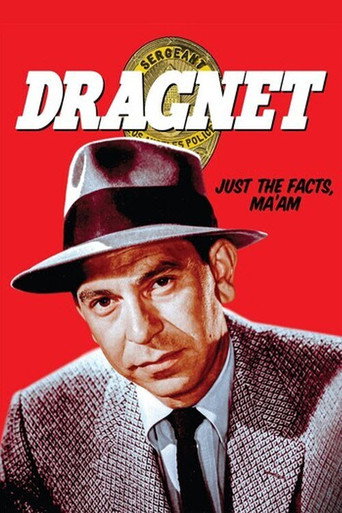
Dragnet
1951 · TV series · 30 min episodes · 8 seasons
Created by Jack Webb
Follows the cases of a dedicated Los Angeles police detective, Sergeant Joe Friday, and his partners. The show takes its name from the police term "dragnet", meaning a system of coordinated measures for apprehending criminals or suspects.
1 positive2 negative6 neutralfrom 9 commenters
Where to watch
No streaming data for this title.



9 comments on Hacker News
Most people will never interact with a cop on duty outside of a speeding ticket or some other mundane encounter. A major chuck of what many people think about police comes from TV and movies.
It's impossible to overstate the influence of Dragnet (the OG police procedural from the early 50s) alone on the widely held idea that police are mostly heroic and good. Police procedurals are still extremely popular, they overwhelmingly portray law enforcement in an extremely idealized way.
There are exceptions (The Wire, The Shield), but they are noteworty in that police are not heroes.
I remember watching an episode of the 1960s police drama, Dragnet.
In one of the episodes, Detective Joe Friday spoke with some computer technicians in a building full of computers (giant, at the time). Friday asked the computer technician,
> "One more thing. Do you think that computers will take all our jobs one day?"
> "No. There will always be jobs for humans. Those jobs will change, maybe include working on and maintaining computers, but there will still be important jobs for humans."
That bit of TV stuck with me. Here we are 60 years later and that has proven true. I suspect it will still be true in 60 years, regardless of how well AI advances.
Dario Amodei, former VP of research at OpenAI and current CEO of Anthropic, notes[0] a similar sentiment:
> "First of all, in the short term I agree with arguments that comparative advantage will continue to keep humans relevant and in fact increase their productivity, and may even in some ways level the playing field between humans. As long as AI is only better at 90% of a given job, the other 10% will cause humans to become highly leveraged, increasing compensation and in fact creating a bunch of new human jobs complementing and amplifying what AI is good at, such that the “10%” expands to continue to employ almost everyone. In fact, even if AI can do 100% of things better than humans, but it remains inefficient or expensive at some tasks, or if the resource inputs to humans and AI’s are meaningfully different, then the logic of comparative advantage continues to apply. One area humans are likely to maintain a relative (or even absolute) advantage for a significant time is the physical world. Thus, I think that the human economy may continue to make sense even a little past the point where we reach “a country of geniuses in a datacenter”.
Amodei does think that eventually we may need to eventually organize economic structures with powerful AI in mind, but this need not imply humans will never have jobs.
[0]: https://darioamodei.com/machines-of-loving-grace
In high school I toured Oakland Center, the regional air-traffic control center for much of the U.S. west coast. The controller with whom I sat had the big circular display we've all seen, and I noticed one contact labeled "NASA 714" moving away from the coast to the southwest, and I asked what it was.
It was the Gerard P. Kuiper Airborne Observatory¹, a converted C-141 transport with a telescope inside, en route to Hawaii on a mission. (Nice!)
"714" is also the badge number of Detective Joe Friday from the "Dragnet" TV series², and is a telephone area code serving part of Southern California³.
The "cylinder" part came when I was casting about for an HN handle, and it sounded good in combination with 714.
1: https://en.m.wikipedia.org/wiki/Kuiper_Airborne_Observator 2: https://www.perfessorbill.com/misc/badge714.htm 3: https://en.m.wikipedia.org/wiki/Area_codes_714_and_657
The cop dramas in the 60s/70s we almost infomercials pedaling very specific messaging. Some was aimed at police in an attempt to educate the myriad of forces on the law (Dragnet) while others educated the public. The explosive nature of car crashes mirrored the "educational" nature of contemporary traffic safety films. (I would provide links to youtube but such films are too gruesome, showing actual dead bodies.)
CSI: $LOCALE, NYPD Blue, Brooklin 99, Law & Order, Homicide: Life in the Streets, COPS, etc are basically "copaganda". This shit goes all the way back to Dragnet and FBI-glorifying movies like The Untouchables.
https://en.wikipedia.org/wiki/Copaganda
> Copaganda, a portmanteau of cop and propaganda, is a phenomenon described by critics of law enforcement in which news media and other social institutions promote celebratory portrayals of police officers with the intent of swaying public opinion for the benefit of police departments and law enforcement...
Movies like Top Gun: Maverick that are made with the cooperation of the DOD should be called what they are: propaganda. When Hollywood makes movies that glorify the military, they are part of the military-industrial complex. When they make movies critical of the military, they are part of capitalism commodifying resistance and selling it to people.
Podcasts are radio on demand. They offer all the variety that radio does, or did, and more. They can offer the quality of a good commercial radio show, or the quality of a rotting potato, or anything in between. It’s up to you to find something you like. There’s so much out there that there is probably something you’ll like.
So many of these comments talk as though “podcast” implies news or commentary and that’s it. Did I stumble into an alternate universe? I know those exist (news and commentary podcasts exist, that is), but there’s so much more. The closest I get are news-related comedy shows like Wait Wait or the BBC’s Now Show. I’m always on the lookout for the next episode of Welcome to Night Vale, and on the rare occasions that there’s a new Hardcore History, it’s a real treat. If I run out of something new, I love to listen to an episode or two of the old Dragnet radio series and get immersed in 1950’s Los Angeles.
Podcasts are inferior to text or video? That’s like saying that cheese is inferior to the Central Limit Theorem. The comparison doesn’t even make sense.
I basically can’t listen to podcasts without something physical to do. If I’m idle and trying to listen, I’ll start reading something at the same time and miss half the show. But while I’m out for a walk or doing yard work or cooking or on a long drive? They’re the best! Text or video aren’t sensible there. The only competition would be radio (or, ugh, my own thoughts), where the comparison is just like the comparison between live TV and video on demand.
Yes, I understand that. Every system has good folks and bad folks. But at some point, systems reach a state where the people trying to do good in the world are actually part of the problem, not part of the solution. At that point, the system itself is bad.
In the states it matters whether you torture people. Sure, bad folks get away with it, but if you get caught, you can be assured that the system will work against you. Same goes, mostly, for killing people without reason. Several public incidents over the last few years have shown this. I think the trick is to have video footage handy.
False arrest? Not so much. Police harassment? I'm sure there are cases brought to trial, but it's really rare. Taking your money when you didn't do anything? As we can see, that's already part of the system.
So over time, the system slips into being, for lack of a better word, "evil". More and more stuff that was out of bounds becomes normal. Sadly, I honestly think the reason for this is just officers trying to do a good job. Maybe cutting a corner here or there. No evil intent required.
This is going to sound weird, but if you'd like a good example of how the US traditionally felt about Law Enforcement, watch a few episodes of the old TV show "The Andy Griffith Show" with Don Knotts in there. Perhaps follow that up with a couple of episodes of "Dragnet"
These are highly-sanitized 60s shows, but it's clear that for a population who had most men return from armed combat in WWII or Vietnam, over-zealous macho policemen were a cause of great amusement. When real crimes did occur, the cops were considered just part of the population, perhaps with more analytical skills and with a job most people wouldn't like, but not that different from anybody else.
I believe that attitude started turning in the mid 70s with the Dirty Harry movies. Crime was considered a terrible problem, and the courts were considered to be advocating letting criminals rampage. Then we had the organized crime mania. Then drugs. With each public fear-fest, legislators gave the police more and more power -- just to use against the terrible threat of the current day, of course. It didn't work out that way. Now we have cops using organized crime and drug laws against some yokel growing 3 pot plants in his basement.
This is a parody of an old TV show called "Dragnet". Each episode ended with a dramatic narrator reading something 99.9% similar to the comment you replied to. Same fixed format, everything.
Kids these days :) :)
They're measuring the wrong thing. These kids would totally kick previous generations' collective asses at GTA and completing raid instances.
Ever watch your parents try to use MS Word or even a web browser? It's painful. Kids today may not know how to use a ruler but they can use 3DS Max. Let's see the Greatest Generation do that. Nonlinear video editing--? What's that?!? Kids today do it all the time and post to YouTube.
This month's Scientific American Mind says: "A generation ago TV programs such as I Love Lucy, Dragnet and Starsky and Hutch required virtually no concentration to follow. Beginning in 1981 with Hill Street Blues, single-episode dramas began to weave together as many as 10 threads into their plotlines. The hit drama 24 connects the lives of 20 or more characters, each with a distinct story."
The subject of the article is massive IQ gains during the 20th century. "If asked what dogs and rabbits have in common, a boy in 1900 would have said, "You use dogs to hunt rabbits." A boy in 2007 would say, "They are both mammals." It would never have occurred to someone a century ago to offer something so trivial. Who cares that dogs and rabbits are both mammals? What is important is what things are useful and under one's control." The context is working on abstractions with no concrete referents. (Although the article badly botches the proffered explanation of what a mammal is.)