 Hacker Cinema
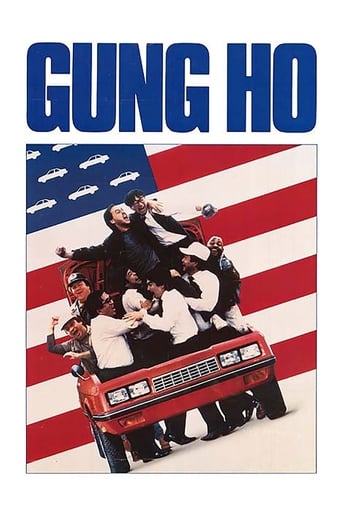
Gung Ho
1986 · Film · 111 min
Directed by Ron Howard
When a western Pennsylvania auto plant is acquired by a Japanese company, brokering auto worker Hunt Stevenson faces the tricky challenge of mediating the assimilation of two clashing corporate cultures. At one end is the Japanese plant manager and the sycophant who is angling for his position. At the other, a number of disgruntled long-time union members struggle with the new exigencies of Japanese quality control.
5 positive2 negative12 neutralfrom 19 commenters
Where to watch
No streaming data for this title.
Videos commenters linked
From YouTube links in the comments below. Most are clips and trailers; “Full” means the uploader says so.


20 comments on Hacker News
the USA was worried that Japan would take over/buy up the USA in the late 80s, esp. after Sony bought Columbia Pictures and Mitsubishi bought Rockefeller Center in NYC.
see https://www.businessinsider.com/japans-eighties-america-buying-spree-2013-1
and movies like Gung Ho, and Rising Sun, https://en.wikipedia.org/wiki/Gung_Ho_(film) and https://en.wikipedia.org/wiki/Rising_Sun_(1993_film)
> It’s completely unsurprising that American mid-skill workers are worse at cooperating on delicate large scale manufacturing than Japanese ones.
Watch the 1986 movie "Gung Ho" starring Michael Keaton, about a Japanese car company opening a fab in the US. It's amazingly witty and funny.
The gist is that Japanese workers (and Asians in general) are expected to sacrifice their personal life for the good of the company with all the downsides that incurs for them, while American workers want to do the bare minimum at work and also expect to be paid significantly more than workers in Asia (duh!).
In the globalized world of today (let alone the 1980's), manufacturing is a race to the bottom in terms of cost where you need to squeeze your labor as much as you can to keep costs down, and high income countries like the US, can't compete, nor do they want to because they have better options to pump up their GDP, like printing USD.
So why do we keep discussing this over and over again? Working in factories competing with Asia kinda sucks for the 21 century wealthy westerner so they don't want to do it like in Asia, which is what it takes to keep prices low and consumers happy. So opening factories under these conditions seems like you're setting yourself for failure form the start.
>"this is not how we do it in Taiwan"
Reminds me of the movie Gung Ho where the Japanese are trying to build cars in 80's America.
https://www.youtube.com/watch?v=hKNeFHBPgRo
American build quality "documented" in the movie "Gung Ho"
What's sad/amusing about this is that these ideas where explored in the 80's and we seem to have forgotten.
For sure '9 to 5' covers this territory (eg, daycare at work for working moms), and if memory serves so do two Michael Keaton movies (Gung Ho and Mr Mom).
The old joke about Alzheimer's, "I get to meet new people every day" seems somewhat appropriate here. Forgetting things we already knew gives us lots of things to talk about.
Or 1986 Ron Howard comedy film with a Chinese/American title but about Japanese car manufacturers in the US:
https://en.m.wikipedia.org/wiki/Gung_Ho_(film)
Maybe American Factory (2019) or Gung Ho (1986). The latter isn't a documentary though.
Let’s take a step back and reminisce about the late 1980s and 90s, a time period when the U.S. was consumed with panic about Japan’s claim on the future via their technological might and wise long-term business sense. Steve Jobs looked up to Sony. Gibson set Neuromancer’s opening scene in Chiba. The anxiety is incredibly overt in movies like Gung Ho and books like Crichton’s Rising Sun.
Now they will have headaches for months because Internet Explorer is sunsetting.
I don’t intend to be mean, but I find the perspective interesting. Especially as new anxieties grow about China’s perceived claim on the future for somewhat similar reasons.
Reminds me of https://en.wikipedia.org/wiki/Gung_Ho_(film)
See also: https://en.wikipedia.org/wiki/Gung_Ho_(film)
Farther back than that even, go watch movies like Gung Ho from 1986 with Michael Keaton which did a good job at vilifying Japanese companies/Japan.
>The local auto plant in fictional Hadleyville, Pennsylvania, which supplied most of the town's jobs, has been closed for nine months. The former foreman Hunt Stevenson goes to Tokyo to try to convince the Assan Motors Corporation to reopen the plant. The Japanese company agrees and, upon their arrival in the U.S., they take advantage of the desperate work force to institute many changes. The workers are not permitted a union, are paid lower wages, are moved around within the factory so that each worker learns every job, and are held to seemingly impossible standards of efficiency and quality. Adding to the strain in the relationship, the Americans find humor in the demand that they do calisthenics as a group each morning and that the Japanese executives eat their lunches with chopsticks and bathe together in the river near the factory. The workers also display a poor work ethic and lackadaisical attitude toward quality control.
That is a even a bit more revisionist, our relationship with Japan was very friendly in the 1980s, and the economic competition aspect was more benign even in the rust belt. As long as we are drawing from pop culture, the movie Gung Ho (https://en.wikipedia.org/wiki/Gung_Ho_(film)) is a more accurate reflection of the sentiment of the time.
There has just to be a gung ho kind of movie for China, as far as I can tell. Likewise, Japan continued to be a top strategic ally of the USA in the 80s, it was never seen as a strategic competitor like China is today.
The Hollywood version of this is fairly fun: https://en.m.wikipedia.org/wiki/Gung_Ho_(film)
This reads like the film "Gung Ho" made reality.
Has everyone at Tesla watched the classic car factory film?
https://en.wikipedia.org/wiki/Gung_Ho_(film)
The decline of the Rust belt began in the 1970s, and by the 1980s you already had movies like Gung Ho
https://en.wikipedia.org/wiki/Gung_Ho_(film)
dramatizing existential crises of factory towns in the face of manufacturing off-shoring.
Factory towns are nothing new, and neither are factory towns disappearing overnight. What's relatively recent in modern American history is the reticence of Americans to move, thus the title of the article. But this reticence is probably a regression to the mean, much like everything else about the post-post-WWII economy.
This is a good start:
https://en.m.wikipedia.org/wiki/Lost_Decade_(Japan)
It's also interesting to review old films and media from the late eighties (Gung Ho, and Die Hard). It's hard to comprehend if you didn't live through it, but there was a massive level of anxiety in the US that Japanese business culture and management prowess was going to be impossible for the US to overcome, and that th US was in decline.
The Asset bubble in Japan was so insane that at one point the nominal value of the Imperial Palace was equal to the value of all property in the state of California. Aother good Wikipedia article to read is this one:
https://en.m.wikipedia.org/wiki/Japanese_asset_price_bubble
Don't forget about the 80's flick, Gung Ho, where a Japanese Company takes over an American Car plant. http://en.wikipedia.org/wiki/Gung_Ho_(film)
I think the films being referred to were more along the lines of "how to spend your millions", "what it's like to show off your superbowl ring", or commercials where sports stars are asked "What are you going to do now?" and they respond "Go to Disney Land", as if these somehow indicated HOW to win. The films you're referring to are the proper ones to watch to, as you say, study the problem area and come up with winning strategies. It's not watching movies like Big to find out how to become an executive at a toy company or Gung Ho to determine how to run an auto manufacturing plant.
I also enjoyed Mike Judge's other film "Idiocracy". It's not explicitly a hacker film, but it's a sci-fi story about an average guy in a world of idiots, so it verges on hacker territory. It also has some examples of hilariously bad human/computer interface design.
(And if you're into cry-yourself-to-sleep-reality movies, there's also Outsourced, a recent comedy about a call center manager who must train his replacements in India. I found it surprisingly enjoyable. Its primary themes are culture clash and figuring out what's important in life, so it shares similarities with Office Space and Gung Ho.)