 Hacker Cinema
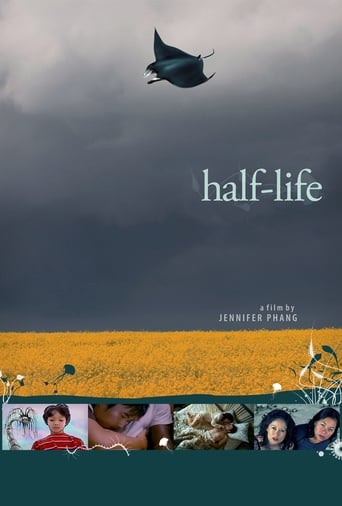
Half-Life
2008 · Film · 106 min
Directed by Jennifer Phang
As troubling signs of global cataclysms accelerate, a brother and sister react to their father's desertion and the powerful presence of their mother's new boyfriend.
13 positive2 negative1 mixed26 neutralfrom 42 commenters
Where to watch
No streaming data for this title.
Videos commenters linked
From YouTube links in the comments below. Most are clips and trailers; “Full” means the uploader says so.




43 comments on Hacker News
Perfect fit half life the movie
I appreciate the experience report, it's interesting to hear the differences, and it's fun to think back on SOMA after not thinking about it for years. There was a funny discussion elsewhere recently about movie tie-in games that this reminded me of. For a 007 game, someone identified as James Bond while playing, but because they sucked at the game and kept dying, they felt very drawn out of the experience and un-immersed. "James Bond wouldn't die."
Do you read novels that narrate with the first person "I" differently than you read novels that don't? (For me there's no difference.)
In games, what matters to me when it comes to immersion or even how much I put of myself into it, isn't anything like camera perspective, but the level of control I have (or think I have). There's two types of control, the first being over the character(s) I'm puppeteering/piloting. It goes beyond just their movements and includes their behavior, thoughts, words, and what they don't do as much as what they do. The second is control over the narrative or story. If the world or story or other characters actually change or react to things I do or don't do, that does help sell me on the idea that I have some control. There's a huge variety in how different games tweak these knobs, and sometimes control is given in just lack of resistance. For example, the Half Life series doesn't offer much meaningful control over either the character of Freeman or the plot, but because Freeman is under-developed and silent, there's no resistance to playing him as you please within the confines of the game. I have the illusion of a lot of control over his character. And the game itself has a good amount of environmental control -- you can close doors behind you, if you want. It helps sell the immersion and makes it easier to self-insert, if desired. I played another game where a character kept sending me text messages, and I would just ignore them all instead of replying, but I wasn't playing "me", I was playing a role, and thought it made more sense for the character to stay mad and give the silent treatment. Nothing really came of it but it was fun, like closing doors.
Solid Snake in Metal Gear Solid is much more developed than Freeman, and you have pretty much no control over his characterization, and only one moment of control on the story, so I've never felt like I was Snake, or Snake was me, I was just simply puppeteering him, and was mostly along for the ride like a movie or book. The immersion was still good even if I wasn't directly, personally in it. And being a game, it could have a certain fight which sticks in one's memory forever. Still I felt with Simon the way I felt with Snake, he was too much his own character for me to inhabit. Geralt in the Witcher series is also pretty well-developed, but the game offers a lot more flexibility and control over him, so you can steer him in directions that more resemble yourself, or what you would like to be, or what you want to pretend to be right now because you're curious what happens in the game if you do so. I still never felt like I was Geralt, or Geralt was me, but it was easy to put more of myself into playing. The world itself also changes based on my actions, so much that you can import saves from the previous game when you start the next game to carry over some things. Two of the most immersive games I've played, Gothic 1 and 2, give you a pretty under-developed nameless hero to steer, and insert yourself into if you wish, and a very reactive world and population. It's third-person.
(Probably the majority of my top-rated games have little of either control. Some are Star Fox 64, Mega Man X, Super Mario World, Ikaruga, and Doom. I never think of myself as Fox, X, Mario, Shinra, or Doomguy, or them as me, or even me as role playing them. I'm just piloting them. Same with Bond in Goldeneye for the N64. In those games I'm not usually thinking of the story or themes from moment to moment. I might not be immersed, depending on how exactly you define that, but I'm totally engrossed in the action. Sometimes there are those narrative moments worth reflecting on anyway (the end of Ikaruga is quite tragic when you think about it), but I had no influence over them.)
I'm easily taken out of the whole thing if the game suddenly offers incredible resistance or otherwise breaks established control patterns. A typical example would be winning a fight and then a cutscene plays and gives a scripted loss instead. (Sekiro's opening fight gets a pass, partly because I did lose the first time playing.) Related is if the mechanism of control suddenly changes. If it's an action-oriented boss fight that I win, then a cutscene, then a quick (or not so quick) prompt for "Press X to finish the big bad", I'm pretty irritated.
For consequences, I'm mainly talking about how my actions or non-actions affect the characters themselves, the world and its inhabitants, and/or the story. In SOMA, these kinds of consequences aren't really there. There's one mostly visual consequence near the end for one choice (and it raises some questions about pressure suit construction or whether such a suit was even needed to begin with), but otherwise nothing really comes out of anything you do with the choices you're presented with (unplugging this, killing that, infecting this, erasing that, answering a survey this way (including asking to die)), you just have your own reasons and thoughts about it (like closing doors, or ignoring texts). These aren't bad and can be nice for immersion, but it could have been more. A game as simple as MegaMan X has, as a consequence of beating Chill Penguin, the freezing over of Flame Mammoth's stage, which makes it easier to traverse...
I agree the remark on death consequences not being particular severe (restart/redo a bit) isn't that fair and applies to many games. (Even BioShock has that consequence, it's another one of my top-rated games, it plays with the distinction of who (the player or the game) has what kinds of control in a unique and memorable way, even if a story-affecting choice is kind of minor and lame.) But you don't need to go all the way to sadistic things like deleting the game or what have you to introduce more meaningful consequence. Dark Souls (another favorite) has as its primary death-consequence an additional gameplay aspect where, besides going back to a checkpoint, you need to return to where you died to recover your unspent currency or risk losing it forever if you die again. That mechanic is fundamental to the "souls-like" genre it birthed. Dark Souls 2 goes a bit further by progressively "hollowing" your character with each death, lowering your max HP and making you look more and more zombified, only reversible with an item not sold in unlimited amounts. Some characters react differently to you (or are interactable at all) depending on your state. It's not a flawless execution; it does tie into the underlying narrative theme of hollowing, but as expressed through other characters, that's more about memory loss and loss of purpose, which mainly applies to the player only if they give up and stop playing the game. Still, it's a nice touch that makes the game feel more meaningful and reactive to how you're playing it, even if how well you're playing it (i.e. are you dying a lot) isn't quite the same level of control as pushing the red button, blue button, or walking away.
Another option I've seen other games do is when you die and respawn, you can come across your previous corpse. Works really well for robots. It can be purely visual, or offer something on the gameplay level with looting your old body. It might have been interesting for SOMA to include something like that, and offer a way for Simon to come to grips with the idea of mind copying well in advance. Or further his instability, having to walk over so many of his own bodies.
I feel that's like saying "I can get just as fully immersed in a book so who needs movies?"
They're different experiences. I don't need Tetris or PacMan in VR. Conversely, Half-Life 1/2 etc are not remotely intense as Half-Life Alyx. In the first 2 you're watching a movie. In the later you're in the world of Half-Life
> e.g. if they used a seperate rendering package or mostly painted by hand
IIRC Max Payne was one of the earlier games to rely heavily on photo-reference textures (instead of hand drawing or computer generating them). Keep in mind that in 2001 digital cameras were rare, expensive, and low-res, so people often just used film cameras and scanned in the physical photo with a flatbed scanner. Max Payne was far from the first, though; even 1998's Half-Life used some photo-ref textures.
The lighting in Max Payne's textures was probably mostly just the lighting from the original photo. Every texture had to be hand-manipulated to make it usable on 3D models, so changing the lighting would have added even more work and would have looked less realistic.
Are people who know of or remember Half Life even a significant fraction of the market anymore?
At this point it's like releasing a new Fred Astaire musical. A new episode of The Lone Ranger.
> Another purposeful animation is this subtle scale down effect when pressing a button. It’s a small thing, but it helps the interface feel more alive and responsive.
If you haven't watched the Half Life documentary, I can't recommend it enough. In it Gabe Newell talks about the way he wanted the game to be different from games that came before it in that you could interact with things around you so you felt like you were actually in with and interacting with this world. He then related it to a psychological concept (maybe associated with self realization or external validation) and how as humans we crave the kind of physical objective feedback as recognition of our existence and how important and valuable that is. Really a neat idea and whether or not the science is sound, there is something immensely satisfying about interacting with virtual objects and having them respond in a physical manner that replicates physical reality.
I watched couple of Half life videos/movies and I found the story line engaging. I haven't tried playing the games though. I guess next step will be that, in case they support controllers as I don't use mouse.
this balancing act between scripted story and open gameplay with "conscious" AI defense is so hard to pull off. In the scripted entertainment league Half-Life rules I think. Crysis had the tech to do the real thing and failed - too much cinema and a bad story. But the realism, the mechanics of movement and physics - it was all there in god tier quality.
I'm talking about HL2, not the episodes. I don't judge HL1 by what was written into HL2 years later, nor do I judge HL2 by what was written into the episodes or Alyx years later. Not least because it's common knowledge that the writers have been following the "Lost" philosophy of writing, making up shit as they go, creating mysteries they themselves don't know the answer to, punting that down the road to their future selves.
In Half Life 1 you start with a dogshit reputation and insofar as you gain any reputation with the NPCs its because you've progressed through the game to earn it. The scientists treat you like base labor in the beginning, then come to see you as useful, as a fighter, after you prove it. The soldiers start without knowing who you are, but after you tear your way through their ranks they start hating you by name.
In Half Life 2, all the NPCs you meet act like you're already a famous hero and there's really no indication in the game that this comes from g-man propaganda rather the vortegants and/or the black mesa scientists. In HL2 both the vorts and the scientists make a point of saying they owe Gordon a lot. The natural read on this, given the context of the first two games and not any later retcons, is that the scientists or vorts have basically deified you. Mossman talks about how she wishes she could have worked with you at Black Mesa as though you were not just a war hero but also a legendary scientist. What scientific achievements did Gordon have at Black Mesa? He pushed samples around and showed up late for work. What kind of stories were the other scientists telling her about you? Also Alyx starts hitting on you right away.
Whatever the plot justifications for it, clearly there was a commercial motivation of pandering to the player. It aged poorly.
1998 - Half-Life
1999 - Half-Life: Opposing Force
2001 - Half-Life: Blue Shift
2001 - Half-Life: Decay
2004 - Half-Life: Source
2004 - Half-Life 2
2004 - Half-Life 2: Deathmatch
2005 - Half-Life 2: Lost Coast
2006 - Half-Life Deathmatch: Source
2006 - Half-Life 2: Episode One
2007 - Half-Life 2: Episode Two
2020 - Half-Life: Alyx
Some weird Half life episode 3 marketing but whatever, lemme grab my crowbar
But Half-life is IMO one of the top gaming franchises. And after seeing Fallout adaptation, I think Half-life TV series would also be successful if properly made.
Loved the documentary. I played the hell out of that game back in the day. There’s a renaissance of Half-Life Deathmatch too (short-lived, no doubt) if anyone wants a hit of nostalgia. Valve even released a couple of the concept art character models, some gameplay tweaks, and some new maps. New content for a 25 year old game.
Also FYI, Half-Life and HL2 are currently both very playable in VR. Half-Life even runs natively on the Quest 2.
One of my favorite documentaries was made by Noclip, which tells the story of Half-Life and Valve. It is soo good, a must watch. Interestingly, though, it features no one from Valve, as they, in typical Valve fashion, ignored their requests. https://www.youtube.com/watch?v=BQLEW1c-69c
So I'm very excited to watch this new documentary featuring people who worked on the game, made by the same people, such a surprise haha.
I think there's a couple of orthogonal issues here.
One of them is the nature of interactivity in the levels themselves. There's a spectrum between having a game grammar made of distinct discrete interactive reusable objects and then building unique situations by assembling them in interesting ways, versus having (essentially) unique scripted traps or interactive things or set pieces that only show up in one place. Older action games that inspired Doom tend to draw from that former tradition; a lot of FPS games that came after Quake tended to go more down that second road. Quake's trigger system specifically opened up the door to a rudimentary kind of visual scripting that made the latter style of design more possible in a way that wasn't possible in Doom (although it was possible in Hexen via HexenC(?)). I think you could say that that style of design really came more into its own with Half-Life, which foregrounded unique interactivity grounded in very specific, themed levels much more clearly. Doom at its best seems like it's much more in the design space of, say, Robotron and old Mario games. Fewer unique set pieces, much more focus on discrete interactive toys to be recombined... and given id's background with Commander Keen and their earlier recreation of the first level of Mario 3, this design influence shouldn't be a surprise. Anyway, Quake feels like it is at the intersection of these two styles of design.
I think it is true that Peterson did try to go more down that second road of design in the episode 4 maps in a way that there was less of in other maps, and that it interesting.
But the other thing that sticks out to me more so, in terms of level design, is about the way the space is shaped. A lot of the very best Doom and Quake levels have a tendency of having different parts of levels intersect and interact in interesting, playful ways. The order that you see areas is different from the order that you hear areas is different from the order that you can attack into or interact with areas is different from the order you can move through areas is different from the order that different kinds of enemies can move through areas or attack areas. And that changes as you progress through a level, get keys, and activate switches. There's a tendency for levels to start somewhat linear and movement constrained but give information about later areas in a somewhat more non-linear, tantalizing way, and then as a player progresses, for the player's movement in a level to become more like a multiply connected graph as switches, keys, and activated lifts make a lot of one-way paths become two-way. And that style of design plays to the strengths of Doom and Quake using BSPs for levels as their fundamental data structure - BSPs specifically make these kinds of weird and surprising visual and physical intersections between areas manageable in terms of computational performance on 90's era hardware.
Whether or not someone considers the design approaches I just outlined appealing is fundamentally an aesthetic issue, obviously - there's no one right way to enjoy a game. But my general sense is that the Sandy Peterson maps in Doom and Quake tend to explore these approaches to play much less than the maps made by other designers.
The software I personally have the most issues with is Star Wars Episode 1: Racer, a 3d title from 1999 that from what I understand uses x87 math extensively. In Parallels (i.e. no Rosetta) it runs at 120fps easily, while in CrossOver the frame rate barely ekes above 20. Old titles like Half-Life, all other Source games, Fallout 3, SWTOR etc. all run vastly worse than they should, and many cannot run at playable framerates through Rosetta. Honestly, the problem most likely extends to more of Rosetta's floating point math than just x87.
The author of REAPER has also written about it some: https://user.cockos.com/~deadbeef/index.php?article=842
There's been lots of discussion about the issue in the Codeweavers forums, and Codeweavers points the blame squarely at Apple, who have been, predictably, very quiet about it.
> to play Quake 2.
In just a few years we had Quake 2 (1997) to Half-life (1998), Thief: The Dark Project and Quake 3 Arena/Unreal Tournament (1999). The year 2000 would see Dues Ex, The Sims, Diablo II, Perfect Dark, Final Fantasy IX, and Jet Set Radio... Not to mention Spyro, Red Alert 2, Paper Mario, Majora's Mask, Escape from Monkey Isand, Hitman 47...
So much amazing history in such a short period of time (let's not mention popular cinema...)
On the subject of game development at Valve, there's a lot of things that have been worked on but never turned into an actual release. There were 5 cancelled Half-Lifes between Episode 2 and Alyx (Including Half Life 3), Left 4 Dead 3, F-Stop, "RPG". A.R.T.I, SimTrek and probably a few more.
That sometimes over-cancelling willingness I think is also part of what makes the end result great-TF2 took 9 years and several versions similarly to Alyx, but I think both were worth the wait.
NoClip is fantastic; I also really enjoyed the Rocket League[1] and Half-Life[2] documentaries. Danny just seems like a genuinely nice guy who just loves to tell the stories behind these games, it's awesome to see the success he's had with NoClip.
[1]: https://www.youtube.com/watch?v=Om0j9SLBDPQ
[2]: https://www.youtube.com/watch?v=BQLEW1c-69c
I was riveted by Half-Life in 1998, but I recently picked up it's well regarded remake Black Mesa (which updates the graphics to approximately 2006 levels) and IMO, it doesn't hold up at all.
Nothing about it is epic - it feels like a cramped dungeon crawl. The gameplay and puzzles are extremely simplistic (lots of slow moving enemies crawling down a hallway). The story is a bad B-movie compared to some of the compelling modern games that are raising world-building to new levels. When you compare it to modern games, I don't see how anyone could justify spending more than an hour or two on nostalgia playing.
That doesn't prove it's not a niche, dude.
Valve, like a lot of other companies, hopes that VR will become a thing, so they're making a headset. Because they'd like to sell headsets, they took a major property and made a VR version. If they lose money on their VR version of Half Life, they're fine with that.
Some game makers will surely try VR versions as well. This could be a big wave, and they want to be ready, so it's ok to lose money. But if unit sales aren't there, they're not going to keep doing it. In which case, things could well end up just like every other attempt at VR going back to Nintendo's 1995 effort. Or like the various waves of 3D movies and TV, where everybody's really excited for a hot minute and then people stop caring.
I remember so many of the games of that time made the exact same mistake: they would focus so heavily on a piece of technology that often just wasn't-quite-there-yet, and yet since that was the game's "thing" (especially since games were hyped so early in magazines), they could never really let it go. With Tresspasser, if they had gone with the initial vision of it being a survival-horror dinosaur game, but they had designed it more like a contemporary like say Half-Life, it's an idea that totally could have worked. Remember how scripted Half-Life was, especially some of those early levels that were almost like standing in a movie? (A new experience back then). I could totally imagine a dinosaur game working with that kind of model and tech. You can imagine showing a JP-style scene where the dinosaurs do something very clever in a controlled environment, and maybe having player's project more into the AI based on that; which would have been a much better investment than a state machine they ended up just having to mostly disable. (I remember people were very complementary of Half Life's AI, but I think it really boiled down to clever level design more than anything). The problem was that while the physics were really interesting, there just wasn't enough there to actually build a game on, and a lot of things that were interesting were awful gameplay wise (the weird floppy arm for instance).
I do have a lot of nostalgia for it though. I remember playing it when I was 13 or 14 on something like a K6-2 300mhz, and as disappointing as it was it was also really interesting.
True, but regardless it's too late. I'd just accepted Alyx as the third major installment of Half-Life, that's really what I meant.
Technically there were the episode releases too, and so it doesn't really hold up to scrutiny. I just liked the idea that they released one full game on schedule befitting the name.
> Half Life is not exactly complex or subtle in its storytelling
Agreed, but I wasn't arguing it was. It's neither complex nor subtle. It is "story heavy" or rather story-driven, or rather "cinematic". This is a game where the story propels the gameplay. Not saying it's particularly good fiction, just that the fiction matters in the game. Notice how much of what I'm saying applies to Star Wars too, where -- also -- skipping a movie can be done but is not recommended ;)
Not even Half Life, the best movie-game would be a good movie. But it was damn great as a game.
> Did people love the Half Life series because of the story?
Yes, or at least I did. Very much so. I loved the story so much that I would probably be quite happy watching a Half Life 3 movie.
You obviously haven't played a single game. I feel sorry for everyone who haven't played games like Mass Effect or Half-Life or Dwarf Fortress even. Playing the right games is way better than watching a movie or a series. Not to mention the benefits of mental exercises some games present to you (Talos Principle for example). You are also making the mistake of comparing apples to oranges. Running is good (although not so effective) for your health while gaming is good for a wide variety of things: creative thinking (Minecraft), problem solving skills (Talos Principle), interactive movies (Quantic Dream games), etc. Your dismissive blanket statement not only annoys gamers but also makes you look dumb because only someone with zero gaming experience can say something like this.
I didn't think I would, but I seem by those archetypes to land under "Achievers", this despite me never 100%:ing a game (the rare exception being Binding of Isaac, love the item synergy sandbox/breaking of that game), and hating achievements, never looking for collectables, etc.
I do however always accumulate/optimize for maximum ammo/currency/gear/weapons/items, to the point where I believe I completed >80% of Half-Life with the crowbar, to conserve ammo.
I also like you love singleplayer games and a well-written story, but I on the other hand hate open world games (because they're never open nor "worldy" enough), and equally hate too linear games (looking at CoD past 3 and the like).
I grew up loving games like Quake (for the multiplayer/mechanics/general tech side of it), The Longest Journey for the story, Half-Life for both aspects, and a bunch of games struggling with either storytelling/mechanics or other but loveable for their attempt at trying something more than they could achieve (examples being Outcast, Citizen Kabuto, Oni, Advent Rising, Too Human).
When thinking of what the last bigger/sorta AAA games I enjoyed playing was I think it's Half-Life 2 (kind of obvious), but also FarCry (1), Crysis (1, but also Warhead), Just Cause 2.
All of them had a story, most of them were open world and allowed you to approach a problem with undesigned solutions, which is what I really love.
I've bought GTA 4, 5, Far Cry 3, 4, Just Cause 3, and many many others, played them for less than a handful hours, and given up because it just feels like I have to churn this mill just to advance a movie, at which point I may as well watch a movie, or watch someone else play the game (which I now completely understand as a concept).
"Open world" games I've played in recent years - after the original concept of open world once went linear for consoles, and then consoles catching up enough to enable open world games again - don't seem to be so much about designing a world with some rules and a number of tools, but simply providing more than 1 or 2 designed solutions to a problem, which feels completely hollow to me.
I have no doubt that this is why MineCraft (which I haven't played much for lack of story/"game", although having plenty of sandbox/open world) and that genre has sprouted up to much success.
Sorry for hijacking. I don't know how this turned into a longwinded games rant, but it raised questions since I identified with you, while still feeling characterized under "achiever".
I think it's broader than just "designed for easy control on a console". There were other factors at play.
I think what actually set this type of design in motion can be traced back to that point in time when Half-Life came out and all of a sudden everybody seemed to criticize Quake (and indeed id Software in general) because their shooters lacked a story (actually, my recollection is a little fuzzy - games like Thief and System Shock were certainly exploring the 'story' space as well, I'm just not sure off the top of my head in what order the games arrived on the scene).
The realistic movement (head-bobbing, slowness, inertia, etc) seems like it's meant to convey a vague sense of what the physical impact of running would be, in the same way that camera shake is used to accentuate punches in a fighting game or a movie with fighting scenes. It's something that conveys momentum and mass.
It's an element to convey story and immersion. I feel like there's probably an axis here, where you have pure arcade games like Geometry Wars on one end and ultra-cinematic shooters like Battlefield 4 on the other. I'm really guessing here but I imagine Battlefield 4 (or let's say even the original Call of Duty, though I've only heard/read about it and never actually sat down to play it) wants you to actually feel the things that the soldier in the story is feeling. In some sense, it wants to be an interactive movie experience. As opposed to Geometry Wars and Doom, where the gameplay comes first and the story is nearly non-existent or very secondary.
I remember one of the biggest praises given to Call of Duty (EDIT: actually, reading further down, I think it was Soldier of Fortune that I was thinking of!) that it felt like you were in the opening scene of Saving Private Ryan. I can't help but think that must have been a huge contributor to the tone of console shooters that came afterwards.
When I was a senior in high school, Cisco offered their NetAcademy program to a few high schools around the nation. It was a pretty sweet deal: for a relatively small price, you could earn your CCNA as an optional elective. You had to get approval to take the class; basically, the 10 of us were the most technically minded and computer literate students in the school.
So, of course within a few weeks many of us were staying after school to use the top-of-the-line (circa 1999) computer equipment to play games. :) Half Life and the various mods (particular Action Half Life [0]) were favorites. Even the teacher eventually got in on the fun.
"You shot me! If you shoot me again I'll fail you!"
A lot of times a few folks would come over to my house in the evenings because we had a blazing fast (again, circa 1999) 128k ISDN line in the house, supposedly to do "homework" but really gaming, surfing the web, playing MUDs. Sometimes we'd kick on a movie like Army of Darkness while gaming.
Such great memories and an awesome time to be alive. I still keep up with a few folks from back then but I'd love to know what happened to everyone else.
[0] https://en.wikipedia.org/wiki/Action_Half-Life
Because buying a movie or a game is much more intentional in the sense that it appeals to a specific demographic that has opted in (my grandma would HATE Half Life or any most rated R movies, but is way less offended by a sexual reference in a sitcom).
Mainstream Media doesn't want it, enter Showtime and HBO.
I watch movies and play games that I wouldn't want my six year old to be exposed to when he was flipping the channels? Like Leonidas in 300. My kid would have nightmares for days!!!
This is my problem with many modern games as well, they think they are movies, but the story, characters, actors, music don't quite pull it off. I love the portal/half-life games because they manage to feel movie-like without ever taking you out of the game. You can tell a good story without making a movie.
There are a lot of parallels between video games and film. Film didn't go directly from Lumière and Edison to the golden-age cinemas with plush seating and respectable audiences. It didn't even go directly to the wooden-benched seats of the storefront nickelodeons. It started out as a working-class vaudeville attraction, frequently in the form of titillating peep-show reels. It was crass, crude, and utterly commercial. It deserved and received little in the way of respect as an art-form. Video games were similarly dismissed as culturally insignificant for a long time, although they pandered to a different audience: the young. Games of the 70's and 80's were almost exclusively targeted at the very young and can be thought of as video gaming's vaudeville peep-shows.
As the children who played those games grew up, so too did the demand for slightly more grown-up, but not too grown-up, fare. Pac-Man and Q-Bert gave way to DOOM and Civilization. Video games became exceedingly violent, but in a crude and cartoonish manner that concerned few. Technology steadily improved and soon the violence was not so cartoonish. There were many other advances. Games, such as Half Life, brought seamless story telling into the genre. Games became more movie-like. However, the overwhelming majority of games, to this day, mimic only the worst kind of relentlessly violent action films.
When sound was introduced to cinema it came with massive technical limitations. Cameras had to be mechanized to synch with sound recording, and the results were much larger and louder than hand-cranked cameras. These had to be wrapped in noise dampening materials so that sound could be recorded. The result was huge, cumbersome cameras. The audience's demand for sound meant that cinematic techniques that had been flourishing in silent cinema were set back decades until camera technology improved enough to compensate. Similarly, today's gamers demand realistic worlds with people in them, but video game technology is wholly inept at portraying most forms of human interaction. It has been easy to realistically murder someone with a gun for quite some time now, but has any game managed to simulate a simple, two-way, free-flowing human conversation yet?
There is a huge, rich world of cinema beyond action films. Many will never feel the need to experience that greater world, but it is there. It allows us to see the world through strange and foreign viewpoints and learn more about the world around us. Video games, although their finances have outstripped cinema, remain inferior in this respect. Indie games are carving out a niche for themselves, but primarily by picking up where video gaming's vaudeville days left off once the realism became the craze. I feel that games, as an art-form, and gamers as an audience, will be seen as inferior, and perhaps rightly so, until realistic dramas, comedies, etc. become possible. There will always be big tent-pole action games, just as there are in cinema, but there must be more for gamers to be seen as more than blood-crazed teenagers.
If you ever get the time, I feel like Half-Life would be an awesome play-through for you. It really is the #1 FPS in terms of story for me, and I've been playing through the new Black Mesa port (it's HL on a newer engine) and it's been great.
HL2 is practically unbeatable in my mind, I sound like a fanboy but it and its Episodes are really an amazing series of games.
They are extremely good at putting you in the mindset of Gordon Freeman and at creating a sense of being chased and action while presenting very relatable characters.
Also, if FPS really has you that turned-off, there has been a great revival of strategy and Rogue-like indie games recently. But it all depends on what you're interested in.
If you hate action and want to be impressed by an immersive FP experience, look at Gone Home.
http://www.gonehomegame.com/
Well, Half-Life might work as a silent film. (Zing!)
Sorry, couldn't resist the obvious joke.
To me, a good story generally involves good characters. Are there actually any good characters in half-life? Gordon is literally a blank slate, and Alex is an extremely generic attractive side-kick. And uh, theres a scientist and barney. The only interesting character I can think of is the G-Man, but he's more interesting in terms of what he suggests about the structure of the world rather than as a character in his own right (at this point).
I just don't get where the story draws from. Half-Life was effective because it presented a great experience rather than a great narrative.
I agree and disagree, to varying degrees.
HL1 was definitely better than HL2 (which I still liked), which would make a terrible movie.
But HL1 as a movie? It's already been made. Half Life is Die Hard with aliens as a video game. "Fairly regular guy is put into an unpexpected situation where is is forced to kick ass and crawl through air-ducts in the ceiling." We don't need a Half Life movie.
Imagine a "Half-Life" film composed of one continuous shot from the first-person perspective.
I thought silent hill was quite good, probably due to less rigid 'canon' allowing for flexibility in characters and story. Admittedly, this would make it the exception and not the rule. I also think this means that Half Life/Portal would not translate well into a movie.
This is a really unpopular opinion[1], so I hope I don't get a lot of flak here, but while Half-Life 1 had a lot of intrigue, Half-Life 2 felt plain awful and I'm not really sure how they could turn any of #2 into movie material unless they really de-emphasized Gordon to the point where he's a minor character.
You'll notice, after all, that most live-action stuff centered around the Half-Life universe doesn't really contain any Gordon (at least the ones I've seen)[2].
Half-Life 1 was the story of a scientist caught up in something much larger than himself. You played this hapless guy who escaped and explored worlds, with compelling confusion about who your enemies and friends were. It was dream-like and scary and mysterious and great.
Half-life 2 felt like you were being lead through a metaphorical tunnel the entire game. Literally some parts had NPCs reminding you to "go this way" for hour-long stretches. Most of the game wasn't escaping terrifying situations, instead it felt like you were merely "in transit". It's hard to have a thrilling feeling of excitement and horror as you're being nagged to get to the next plot device.
What's more, whereas in HL1 you were this scientist caught up in a mess, in HL2 you play essentially the role of a hired brute. You do zero Gordon-specific things. When you meet Barney at the start of the game, if you swapped bodies with Barney at that moment, nothing in the game would have changed at all. Congrats on that MIT degree the NPCs will remind you, now kindly plow through 6,000 bugs/zombies/cycloptic humans as we tell you what to do.
I have a inkling that the sour direction HL2 took is at least part of the reason they're having trouble with HL3 but who's to say. Most reviews say its one of the greatest games ever, so maybe I'm way off kilter.
Anyway, I think a Half-Life movie, if it covered any of the events in Half-Life 2 at all, would suffer severe problems if it tries to make a story of a mute scientist who kills his way to the 90th floor of Castle X to save the world. It's just not a very compelling story.
[1] I was lambasted for offering this opinion on Reddit. The game also has a 96 on Metacritic, with zero negative reviews: http://www.metacritic.com/game/pc/half-life-2
That makes it the #1 all-time highest scoring game on Metacritic (tied with HL1!), which seems insane to me, and several (in my opinion) better games within that genre come to mind.
[2] What I was thinking of specifically was "Escape from City 17": https://www.youtube.com/watch?v=q1UPMEmCqZo
Valve have already stated multiple times that they are done with the episodic model, so yes, the next Half Life release should be HL3 rather than episode 3. Which is likely why it's taking so long.
And how do you create that "somebody" in a world hostile to self-bootstrapping? The only option I see is to spend a significant (and economically fairly stupid because of the opportunity costs you give up in doing so) amount of time incrementally building larger and larger projects, hoping that you're still enough of the flavor-of-the-month that people will continue to fund you. (For an example of why I'm skeptical of this sort of things, I'd suggest watching Mojang's Scrolls title upon release. Edstradamus predicts notable failure.)
Valve, with the original Half-Life didn't come completely out of nowhere, but it was pretty close. I am confident enough to say that it wouldn't have happened if they had to use a Kickstarter clone. I'm willing to be convinced otherwise, but I can't think of a case where a creative work running, say, $5,000,000 (which is a moderate movie budget, if you have examples from that medium) was pre-funded by a crowd of consumers (i.e., excluding patronage, which I think most would agree is not a desirable model to return to) as opposed to profit-seeking investors.
Half Life is the equivalent to The Seven Samurai.
I have Half Life. Yes, I have The Seven Samurai, in its black and white goodness. They both helped define in their respective areas the future. Half Life was that game for me. I still remember the feeling of finally seeing the soldiers, and then coming to a firm realization in horror that they were trying to kill me as well. The entire pulled me in at the time.
Art is, at it's core, something someone creates to experience. A painting is art because you experience it with your eyes. A song is art because you experience it with your ears. Both were creations intended to be experienced.
Architecture is art, not just because you can see it, but because you can actually feel it, move through it, use it. Beautiful architecture can be functional, and usually is. It solves a problem while being beautiful.
So, why does a game not become art? Winning, as described by Ebert? Architecture's goal isn't being art, it's to be a structure. The purpose of the art doesn't dictate whether it's art. The Mona Lisa isn't less art because it was commissioned. The goal of the Mona Lisa was in celebration of a birth, but does this diminish it's artistic value? The 'players' here used the painting for another purpose.
So, it can't be the goal. Winning isn't why I played Half Life. The story was why I played, the emotions it pulled on.
You make the argument that great films are driven by a single vision. But The Seven Samurai was not driven by a single person. So, if a game is designed by a single vision, can it become art?
The argument against games as an art is not new. Movies weren't art. Pictures weren't art. So many things weren't art before their time, and had to become art, evolve to art.
No. Discounting games as art diminishes all other forms of art.
That depends on what you mean by "interactive movie". I've seen some games that rely too heavily on cutscenes, and other games that keep the character pretty strictly on rails (e.g. Call of Duty and Half-Life series), and I generally detest both of those.
I like to get into high tactics, if not strategy, in the FPSes I play, which means I like games that have the scope and openness for emergent action. Typical examples would be Far Cry and Far Cry 2 (but not Crysis, being spoiled by the suit's power). These aren't really what I'd call interactive movies, because even though they have plot to keep the character moving along, the main meat of the game is in how you tackle "action bubbles" - but those action bubbles are nice and broad that there's plenty of scope for deception, diversion, distraction, improvisation with explosives in the environment, and an openness to lots of different approaches that linear games like Half-Life (particularly 2 and episodes) can never really match.