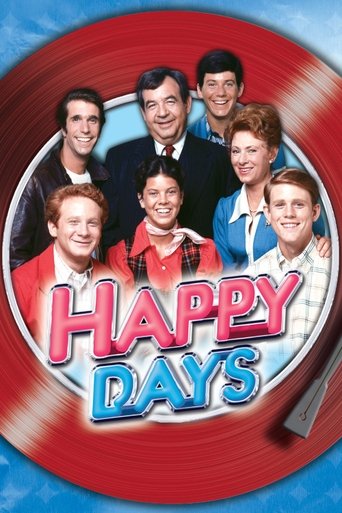
I watched and (apprently!) still know the entire theme song, which is wild because they stopped making new episodes when I was a toddler. Must have been in reruns; I wonder if it was that after school / pre-dinner time slice when we watched Happy Days and 321 Contact?
I don't entirely place the blame on boomers for the raise of 1950s nostalgia and the corresponding misalignment of economic goals.
Someone (not a baby boomer) working in a traditional blue collar job today looks back at the portrayal of life in a rerun of a 1970s sitcom - Happy Days (or spin off, or even an "average" person sitcom from the 80s... Roseanne, Married with children) on late night cable and wonders what it would take to have that lifestyle today? Well, taxes are taking too large of a chunk of the family budget so people gravitate to candidates that say they'll cut taxes.
I don't know. I'm not a sociologist but it seems like we (at least the USA) have lost the concept of shared behavioral norms, and even where we haven't, public/private shaming is no longer an effective way to enforce those norms.
Maybe I'm longing to go back to an episode of Happy Days that never really existed, but I kind of remember a time where if you were sitting out on your porch and someone walked by and threw trash on the sidewalk in front of you, you could tell them "I saw that! How dare you throw trash down and litter in this neighborhood!" and chances are, they'd show a little remorse and maybe reverse their decision. Now, it's "Fuck off, Karen! Mind your own business! I can do what I want and you can't stop me!" And we just kind of start accepting bad behavior from strangers.
"I don't give a fuck, and you can't tell me what to do" has become this awful national motto.
The fact that Valli topped the charts again in 1978 with “Grease” still boggles my mind.
Not if you were living through the 1950s nostalgia revival which was going strong at the time and lingered through the early 80s. It was on TV (Happy Days and Sha Na Na), the movies (American Graffiti, Porky's) and a bunch of retro musical acts (The Stray Cats) or retro projects by established artists returning to the music they grew up with (Robert Plant's The Honeydrippers).
The sound of rock music undoubtedly changed between the beginning and middle of the 1960s. But by looking at the Billboard Hot 100, we can see if that change in sound was being made by a fleet of new groups or a bunch of older acts adapting.
This methodology leaves out a lot of bands, and not just the long tail that never cracked the top 100. There are MANY locally popular bands that never broke out nationally and therefore never made it to the Billboard Hot 100. There were also bands doing types of music that never charted particularly well yet were influential in their own way. For a sampling of this, go to the MIT/WMBR archives (https://wmbr.org/cgi-bin/arch) and listen to "Lost and Found" which highlights a lot of these types of music. Or search for things like "60s garage bands" "60s funk" etc. on YouTube.
The author also mentions the 1991 change to the Billboard methodology which really calls into doubt a some of the "hits" that came before. In a nutshell, music charts in the United States were based on a sample of self-reported sales from record store managers. You can imagine the bias and BS that went on with those numbers.
Then there was manipulation further up the funnel. Record companies weren't supposed to give outright cash payments to DJs (wink wink) but there were many other ways of exerting influence on influential media gatekeepers.
Some of the influence was obvious. Picking artists that had the "right" look. Promoting "safe" artists. Forcing hitmaker producers on new and established artists. Selective access and backroom benefits for powerful DJs and music journalists and other influencers. Ignoring, sidelining, or co-opting trends bubbling up from the underground, from proto-metal in the late 60s to punk in the 70s to rap in the 80s.
As soon as Soundscan was implemented, there was an immediate realignment, with rap and grunge and techno and country storming the pop charts.
I used to work for a major airline many years ago. I remember when they introduced these crazy fees e.g., seat change fee. I was really disappointed then and soon left. I learned Don Carty then joined Dell who soon started their Byzantine ordering process. I was again disappointed. I still buy Dell monitors because I like them but I never buy from their website.
I remember an episode of the TV show Happy Days when the restaurant owner started charging money to use the toilet stall. It was a sad joke and many businesses are following suit.
> Making friends with the wrong people can really mess up your life.
> And yet, I keep reading about this epidemic of loneliness...
Both things can be true at the same time, this is not a dichotomy.
At the same time, there's a old saying in my company that goes like "better alone than in bad company". Timeless wisdom, I guess.
On this matter, I was recently brought to pondering about the extinction of the so called "third place". The reasoning goes like this: people often used to have three places they attend the most: they home, their workplace, and the "third place".
The "third place" can be pretty much everything, and it's the place where socialising happen: for example, in many sitcoms it used to be some kind of bar/pub/restaurant: the McLaren's in HIMYM, "Arnold's" in Happy Days and another similar one whose name i can't remember in Friends. When I was a kid, it was a public park where we played soccer, and most kids just spent time there.
It seems this is going out of style or something?
Two things I noticed are:
- nowadays spending time in bars/pubs etc can get costly. Might be the general economic downturn, but it seems to be that going at the bar and having a beer or two used to be more accessible in the past (older folks are welcome to chime in and offer their perspective).
- pubs with larger university people tend to be more affordable, but the age band is quite restricted... Not formally, but somewhat implicitly.
"I feel that the majority of relationships and marriages say 60-70 years ago were happy and mutually fulfilling, but now anecdotally it seems that most people are not happy whatsoever."
It's possible this is true. But here's a little anecdote. 70 years ago is 1953. The American sitcom "Happy Days", produced in 1973, makes this era look great. I know British writer Alan Moore has said he's seen the TV show Happy Days, and things in Britain in his childhood were nothing like "Happy Days". The country was struggling with how the world had changed post World War 2.
I imagine Japan was going through some serious stuff as well.
Movie remakes might not be quite enough to make the 30 year number work. I feel like there is some confirmation bias here.
Consider "Happy Days", made in the 1970s to celebrate the 1950s. The wave of mods and paisley jangle pop in the 1980s to celebrate the 1960s. All the "Big Star" sounding bands of the late eighties and early nineties celebrating Alex Chilton circa 1972.
I would guess the movies are a lagging trend, the real number is likely 20 years, approximately equating to mid childhood, early teens as being idealised and getting expressed in successful adulthood at 30 in pop culture by those who experienced those times in formative years.
That would put the first wave of 80s nostalgia in the 2000s[0]
Stranger things is more like nostalgia for early 2000s 80s nostalgia.
> A bit of a tangent but you can scan virtually any film made between 1915 and 2000 or so and get a pristine, super sharp 4K to 6k copy.
Another tangent-- if you watch the original 35mm film on a 35mm projector, you won't get the same "pristine" experience as the 4K or 8K tv which does some uncanny frame-rate upsampling thing which makes the moving images appear as if they're happening in real life.
If you listen to a mono reel-to-reel or record of Helter Skelter on equipment available to the Beatles at the time of the recording, McCartney's voice will sound pretty godammned close to as pristine (if not exactly for most people) as listening to a 24-bit zillion-herz professionally remastered digital recording of the same thing.
We've spend the past fifty years developing so much fidelity in video that we scratch our heads thinking about someone watching Happy Days on an old school tube.
We've spent the past 30+ years trying to convince cranks that CD quality doesn't degrade to triangle waves right below Nyquist. Meanwhile, it seems that vinyl made a comeback and shows no signs of slowing any time soon. Also meanwhile, absolutely nothing has improved audibly in terms of "framerate" because CDs really were able to encode the entire frequency range that is audible to human beings. (Higher sampling rate can be useful for digital filters and other purposes, but that's not what we're discussing here.)
the question of facilitation of piracy can be an issue
it doesnt have to stick if you get enough copyright trolls on you your wallet will get thin as you handle multiple court cases regardless of outcome
I recall something about canada considering a publicly broadcasted TV show to be in the public domain so that things like threes company or happy days are fair game in canada... is that true?
>The cultural, scientific, and commercial works that have been created in English in the past 100 years dwarf anything created in French or Latin by a gigantic order of magnitude.
I beg to differ. Compared to the Latin and French corpus, the body cultural works created in English is paltry and subpar. And that's the British ones, American ones, even less so. I can give you scientific and commercial if you feel any better.
>Why would we possibly switch to anything else, and lose 'access' to all that? All of the greatest movies and TV shows, the millions of scientific articles, the music, the computer code...
Yeah, pop music, movies, and TV shows. We'd lose Happy Days, I love Lucy, Breaking Bad, the Beatles, Michael Jackson, and Kanye West. OK, and Melvin and Henry James and Hemingway. Not much loss.
We would still have Racine, Rousseau, Rabelais, Rimbaud (and that's just part of the R).
Plus, all the huge variety and masterpieces of the peoples of the earth, before American commercial monoculture and its marketing power ate everything else.
which was reprised in an episode of arrested development where Henry Winkler (who played Fonzie in Happy Days) jumps over a shark on a dock: https://i.imgur.com/uHPHW0c.gif
Nostalgia can be about idealized versions of the past that one never experienced oneself though. When I was a teen there was a very popular TV show about the 1950s called "Happy Days" that was popular even among us teens who had no experience of the actual 1950s. Similarly, more recently, "Mad Men" about the 1960s.
I also heard an interview somewhere/sometime where he indicated the same thing: Although popular in our lexicon, the show actually did not go into a death spiral after that episode. It was hugely successful. Nevertheless, the term remains.
That's not called jumping the shark. Jumping the shark is when something formerly cool/great (originally, Fonzie in TV sitcom Happy Days) does something so blatantly stupid (originally, jumping over a shark on water skis) that it becomes painfully obvious that they've lost all credibility.
blind devotion to a product long-past its prime. that's my explanation why users are stupid.
Why did people watch Happy Days long after it started to suck? Fonzie Jumping the Shark was two seasons into the pain. But it didn't lose ratings until that episode.
What's popular is not always good. and what's good is not always popular.
Definition of Gamergate: depends on who you ask, it's a heavily politicized movement. Best to research this yourself from a variety of sources and come to your own conclusion.
Definition of jumping the shark: A late episode of the TV program Happy Days involved a major character jumping over a shark on a pair of water skis. He had done previous stunts involving jumping over things on a motorcycle. Basically the writers ran out of ideas and resorted to things like this to keep viewers interested (not altogether successfully). So now we have the term "jumping the shark" to indicate a decline in quality.
I think it's an illusion. If you look at culture today, there are a bunch of influences from the 80s. (For example, Taylor Swift's latest album is titled '1989' and has an 80s-influenced feel to many of the songs.) In the 80s, there was a bunch of 50s influence. Billy Joel had released "Uptown Girl" and the rest of an album of almost doo-wop pop hits. Grease was a hit movie in 1978, just a few years earlier. You could still catch shows like Happy Days, Laverne and Shirley, and Hee-Haw on TV. So I think it's just a matter of what you remember. I watched and listened to all that stuff and the 50s still seemed like ancient history to me. (My parents were barely teenagers in the 50s!)
I too saw it in a theater when it came out and I recall thinking "who the fuck orders a tab? Have a Diet Coke" and that it was a pretty awkward way to make the gag.
We knew about the 1950s from "Happy Days" which, in retrospect was analogous to "Freaks and Geeks" for my generation. The difference was that the media was obsessed with the baby boomers in a way that they never were about Gen X. The baby boomer history and progress was in our face all the time and I couldn't wait to be old and have them mostly be dead so I could stop getting media progress reports on them.
I think the modern media goes back to the early 1970s. Some movies and some music from then seems pretty current still. Earlier than that things seem increasingly weird and foreign.
Plenty of shows taped in front of a live studio audience still sweeten it with a laugh track. But I have no idea if BBT does.
edit: wikipedia says yes. "Sweetening has been used in a number of television series, from older shows like Happy Days, Taxi, The Mary Tyler Moore Show, to newer sitcoms Two and a Half Men and The Big Bang Theory" http://en.wikipedia.org/wiki/Sweetening
The peculiar nouns "-osity" thing was not originally a hacker thing. Discounting other unnecessary word endings being introduced to the public at large by the Fonz in Happy Days when he continually added the "-omundo" to the end of things, the "-osity" type of adjective -> noun mutilation may have been picked up from surfer/Cali talk, introduced into the mainstream by movies such as Fast Times at Ridgemont High (Spicoli) and later by Bill and Ted's Excellent Adventure and Pauli Shore (on MTV and then in really bad movies).
By the same token terms like "barf" and "bogus" were just popular terms in the very early 80s because of all of the California influence.
Of all of these, the ones that look most familiar for the time that really have little to do with popular culture of the time were: BITBLT (just because I remember seeing it and thought "what the hell"), crash (mid to later 80s when used the first Macs), and down (which wasn't really used much until the 90s, because when you couldn't connect to a BBS or Compuserve, etc. - which almost was never the case to my memory - you just couldn't connect, and prior to modems there was no connection- just cassette tapes and eventually floppies - and no I did not have a card machine :) and I didn't see a minicomputer with a huge-ass 8 inch floppy until my first network admin job in the 90s).
I used to think "jump the shark" referred to something like this: after a slow asymptotic climb, a precipitous drop in popularity representing the leading and trailing edges of a shark's fin respectively.
It wasn't until a few years after hearing this phrase that I learned it came from a Happy Days episode.
Looking at the original episode of "Happy Days," I find it difficult to believe that the producers were not keenly aware that they had walked away from the show's concept and were now milking cheap popularity for all it was worth.
I suspect that the definition you give and the one I use are compatible even though they differ. Under the definition you give, the defining moment is really set by the viewer. It's the instant you know it's all downhill from here, not the actual peak. So Gruber's phrase might be the defining moment for Hank.
It's also possible, as was the case for Happy Days, that the producers turn cynical and start resorting to cheap tricks like throwing out all character development and turning the show into a parody of itself, focusing on a caricature minor character rather than the more well-rounded principals. That's the definition I prefer.
They could go together, and I would say there's value in combining them, as in:
"I realized that HN had Jumped the Shark when Paul introduced the Date-a-Hacker feature."
I don't know where people get the "Happy Days" type concept of the past that this piece talks about. If you watch old (American) movies, relationships between men and women were typically portrayed in a very awkward, stilted, "I have no idea how to talk to you" kind of way. I strongly suspect that reflected actual cultural norms to some degree or another.
Liked the show? Maybe it was the old commercials. The "Taxi" and "Happy Days" research appears to fail to distinguish between a program being interrupted by today's commercials versus yesteryear's commercials. Many people delight in old ads, whether they be newspaper ads, magazine ads, movie posters, or whatnot, because they're history. They show us the changes in design esthetics, cultural values & propaganda, fashion, and so on. (I happen to be keen on fonts and women's eyebrow styles.) That's why such things have value as collectibles. I can't help picturing the research subjects smirking at the "bad" ties worn by the Michael Brownstein lawyers.
Liked the show? Maybe it was the pacing of the program for commercial interruption. TV ads are not injected at random intervals. They're injected between scenes. But not just any scenes. They're injected after scenes which were written to be followed by a commercial break. In other words, the TV show was designed to be enjoyed with the breaks. For example, contrast made-for-TV movies (designed for breaks) with made-for-theater movies (designed for continuous viewing). Watch an adless video of a made-for-TV movie, and you can see the story build to a little climax every few minutes, and more frequent climaxes as the story progresses. The ever-increasing climaxes get so tiresome, in my taste, that they cry out for interruption.
There was an episode of Happy Days in which Richie got into a little trouble, and Fonzie gave him advice on how to act tough and command respect. It didn't work for Richie. Fonzie then remembered the key component: it wasn't just acting tough; at some point in time, you had to have actually won a fight to prove it.
Consider programmers that you respect; why do you respect them? Is it their in-depth knowledge? Interesting projects they've worked on? Publications they've written? Their ability to teach? I would venture to guess that most people don't just set out to be a respectable person in the abstract; they work to excel at particular things in their life.
 Hacker Cinema
27 comments on Hacker News
I watched and (apprently!) still know the entire theme song, which is wild because they stopped making new episodes when I was a toddler. Must have been in reruns; I wonder if it was that after school / pre-dinner time slice when we watched Happy Days and 321 Contact?
I don't entirely place the blame on boomers for the raise of 1950s nostalgia and the corresponding misalignment of economic goals.
Someone (not a baby boomer) working in a traditional blue collar job today looks back at the portrayal of life in a rerun of a 1970s sitcom - Happy Days (or spin off, or even an "average" person sitcom from the 80s... Roseanne, Married with children) on late night cable and wonders what it would take to have that lifestyle today? Well, taxes are taking too large of a chunk of the family budget so people gravitate to candidates that say they'll cut taxes.
Though, they're missing out on the 1950s tax structure... where people making $200,000 (1950s dollars - about $2M in 2020s dollars) were getting taxed at 91%. Corporate tax rate was much higher too. https://en.wikipedia.org/wiki/Income_tax_in_the_United_States#History_of_top_rates
The plank of "we're going to raise taxes" doesn't get as many nostalgic votes for people hoping to return to the lifestyle of the 1950s.
There's a whole lot of other factors too.
A right leaning 30 year old today is voting to try to have what they perceived how it worked in the 1950s from shallow portrayals of the period.
I don't know. I'm not a sociologist but it seems like we (at least the USA) have lost the concept of shared behavioral norms, and even where we haven't, public/private shaming is no longer an effective way to enforce those norms.
Maybe I'm longing to go back to an episode of Happy Days that never really existed, but I kind of remember a time where if you were sitting out on your porch and someone walked by and threw trash on the sidewalk in front of you, you could tell them "I saw that! How dare you throw trash down and litter in this neighborhood!" and chances are, they'd show a little remorse and maybe reverse their decision. Now, it's "Fuck off, Karen! Mind your own business! I can do what I want and you can't stop me!" And we just kind of start accepting bad behavior from strangers.
"I don't give a fuck, and you can't tell me what to do" has become this awful national motto.
The fact that Valli topped the charts again in 1978 with “Grease” still boggles my mind.
Not if you were living through the 1950s nostalgia revival which was going strong at the time and lingered through the early 80s. It was on TV (Happy Days and Sha Na Na), the movies (American Graffiti, Porky's) and a bunch of retro musical acts (The Stray Cats) or retro projects by established artists returning to the music they grew up with (Robert Plant's The Honeydrippers).
The sound of rock music undoubtedly changed between the beginning and middle of the 1960s. But by looking at the Billboard Hot 100, we can see if that change in sound was being made by a fleet of new groups or a bunch of older acts adapting.
This methodology leaves out a lot of bands, and not just the long tail that never cracked the top 100. There are MANY locally popular bands that never broke out nationally and therefore never made it to the Billboard Hot 100. There were also bands doing types of music that never charted particularly well yet were influential in their own way. For a sampling of this, go to the MIT/WMBR archives (https://wmbr.org/cgi-bin/arch) and listen to "Lost and Found" which highlights a lot of these types of music. Or search for things like "60s garage bands" "60s funk" etc. on YouTube.
The author also mentions the 1991 change to the Billboard methodology which really calls into doubt a some of the "hits" that came before. In a nutshell, music charts in the United States were based on a sample of self-reported sales from record store managers. You can imagine the bias and BS that went on with those numbers.
Then there was manipulation further up the funnel. Record companies weren't supposed to give outright cash payments to DJs (wink wink) but there were many other ways of exerting influence on influential media gatekeepers.
Some of the influence was obvious. Picking artists that had the "right" look. Promoting "safe" artists. Forcing hitmaker producers on new and established artists. Selective access and backroom benefits for powerful DJs and music journalists and other influencers. Ignoring, sidelining, or co-opting trends bubbling up from the underground, from proto-metal in the late 60s to punk in the 70s to rap in the 80s.
As soon as Soundscan was implemented, there was an immediate realignment, with rap and grunge and techno and country storming the pop charts.
Background on the 1991 Soundscan change is here, if anyone is interested: https://ultimateclassicrock.com/billboard-soundscan/
I used to work for a major airline many years ago. I remember when they introduced these crazy fees e.g., seat change fee. I was really disappointed then and soon left. I learned Don Carty then joined Dell who soon started their Byzantine ordering process. I was again disappointed. I still buy Dell monitors because I like them but I never buy from their website.
I remember an episode of the TV show Happy Days when the restaurant owner started charging money to use the toilet stall. It was a sad joke and many businesses are following suit.
> Making friends with the wrong people can really mess up your life.
> And yet, I keep reading about this epidemic of loneliness...
Both things can be true at the same time, this is not a dichotomy.
At the same time, there's a old saying in my company that goes like "better alone than in bad company". Timeless wisdom, I guess.
On this matter, I was recently brought to pondering about the extinction of the so called "third place". The reasoning goes like this: people often used to have three places they attend the most: they home, their workplace, and the "third place".
The "third place" can be pretty much everything, and it's the place where socialising happen: for example, in many sitcoms it used to be some kind of bar/pub/restaurant: the McLaren's in HIMYM, "Arnold's" in Happy Days and another similar one whose name i can't remember in Friends. When I was a kid, it was a public park where we played soccer, and most kids just spent time there.
It seems this is going out of style or something?
Two things I noticed are:
- nowadays spending time in bars/pubs etc can get costly. Might be the general economic downturn, but it seems to be that going at the bar and having a beer or two used to be more accessible in the past (older folks are welcome to chime in and offer their perspective).
- pubs with larger university people tend to be more affordable, but the age band is quite restricted... Not formally, but somewhat implicitly.
"I feel that the majority of relationships and marriages say 60-70 years ago were happy and mutually fulfilling, but now anecdotally it seems that most people are not happy whatsoever."
It's possible this is true. But here's a little anecdote. 70 years ago is 1953. The American sitcom "Happy Days", produced in 1973, makes this era look great. I know British writer Alan Moore has said he's seen the TV show Happy Days, and things in Britain in his childhood were nothing like "Happy Days". The country was struggling with how the world had changed post World War 2.
I imagine Japan was going through some serious stuff as well.
Poor Chuck, got a trope named after him after disappearing upstairs at the end of season 2 of Happy Days
https://tvtropes.org/pmwiki/pmwiki.php/Main/ChuckCunninghamSyndrome
Movie remakes might not be quite enough to make the 30 year number work. I feel like there is some confirmation bias here.
Consider "Happy Days", made in the 1970s to celebrate the 1950s. The wave of mods and paisley jangle pop in the 1980s to celebrate the 1960s. All the "Big Star" sounding bands of the late eighties and early nineties celebrating Alex Chilton circa 1972.
I would guess the movies are a lagging trend, the real number is likely 20 years, approximately equating to mid childhood, early teens as being idealised and getting expressed in successful adulthood at 30 in pop culture by those who experienced those times in formative years.
That would put the first wave of 80s nostalgia in the 2000s[0]
Stranger things is more like nostalgia for early 2000s 80s nostalgia.
Edit: the twenty year rule? [1] [2]
[0] http://www.inthe00s.com/archive/inthe00s/smf/1342451842.shtml
[1] https://decades.medium.com/how-1980s-nostalgia-ruled-the-2000s-69dbe3058dbf
[2] https://www.furious.com/perfect/culturecycles.html
> A bit of a tangent but you can scan virtually any film made between 1915 and 2000 or so and get a pristine, super sharp 4K to 6k copy.
Another tangent-- if you watch the original 35mm film on a 35mm projector, you won't get the same "pristine" experience as the 4K or 8K tv which does some uncanny frame-rate upsampling thing which makes the moving images appear as if they're happening in real life.
If you listen to a mono reel-to-reel or record of Helter Skelter on equipment available to the Beatles at the time of the recording, McCartney's voice will sound pretty godammned close to as pristine (if not exactly for most people) as listening to a 24-bit zillion-herz professionally remastered digital recording of the same thing.
We've spend the past fifty years developing so much fidelity in video that we scratch our heads thinking about someone watching Happy Days on an old school tube.
We've spent the past 30+ years trying to convince cranks that CD quality doesn't degrade to triangle waves right below Nyquist. Meanwhile, it seems that vinyl made a comeback and shows no signs of slowing any time soon. Also meanwhile, absolutely nothing has improved audibly in terms of "framerate" because CDs really were able to encode the entire frequency range that is audible to human beings. (Higher sampling rate can be useful for digital filters and other purposes, but that's not what we're discussing here.)
the question of facilitation of piracy can be an issue
it doesnt have to stick if you get enough copyright trolls on you your wallet will get thin as you handle multiple court cases regardless of outcome
I recall something about canada considering a publicly broadcasted TV show to be in the public domain so that things like threes company or happy days are fair game in canada... is that true?
>The cultural, scientific, and commercial works that have been created in English in the past 100 years dwarf anything created in French or Latin by a gigantic order of magnitude.
I beg to differ. Compared to the Latin and French corpus, the body cultural works created in English is paltry and subpar. And that's the British ones, American ones, even less so. I can give you scientific and commercial if you feel any better.
>Why would we possibly switch to anything else, and lose 'access' to all that? All of the greatest movies and TV shows, the millions of scientific articles, the music, the computer code...
Yeah, pop music, movies, and TV shows. We'd lose Happy Days, I love Lucy, Breaking Bad, the Beatles, Michael Jackson, and Kanye West. OK, and Melvin and Henry James and Hemingway. Not much loss.
We would still have Racine, Rousseau, Rabelais, Rimbaud (and that's just part of the R).
Plus, all the huge variety and masterpieces of the peoples of the earth, before American commercial monoculture and its marketing power ate everything else.
which was reprised in an episode of arrested development where Henry Winkler (who played Fonzie in Happy Days) jumps over a shark on a dock: https://i.imgur.com/uHPHW0c.gif
Nostalgia can be about idealized versions of the past that one never experienced oneself though. When I was a teen there was a very popular TV show about the 1950s called "Happy Days" that was popular even among us teens who had no experience of the actual 1950s. Similarly, more recently, "Mad Men" about the 1960s.
A fun read by the writer of that Happy Days episode:
http://articles.latimes.com/2010/sep/03/entertainment/la-et-jump-the-shark-20100903
I also heard an interview somewhere/sometime where he indicated the same thing: Although popular in our lexicon, the show actually did not go into a death spiral after that episode. It was hugely successful. Nevertheless, the term remains.
That's not called jumping the shark. Jumping the shark is when something formerly cool/great (originally, Fonzie in TV sitcom Happy Days) does something so blatantly stupid (originally, jumping over a shark on water skis) that it becomes painfully obvious that they've lost all credibility.
https://en.m.wikipedia.org/wiki/Jumping_the_shark
blind devotion to a product long-past its prime. that's my explanation why users are stupid.
Why did people watch Happy Days long after it started to suck? Fonzie Jumping the Shark was two seasons into the pain. But it didn't lose ratings until that episode.
What's popular is not always good. and what's good is not always popular.
Definition of Gamergate: depends on who you ask, it's a heavily politicized movement. Best to research this yourself from a variety of sources and come to your own conclusion.
Definition of jumping the shark: A late episode of the TV program Happy Days involved a major character jumping over a shark on a pair of water skis. He had done previous stunts involving jumping over things on a motorcycle. Basically the writers ran out of ideas and resorted to things like this to keep viewers interested (not altogether successfully). So now we have the term "jumping the shark" to indicate a decline in quality.
edited to change jet ski to water skis
I think it's an illusion. If you look at culture today, there are a bunch of influences from the 80s. (For example, Taylor Swift's latest album is titled '1989' and has an 80s-influenced feel to many of the songs.) In the 80s, there was a bunch of 50s influence. Billy Joel had released "Uptown Girl" and the rest of an album of almost doo-wop pop hits. Grease was a hit movie in 1978, just a few years earlier. You could still catch shows like Happy Days, Laverne and Shirley, and Hee-Haw on TV. So I think it's just a matter of what you remember. I watched and listened to all that stuff and the 50s still seemed like ancient history to me. (My parents were barely teenagers in the 50s!)
I too saw it in a theater when it came out and I recall thinking "who the fuck orders a tab? Have a Diet Coke" and that it was a pretty awkward way to make the gag.
We knew about the 1950s from "Happy Days" which, in retrospect was analogous to "Freaks and Geeks" for my generation. The difference was that the media was obsessed with the baby boomers in a way that they never were about Gen X. The baby boomer history and progress was in our face all the time and I couldn't wait to be old and have them mostly be dead so I could stop getting media progress reports on them.
I think the modern media goes back to the early 1970s. Some movies and some music from then seems pretty current still. Earlier than that things seem increasingly weird and foreign.
Plenty of shows taped in front of a live studio audience still sweeten it with a laugh track. But I have no idea if BBT does.
edit: wikipedia says yes. "Sweetening has been used in a number of television series, from older shows like Happy Days, Taxi, The Mary Tyler Moore Show, to newer sitcoms Two and a Half Men and The Big Bang Theory" http://en.wikipedia.org/wiki/Sweetening
The peculiar nouns "-osity" thing was not originally a hacker thing. Discounting other unnecessary word endings being introduced to the public at large by the Fonz in Happy Days when he continually added the "-omundo" to the end of things, the "-osity" type of adjective -> noun mutilation may have been picked up from surfer/Cali talk, introduced into the mainstream by movies such as Fast Times at Ridgemont High (Spicoli) and later by Bill and Ted's Excellent Adventure and Pauli Shore (on MTV and then in really bad movies).
By the same token terms like "barf" and "bogus" were just popular terms in the very early 80s because of all of the California influence.
Of all of these, the ones that look most familiar for the time that really have little to do with popular culture of the time were: BITBLT (just because I remember seeing it and thought "what the hell"), crash (mid to later 80s when used the first Macs), and down (which wasn't really used much until the 90s, because when you couldn't connect to a BBS or Compuserve, etc. - which almost was never the case to my memory - you just couldn't connect, and prior to modems there was no connection- just cassette tapes and eventually floppies - and no I did not have a card machine :) and I didn't see a minicomputer with a huge-ass 8 inch floppy until my first network admin job in the 90s).
Basically, the majority of this is "bogus". ;)
I used to think "jump the shark" referred to something like this: after a slow asymptotic climb, a precipitous drop in popularity representing the leading and trailing edges of a shark's fin respectively.
It wasn't until a few years after hearing this phrase that I learned it came from a Happy Days episode.
Thanks for a great reply!
Looking at the original episode of "Happy Days," I find it difficult to believe that the producers were not keenly aware that they had walked away from the show's concept and were now milking cheap popularity for all it was worth.
I suspect that the definition you give and the one I use are compatible even though they differ. Under the definition you give, the defining moment is really set by the viewer. It's the instant you know it's all downhill from here, not the actual peak. So Gruber's phrase might be the defining moment for Hank.
It's also possible, as was the case for Happy Days, that the producers turn cynical and start resorting to cheap tricks like throwing out all character development and turning the show into a parody of itself, focusing on a caricature minor character rather than the more well-rounded principals. That's the definition I prefer.
They could go together, and I would say there's value in combining them, as in:
"I realized that HN had Jumped the Shark when Paul introduced the Date-a-Hacker feature."
I don't know where people get the "Happy Days" type concept of the past that this piece talks about. If you watch old (American) movies, relationships between men and women were typically portrayed in a very awkward, stilted, "I have no idea how to talk to you" kind of way. I strongly suspect that reflected actual cultural norms to some degree or another.
Liked the show? Maybe it was the old commercials. The "Taxi" and "Happy Days" research appears to fail to distinguish between a program being interrupted by today's commercials versus yesteryear's commercials. Many people delight in old ads, whether they be newspaper ads, magazine ads, movie posters, or whatnot, because they're history. They show us the changes in design esthetics, cultural values & propaganda, fashion, and so on. (I happen to be keen on fonts and women's eyebrow styles.) That's why such things have value as collectibles. I can't help picturing the research subjects smirking at the "bad" ties worn by the Michael Brownstein lawyers.
Liked the show? Maybe it was the pacing of the program for commercial interruption. TV ads are not injected at random intervals. They're injected between scenes. But not just any scenes. They're injected after scenes which were written to be followed by a commercial break. In other words, the TV show was designed to be enjoyed with the breaks. For example, contrast made-for-TV movies (designed for breaks) with made-for-theater movies (designed for continuous viewing). Watch an adless video of a made-for-TV movie, and you can see the story build to a little climax every few minutes, and more frequent climaxes as the story progresses. The ever-increasing climaxes get so tiresome, in my taste, that they cry out for interruption.
There was an episode of Happy Days in which Richie got into a little trouble, and Fonzie gave him advice on how to act tough and command respect. It didn't work for Richie. Fonzie then remembered the key component: it wasn't just acting tough; at some point in time, you had to have actually won a fight to prove it.
Consider programmers that you respect; why do you respect them? Is it their in-depth knowledge? Interesting projects they've worked on? Publications they've written? Their ability to teach? I would venture to guess that most people don't just set out to be a respectable person in the abstract; they work to excel at particular things in their life.